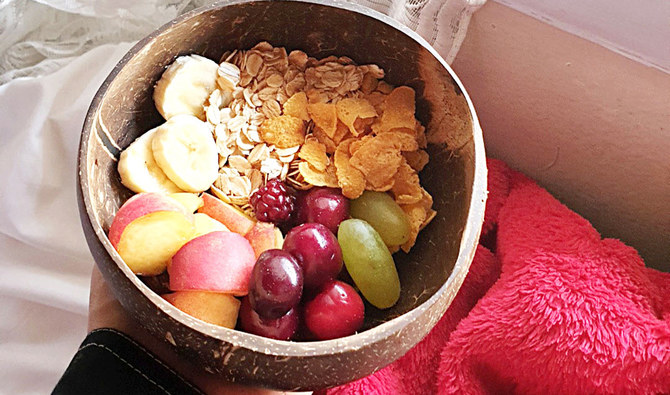
C.B. Jeddah is a store where you can find high-quality, handmade coconut and wooden bowls, which are ideal for all kinds of food, from ice cream to soups, salads and even hot curry. The Jeddah-based store ships orders all over the Kingdom.
Shaima Agil, a public administration student, inaugurated the store last month.
The idea came to her when she decided to adopt a more health-conscious lifestyle and went online to look for recipes. “I saw a picture of a smoothie in a coconut bowl, and I was fascinated by how beautiful it was! It was hard to get one here in Saudi Arabia, though, so I thought: Why don’t I buy these bowls myself and try to sell them here? I’ve been always interested in natural, environment-friendly products, so I bought many bowls and created an Instagram account to display them.”
The startup is planning to add wooden utensils, bamboo straws and key charms made from coconut shells to its line of products.
C.B. Jeddah imports its bowls from Indonesia, where coconut palms grow in abundance and where talented local artisans make the bowls by hand.
Agil explained that artisans first split the coconuts in half, drain them of water, carve out the flesh, then craft and polish them gently until they shine.
“Nature gives us everything we need, so let’s be nice and not harm it with industrial waste,” she said.
Environmental sustainability was at the heart of her startup.
“The huge amounts of coconuts used by companies to produce their different products result in much waste. Some countries burn them, which increases carbon and other harmful emissions. That is why reclaiming them and recycling them helps our planet.”
Customers can text C.B. Jeddah via direct messages on their Instagram account @c.b.jeddah.
“Our products are suitable for those who love nature, decorating and food photography. They also make great gifts,” said the founder.

Startup of the Week: A Jeddah-based store offering eco-friendly alternatives
https://arab.news/ct9au
Startup of the Week: A Jeddah-based store offering eco-friendly alternatives
- The startup is planning to add wooden utensils, bamboo straws and key charms made from coconut shells to its line of products
Mini op-ed: Recognising a shift in how people relate to wellness, self-care
DUBAI: I have spent nearly a decade working in the beauty industry in Saudi Arabia and the UAE, and Ramadan always has a way of prompting change; in habits, in priorities, and in the routines people have been carrying without question. Speaking from my own corner of the industry, one of these habits is often hair removal.
Saudi Arabia’s beauty and personal care market was valued at about $7.56 billion in 2025 and is set to grow to an estimated $8.03 billion in 2026. Within that growth, personal care encompassing the daily (sometimes unglamorous) routines hold the largest share. But market size alone does not tell the full story. A study conducted at King Abdulaziz University Hospital, Jeddah, found that three quarters of Saudi women experienced complications from temporary hair removal methods, including skin irritation, in-grown hairs and hyperpigmentation. A separate 2025 study published in the Majmaah Journal of Health Sciences found that laser hair removal was both the most considered and most commonly undergone cosmetic procedure among Saudi respondents, yet dissatisfaction with cosmetic procedure outcomes was reported by nearly half of all participants. The numbers point to a gap not in demand, but in results.
When I launched a specialized electrolysis practice in the UAE in 2016, it was with a clear gap in mind; safe, regulated, permanent hair removal for the region’s specific needs. The range of hair types here and the prevalence of conditions such as polycystic ovary syndrome, or PCOS, demanded a method that works across all of them. Electrolysis is the only method recognized by the US Food and Drug Administration and American Marketing Association as achieving true permanent results, regardless of hair color or type.
Despite this, awareness in Saudi Arabia remains limited. Part of this is familiarity, laser has dominated the conversation for years, and electrolysis, which requires more sessions and a licensed electrologist’s precision, has struggled to break through. Part of it is education. Many clients who come to us have never heard of electrolysis; they come because they have exhausted everything else.
Right now, Saudi Arabia is in the middle of a genuine transformation in how people relate to wellness and self-care. The beauty market is maturing, consumers are asking harder questions of the brands they choose and Vision 2030 has not just shaped the economy, it has shaped how Saudis are showing up in their own lives. In that context, the idea of choosing permanence over repetition lands differently.
Mariela Marcantetti is a beauty industry entrepreneur based between Saudi Arabia and the UAE.


