

Pakistan permits pedestrian movement on Torkham border six days a week

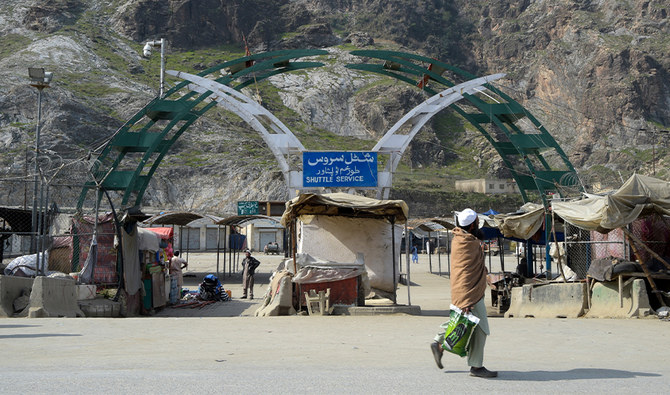
A man walks past an empty bus terminal near the Pakistan-Afghanistan border in Torkham some 54 kms from Peshawar on March 16, 2020. (AFP/File)
Short Url
Updated 15 February 2021
Follow

Pakistan permits pedestrian movement on Torkham border six days a week

  • Officials say move expected to reduce waiting time for cross-border travelers to a significant extent
  • Follows Islamabad’s decision to extend Transit Trade Agreement with Kabul for another three months

ISLAMABAD: Pakistan on Monday allowed the resumption of pedestrian movement at the Torkham crossing with Kabul for six days a week, to ensure ease of travel and reduced waiting time for cross-border travelers, Prime Minister Imran Khan’s special representative for Afghanistan said.
“Torkham (border) crossing between Pakistan and Afghanistan is now open 6 days a week for the pedestrian traffic,” Mohammad Sadiq tweeted on Monday.
“It will reduce the waiting time for travelers on the border significantly. Facilities are being further improved to ensure ease of travel between the two countries,” he added.

Torkham is a major border crossing and the main trade link between the two neighboring countries, with several highways from capital cities Kabul and Islamabad passing through it.
Resumption of pedestrian movement at Torkham follows the extension of the Transit Trade Agreement for another three months, based on a request from Afghanistan, Sadiq said in a separate tweet on Sunday.
“We hope that negotiations on the new transit trade agreement will be concluded in 3 months. Economic diplomacy should lead bilateral relations bet the two states,” he wrote.

In recent months, Pakistan has taken steps to enhance bilateral trade with Afghanistan and facilitate transit trade activities.
In July last year, all main border crossings — at Chaman in Balochistan, and Torkham, Ghulam Khan, Angoor Adda and Kharlachi in Khyber Pakhtunkhwa — were reopened. Afghan overland exports to India through Pakistan’s Wagah border were allowed to resume on July 15, 2020.
The measures are a part of efforts by Pakistan’s government to reopen the economy, largely closed down in March last year over coronavirus fears.


UN says 270,000 Afghans have returned from Iran, Pakistan this year

Updated 10 March 2026
Follow

UN says 270,000 Afghans have returned from Iran, Pakistan this year

  • UNHCR says 110,000 Afghans returned from Iran while 160,000 returned from Pakistan since start of 2026
  • Return numbers seem to have risen since Gulf war erupted on Feb. 28, says UNHCR official in Afghanistan

GENEVA: Some 270,000 Afghans have returned to their country from Pakistan and Iran so far this year, the UN said Tuesday, warning that the escalating Middle East war risked pushing the numbers higher.

UNHCR, the United Nations’ refugee agency, said that 110,000 Afghans had returned from Iran and another 160,000 had returned from Pakistan since the start of 2026.

And the numbers seem to have risen since the Middle East erupted on February 28, with the United States and Israel unleashing a barrage of strikes on Iran, and Tehran responding with drone and missile strikes on Israeli and US interests across the region.

Since then, there have been some 1,700 returns from Iran to Afghanistan each day, Arafat Jamal, UNHCR’s representative in Afghanistan, told reporters in Geneva.

Speaking from Islam Qala, on the Afghan-Iranian border, he said the situation there was “deceptively calm.”

“Returns are orderly but freighted with tension and apprehension,” he said, adding that with the hostilities elsewhere escalating, “I do fear there is more to come.”

“We are preparing for massive returns.”

He pointed out that Afghanistan was “facing the ramifications of what is happening with Iran,” while clashes have erupted along the Afghan border with Pakistan.

The new Middle East war, he warned, was “layering itself on top of an existing war on another frontier,” Jamal said.

UNHCR highlighted that the latest crises came after returns to Afghanistan had already been “exceptionally high” in recent years.

More than five million Afghans had returned from neighboring countries in the past two years, including 1.9 million returning from Iran last year alone.

Jamal warned that “many Afghan families are now facing cycles of displacement: first forced to flee Afghanistan, later displaced again inside Iran due to conflict, and now returning once more to Afghanistan.”

“And upon return in Afghanistan, the triply-displaced enter a spiral of precarity and uncertainty.”
Returns from Pakistan had meanwhile stabilized in recent weeks, as the main crossing point at Torkham remained closed due to the tensions there, Jamal said.

But he warned that “movements could increase sharply once the border reopens.”

UNHCR and the UN children’s agency UNICEF said Tuesday they were working to strengthen their capacity to operate at the borders and within Afghanistan.

But “given the scale of returns and the financial constraints facing humanitarian operations, additional support will be needed if arrivals increase,” UNHCR said, without specifying the amount needed.