

Afghan Taliban reject report chief Hibatullah killed in Pakistan

Top Taliban officials arrive in Doha, Qatar, for talks on the intra-Afghan dialogue on July 7, 2019. (AFP/File)
Short Url
Updated 14 February 2021
Follow

Afghan Taliban reject report chief Hibatullah killed in Pakistan

  • Afghan daily claims Mullah Hibatullah Akhundza was killed in an explosion at a safe house in Quetta several months ago
  • Report about Hibatullah's death comes as the US plans to review its last year's agreement with the Taliban to withdraw troops from Afghanistan

KABUL: The Taliban on Sunday rejected a media report claiming that the group's chief, Mullah Hibatullah Akhundza, had been killed in a blast in Quetta, southwest Pakistan.

A prominent Afghan daily, Hashte Subh, citing anonymous sources, said on Sunday that the explosion had occurred in a safe house several months ago, killing Hibatullah, the group's intelligence head Matitullah and Hafiz Abdul Majid, their chief of finance.

The Quetta house, according to Hashte Subh, had been used as the main headquarters for Taliban leaders since their ouster in a US-led invasion of Afghanistan in 2001.

“This report is utterly fake and far from reality," Zabihullah Mujahid, a spokesman for the Taliban, told Arab News over the phone from an undisclosed location.

"We reject this report ... the enemy is under pressure and is trying to create worry through spreading such rumors,” he said. "Neither our leaders are in Pakistan nor such incident can be kept hidden."

Last year, an explosion ripped a mosque in Quetta, which according to press reports was used by Hibatullah. While Reuters back then reported that his brother, Ahmadullah, was killed by the blast, Hibatullah apparently had not been present in the mosque at that time.
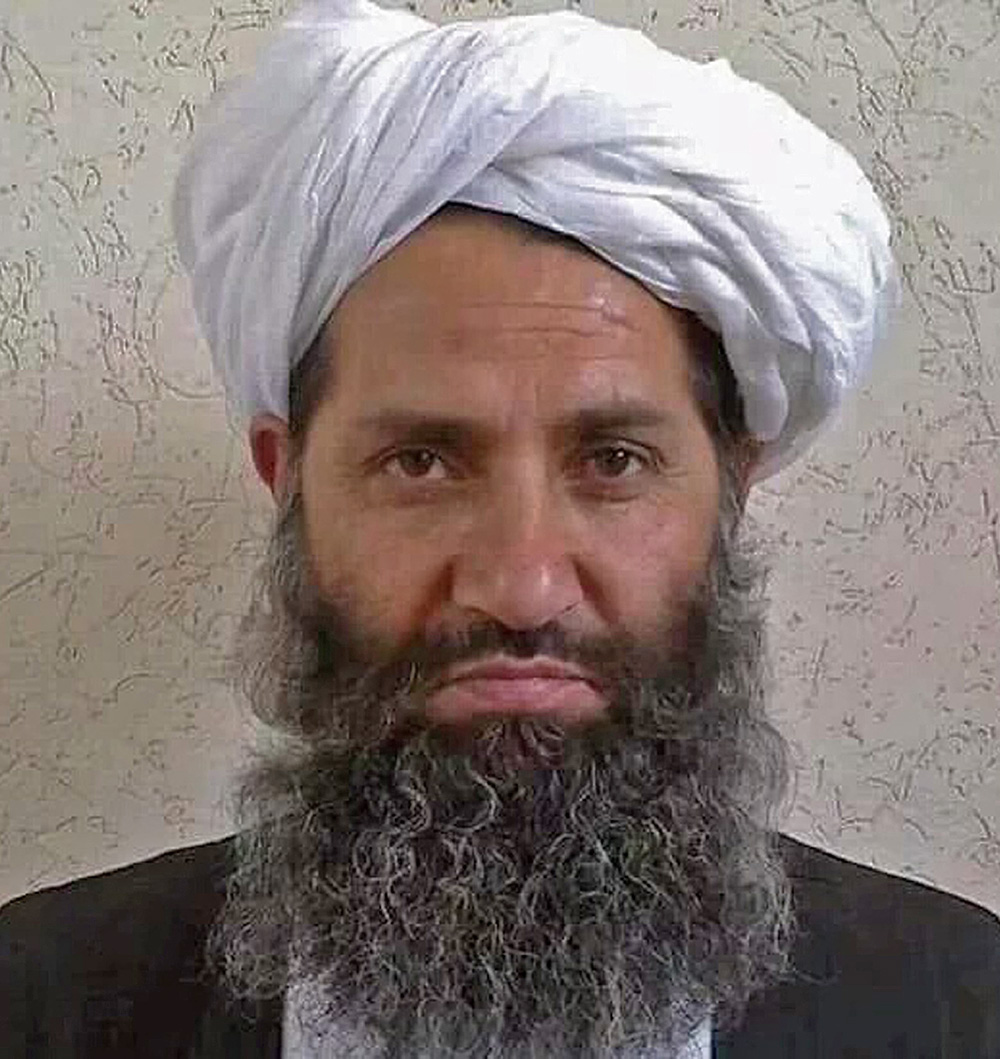


This undated handout photograph released by the Afghan Taliban on May 25, 2016 shows, Mullah Haibatullah Akhundzada posing for a photograph at an undisclosed location. (AFP/File)

In May 2016, Hibatullah, 60, succeeded Mullah Akhtar Mansoor who was killed in a US drone strike near Quetta. Mansoor became the group's chief in 2015, after Mullah Mohammad Omar, the founder of the Taliban movement, died of an illness in a Pakistani hospital in 2013.

Haji Agha Lalai, a provincial council member of Kandahar, the birthplace of the Taliban movement and the group’s seat of power, told Arab News that he had heard that months ago some people wanted to see Hibatullah but "were not able to do so and instead a message attributed to him was read to them."

A senior Afghan security official in Kabul said on condition of anonymity that he had heard months ago that Hibatullah had been killed last summer, but he could neither confirm nor deny it.

There have been no statements by Hibatullah for months, despite ongoing intra-Afghan negotiations between the Taliban and Kabul government in Doha, Qatar, to end decades of armed conflict in Afghanistan.

The news about Hibatullah's reported killing comes amid a halt in the talks and plans by the new US administration to review its last year's agreement with the Taliban to withdraw all US-led NATO troops from Afghanistan by May.

The Afghan government insists that the troops remain and NATO members are set to discuss the forces withdrawal this week.

The Taliban, meanwhile, have repeatedly urged Washington to honor the deal signed by the previous US administration.

"Our message to the upcoming NATO ministerial meeting is that the continuation of the occupation and war is neither in your interest nor in the interest of your and our people," the group said in a statement on Saturday.


Pakistan says defense pact with Saudi Arabia elevated brotherly ties to ‘new heights’

Updated 25 February 2026
Follow

Pakistan says defense pact with Saudi Arabia elevated brotherly ties to ‘new heights’

  • Pakistan, Saudi Arabia signed strategic defense pact last year pledging aggression against one will be treated as attack on both
  • Deputy PM Ishaq Dar says enduring bonds with Islamic and Arab nations form vital pillar of Pakistan’s foreign policy 

ISLAMABAD: Deputy Prime Minister Ishaq Dar said on Wednesday that Pakistan’s defense pact with Saudi Arabia elevated its brotherly ties with the Kingdom to “new heights,” stressing that close ties with Arab and Islamic nations form a key pillar of Islamabad’s foreign policy. 

Pakistan and Saudi Arabia signed a Strategic Mutual Defense Agreement on Sept. 17 last year, pledging that aggression against one country would be treated as an attack on both, enhancing joint deterrence and formalizing decades of military and security cooperation.

Both nations agreed in October 2025 to launch an economic cooperation framework to strengthen trade and investment ties. 

“In the Middle East, our landmark Strategic Mutual Defense Agreement with Saudi Arabia has elevated our brotherly ties to new heights,” Dar said while speaking at the Pakistan Governance Forum 2026 event in Islamabad. 

The Pakistani deputy prime minister was speaking on the topic “Navigating International Relations Amidst Changing Geo-Politics.”

Dar noted that Pakistan has reinforced partnerships with other Middle Eastern nations such as the UAE, Qatar, Jordan, Oman, Egypt and Bahrain. He said these partnerships have yielded “concrete agreements” in investment, agriculture, infrastructure, and energy sectors. 

“Our enduring bonds with Islamic and Arab nations form a vital pillar of our foreign policy, and we will continue to expand our partnerships across Asia, Latin America, and Africa,” he said. 

Dar pointed out that the presidents of Kazakhstan, Uzbekistan and Kyrgyzstan have undertaken visits to Pakistan in recent months, reflecting Central Asian nations’ desire to boost cooperation with Islamabad.

On South Asia, the Pakistani deputy PM said Pakistan has successfully transformed its fraternal ties with Bangladesh into “a substantive partnership.”

“Similarly, the trilateral mechanism involving China, Pakistan, and Bangladesh has been launched with a view to expanding and deepening regional cooperation and synergy,” the Pakistani minister said. 

He said Islamabad has strengthened its “all-weather” partnership with China via the second phase of the multi-billion-dollar China-Pakistan Economic Corridor agreement and “unwavering support” from both sides for each other’s core interests. 

Dar said Pakistan had also reinvigorated its partnership with the US, advancing cooperation in trade, technology, investment, and regional stability. 

“This calibrated approach has enhanced our ability to navigate complexity with skill and confidence, ensuring that our national interests are served without compromising our core foreign policy principles,” he said.