

Lebanon launches urgent vaccine rollout

1 / 6
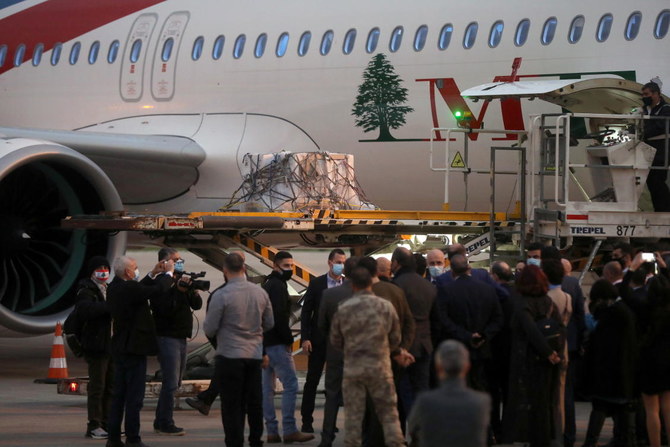
Workers unload the first shipment of the Pfizer-BioNTech vaccine for COVID-19 on Saturday at the Rafic Hariri International Airport in Beirut, Lebanon. (AP)
2 / 6
The first batch of the shipment of the Pfizer/BioNTech vaccine against COVID-19 is unloaded from a plane at Beirut International Airport, Lebanon February 13, 2021. (Reuters)
3 / 6
An aircraft carrying the first batch of doses of the Pfizer/BioNTech vaccine against the coronavirus disease (COVID-19) arrives at Beirut International Airport, Lebanon February 13, 2021. (Reuters)
4 / 6
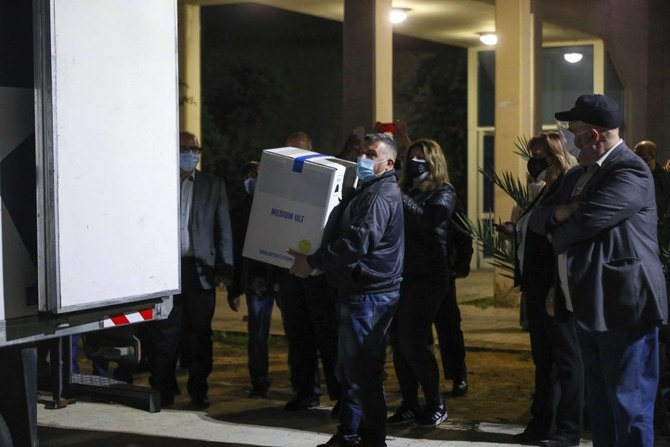
Members of staff unload boxes of the first shipment of the COVID-19 Pfizer-BioNTech vaccine upon arrival to the Rafic Hariri University Hospital in the Lebanese capital Beirut, on February 13, 2021. (AFP)
5 / 6
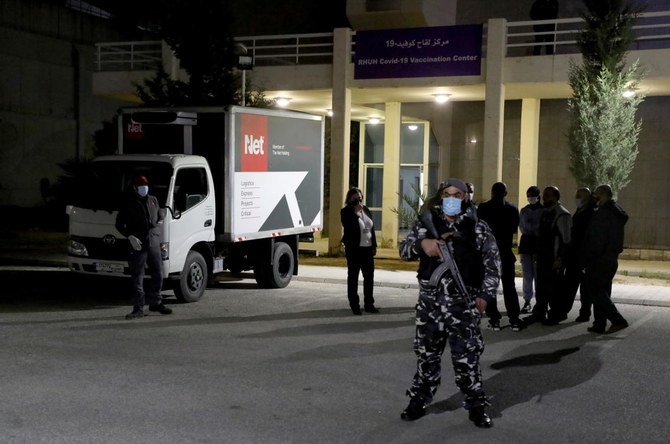
A truck carrying the first batch of doses of the Pfizer/BioNTech vaccine against the coronavirus disease (COVID-19) arrives at Rafik Hariri University Hospital, in Beirut, Lebanon February 13, 2021. (Reuters)
6 / 6
Members of Lebanese security forces stand next to a truck transporting boxes of the first shipment of the COVID-19 Pfizer-BioNTech vaccine, upon arrival to the Rafic Hariri University Hospital in the capital Beirut, on February 13, 2021. (AFP)
Short Url
Updated 14 February 2021
Follow

Lebanon launches urgent vaccine rollout

  • Medical, nursing staff and elderly first to be treated after first Pfizer batch arrives, top health official tells Arab News
  • The AstraZeneca vaccine due to arrive in Lebanon in about two weeks will offer greater flexibility to cover all Lebanese regions

BEIRUT: Lebanon has launched an urgent coronavirus vaccination rollout following the arrival of the first batch of the Pfizer-BioNTech vaccine at Beirut’s Rafic Hariri International Airport.

The consignment of 28,500 vaccines arrived from Belgium and was transferred to the Ministry of Health for storage and distribution to approved medical centers and hospitals.
Medical and nursing staff as well as paramedics working in coronavirus departments in the country’s hospitals will be among the first to be treated when the rollout begins on Sunday.
About 150 people will be vaccinated in three hospitals in Beirut, with the number expected to increase to between 300 and 400 per day by next week in 17 centers across the country.
At least 57 vaccination centers are expected to be operating within three weeks.
Care homes for the elderly will also be included early in the vaccination program, Reda Al-Mousawi, media adviser at the Ministry of Health, said.
Lebanese hospitals have struggled in the past year amid the country’s acute financial crisis and some of the region’s highest coronavirus infection rates.
The total number of virus cases in Lebanon reached 334,086 and 2,462 deaths.
Dr. Abdul Rahman Bizri, an infectious disease specialist and head of the National Committee for the Administration of Corona Vaccine, told Arab News that the first people to receive the vaccine will be identified by the three hospitals, which will begin vaccinations on Sunday.
“I have not been informed that the president, parliamentary speaker and the prime minister will be first to receive the vaccine,” he added.
Bizri said that hospitals have rehearsed their vaccination procedures before opening their doors next week.
“We have learned from the mistakes of the Americans and French, and are trying to avoid the same issues,” he said.
The AstraZeneca vaccine due to arrive in Lebanon in about two weeks will offer greater flexibility to cover all Lebanese regions, Bizri said.
He declined to set a ceiling for the duration of the vaccination process, saying: “It depends on the quantity of the vaccine provided and the behavior of the people. I think that with the start of the vaccination process, people will be more encouraged.”
More than half-a-million people out of a population of 4 million have registered to be inoculated via a health ministry platform.
Ministry hotlines are handling inquiries from those who are reluctant to take the vaccine.
Community health specialist Dr. Ahmad Mughrabi blamed so-called vaccine hesitancy on “distorted messages circulating on social media and the attitudes of some celebrities who say they will not be inoculated.”
Mughrabi said that people in the street and his neighbors “frequently ask questions about the disadvantages of the vaccine and the fear of it, especially unconventional vaccines.”
“The media and the social media in Lebanon bear a great responsibility for confusing people,” he said. “No one is trying to reassure people.”
Mughrabi said that he fears Lebanon will struggle to complete the vaccination campaign within two or three months, adding: “What is the benefit of vaccination in light of the social spread of the virus?.”


Gaza’s Nasser Hospital condemns move by MSF to suspend most services

Updated 16 sec ago
Follow

Gaza’s Nasser Hospital condemns move by MSF to suspend most services

  • On Saturday, MSF said the security breaches, arrests and intimidation put staff and patients at serious risk
  • Nasser Hospital rejects the claims, and says civilian police are inside to protect patients and staff
CAIRO: One of Gaza’s last functioning large hospitals condemned the move by an international organization to pull out of operations over concerns about armed men, claiming on Sunday that the hospital had installed civil police for security. The move comes as at least 10 Palestinians were killed in clashes with the Israeli military in Gaza.
Doctors Without Borders, also known by its acronym MSF, said in a statement Saturday that all its noncritical medical operations at Nasser Hospital were suspended due to security breaches that posed “serious” threats to its teams and patients. MSF said there had been an increase in patients and staff seeing armed men in parts of the compound since the US-brokered October ceasefire was reached.
Nasser Hospital said Sunday that the increase in armed men was due to a civilian police presence aimed at protecting patients and staff and said MSF’s “allegations are factually incorrect, irresponsible, and pose a serious risk to a protected civilian medical facility.”
Nasser Hospital one of few functioning hospitals left in Gaza
Nasser Hospital in Khan Younis is one of the territory’s few functioning hospitals. Hundreds of patients and war-wounded have been treated there daily, and the facility was a hub for Palestinian prisoners released by Israel in exchange for Israeli hostages as part of the current ceasefire deal.
“MSF teams have reported a pattern of unacceptable acts including the presence of armed men, intimidation, arbitrary arrests of patients and a recent situation of suspicion of movement of weapons,” the organization said. The suspension occurred in January but was only recently announced.
Nasser Hospital staff say that in recent months it has been repeatedly attacked by masked, armed men and militias, which is why the presence of an armed civilian police force is crucial. Hamas remains the dominant force in areas not under Israeli control, including in the area where Nasser Hospital is located. But other armed groups have mushroomed across Gaza as a result of the war, including groups backed by Israel’s army in the Israeli-controlled part of the strip.
Throughout the war, which began with the Hamas-led attack on Israel on Oct. 7, 2023, Israel has repeatedly struck hospitals, including Nasser, accusing the militant group of operating in or around them. Hamas security men often have been seen inside hospitals, blocking access to some areas.
Some hostages released from Gaza have said they spent time during captivity in a hospital, including Nasser Hospital.
Ten Palestinians killed in strikes across Gaza
At least 10 Palestinians were killed Sunday by Israeli fire in the Gaza Strip, hospital authorities said.
The dead include five men, all in their 20s, who were killed in an Israeli strike in the eastern part of Khan Younis city, according to the Nasser Hospital, which received the bodies. The strike hit a group of people in an area close to the Yellow Line which separates Israeli-controlled areas from the rest of Gaza, it said.
The Israeli military did not comment on the strike but has said in the past it will attack militants if its troops are threatened, especially near the Yellow Line.
Rami Shaqra said his son, Al-Baraa, was among the militants who were securing the area from potential attacks by the Israeli forces or Israeli-backed armed groups, when they were hit by the Israeli military. He said that they were killed by an airstrike.
Associated Press footage from the morgue showed at least two of the men had headbands denoting membership in the Qassam Brigades, the militant arm of Hamas. In northern Gaza, a drone strike hit a group of people in the Falluja area of Jabaliya refugee camp, killing five people, according to the Shifa Hospital.
The Israeli military said it was striking northern Gaza in response to several ceasefire violations near the Yellow Line, including militants attempting to hide in debris and others who attempted to cross the line while armed.
The Oct. 10 US-brokered ceasefire deal attempted to halt a more than two-year war between Israel and Hamas. While the heaviest fighting has subsided, the ceasefire has seen almost daily Israeli fire.
Israeli forces have carried out repeated airstrikes and frequently fire on Palestinians near military-held zones, killing 601 Palestinians, according to Gaza health officials. The ministry, which is part of the Hamas-led government, maintains detailed casualty records that are seen as generally reliable by UN agencies and independent experts. But it does not give a breakdown of civilians and militants.
Militants have carried out shooting attacks on troops, and Israel says its strikes are in response to that and other violations. Four Israeli soldiers have been killed.