

Lebanon launches urgent vaccine rollout

1 / 6
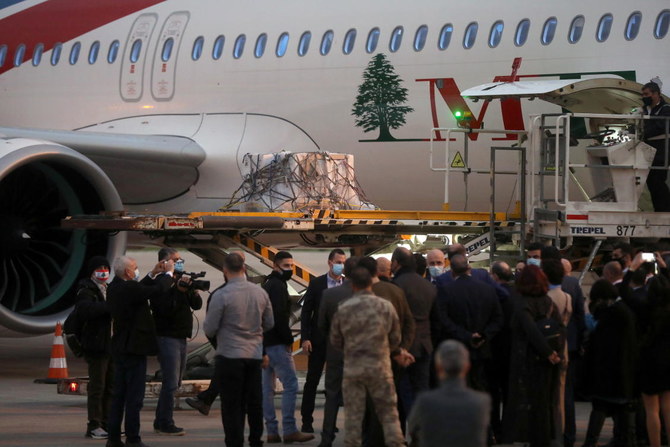
Workers unload the first shipment of the Pfizer-BioNTech vaccine for COVID-19 on Saturday at the Rafic Hariri International Airport in Beirut, Lebanon. (AP)
2 / 6
The first batch of the shipment of the Pfizer/BioNTech vaccine against COVID-19 is unloaded from a plane at Beirut International Airport, Lebanon February 13, 2021. (Reuters)
3 / 6
An aircraft carrying the first batch of doses of the Pfizer/BioNTech vaccine against the coronavirus disease (COVID-19) arrives at Beirut International Airport, Lebanon February 13, 2021. (Reuters)
4 / 6
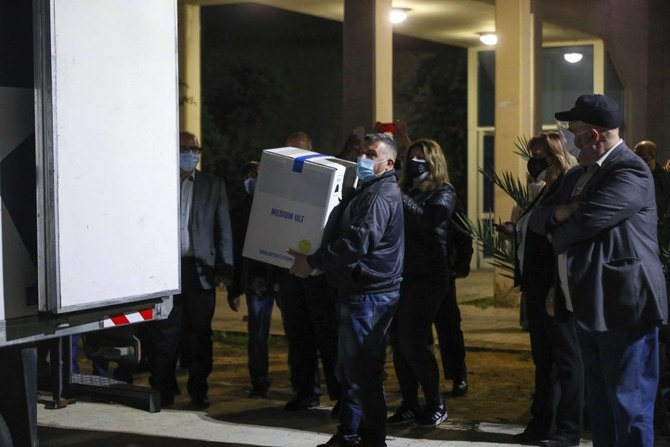
Members of staff unload boxes of the first shipment of the COVID-19 Pfizer-BioNTech vaccine upon arrival to the Rafic Hariri University Hospital in the Lebanese capital Beirut, on February 13, 2021. (AFP)
5 / 6
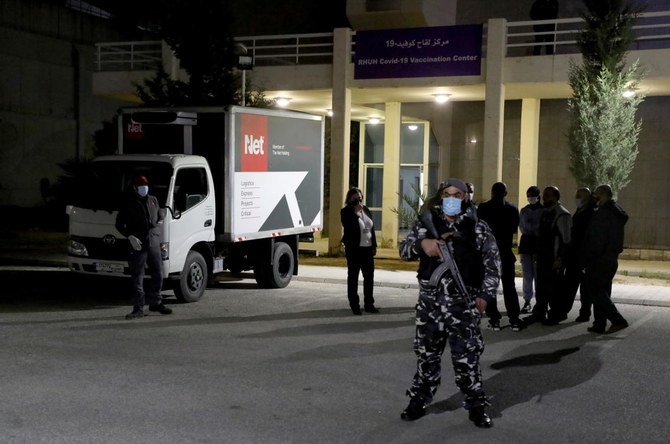
A truck carrying the first batch of doses of the Pfizer/BioNTech vaccine against the coronavirus disease (COVID-19) arrives at Rafik Hariri University Hospital, in Beirut, Lebanon February 13, 2021. (Reuters)
6 / 6
Members of Lebanese security forces stand next to a truck transporting boxes of the first shipment of the COVID-19 Pfizer-BioNTech vaccine, upon arrival to the Rafic Hariri University Hospital in the capital Beirut, on February 13, 2021. (AFP)
Short Url
Updated 14 February 2021
Follow

Lebanon launches urgent vaccine rollout

  • Medical, nursing staff and elderly first to be treated after first Pfizer batch arrives, top health official tells Arab News
  • The AstraZeneca vaccine due to arrive in Lebanon in about two weeks will offer greater flexibility to cover all Lebanese regions

BEIRUT: Lebanon has launched an urgent coronavirus vaccination rollout following the arrival of the first batch of the Pfizer-BioNTech vaccine at Beirut’s Rafic Hariri International Airport.

The consignment of 28,500 vaccines arrived from Belgium and was transferred to the Ministry of Health for storage and distribution to approved medical centers and hospitals.
Medical and nursing staff as well as paramedics working in coronavirus departments in the country’s hospitals will be among the first to be treated when the rollout begins on Sunday.
About 150 people will be vaccinated in three hospitals in Beirut, with the number expected to increase to between 300 and 400 per day by next week in 17 centers across the country.
At least 57 vaccination centers are expected to be operating within three weeks.
Care homes for the elderly will also be included early in the vaccination program, Reda Al-Mousawi, media adviser at the Ministry of Health, said.
Lebanese hospitals have struggled in the past year amid the country’s acute financial crisis and some of the region’s highest coronavirus infection rates.
The total number of virus cases in Lebanon reached 334,086 and 2,462 deaths.
Dr. Abdul Rahman Bizri, an infectious disease specialist and head of the National Committee for the Administration of Corona Vaccine, told Arab News that the first people to receive the vaccine will be identified by the three hospitals, which will begin vaccinations on Sunday.
“I have not been informed that the president, parliamentary speaker and the prime minister will be first to receive the vaccine,” he added.
Bizri said that hospitals have rehearsed their vaccination procedures before opening their doors next week.
“We have learned from the mistakes of the Americans and French, and are trying to avoid the same issues,” he said.
The AstraZeneca vaccine due to arrive in Lebanon in about two weeks will offer greater flexibility to cover all Lebanese regions, Bizri said.
He declined to set a ceiling for the duration of the vaccination process, saying: “It depends on the quantity of the vaccine provided and the behavior of the people. I think that with the start of the vaccination process, people will be more encouraged.”
More than half-a-million people out of a population of 4 million have registered to be inoculated via a health ministry platform.
Ministry hotlines are handling inquiries from those who are reluctant to take the vaccine.
Community health specialist Dr. Ahmad Mughrabi blamed so-called vaccine hesitancy on “distorted messages circulating on social media and the attitudes of some celebrities who say they will not be inoculated.”
Mughrabi said that people in the street and his neighbors “frequently ask questions about the disadvantages of the vaccine and the fear of it, especially unconventional vaccines.”
“The media and the social media in Lebanon bear a great responsibility for confusing people,” he said. “No one is trying to reassure people.”
Mughrabi said that he fears Lebanon will struggle to complete the vaccination campaign within two or three months, adding: “What is the benefit of vaccination in light of the social spread of the virus?.”


Over 2,200 Daesh detainees transferred to Iraq from Syria: Iraqi official

Updated 08 February 2026
Follow

Over 2,200 Daesh detainees transferred to Iraq from Syria: Iraqi official

  • Iraq is still recovering from the severe abuses committed by the terrorists

BAGHDAD: Iraq has so far received 2,225 Daesh group detainees, whom the US military began transferring from Syria last month, an Iraqi official told AFP on Saturday.
They are among up to 7,000 Daesh detainees whose transfer from Syria to Iraq the US Central Command (CENTCOM) announced last month, in a move it said was aimed at “ensuring that the terrorists remain in secure detention facilities.”
Previously, they had been held in prisons and camps administered by the Kurdish-led Syrian Democratic Forces (SDF) in northeast Syria.
The announcement of the transfer plan last month came after US envoy to Syria Tom Barrack declared that the SDF’s role in confronting Daesh had come to an end.
Saad Maan, head of the security information cell attached to the Iraqi prime minister’s office, told AFP on Saturday that “Iraq has received 2,225 terrorists from the Syrian side by land and air, in coordination with the international coalition,” which Washington has led since 2014 to fight Daesh.
He said they are being held in “strict, regular detention centers.”
A Kurdish military source confirmed to AFP the “continued transfer of Daesh detainees from Syria to Iraq under the protection of the international coalition,” using another name for Daesh.
On Saturday, an AFP photographer near the Kurdish-majority city of Qamishli in northeastern Syria saw a US military convoy and 11 buses with tinted windows.

- Iraq calls for repatriation -

Daesh seized swathes of northern and western Iraq starting in 2014, until Iraqi forces, backed by the international coalition, managed to defeat it in 2017.
Iraq is still recovering from the severe abuses committed by the terrorists.
In recent years, Iraqi courts have issued death and life sentences against those convicted of terrorism offenses.
Thousands of Iraqis and foreign nationals convicted of membership in the group are incarcerated in Iraqi prisons.
On Monday, the Iraqi judiciary announced it had begun investigative procedures involving 1,387 detainees it received as part of the US military’s operation.
In a statement to the Iraqi News Agency on Saturday, Maan said “the established principle is to try all those involved in crimes against Iraqis and those belonging to the terrorist Daesh organization before the competent Iraqi courts.”
Among the detainees being transferred to Iraq are Syrians, Iraqis, Europeans and holders of other nationalities, according to Iraqi security sources.
Iraq is calling on the concerned countries to repatriate their citizens and ensure their prosecution.
Maan noted that “the process of handing over the terrorists to their countries will begin once the legal requirements are completed.”