

Pakistan wants 'truly bilateral relationship' with United States — national security advisor

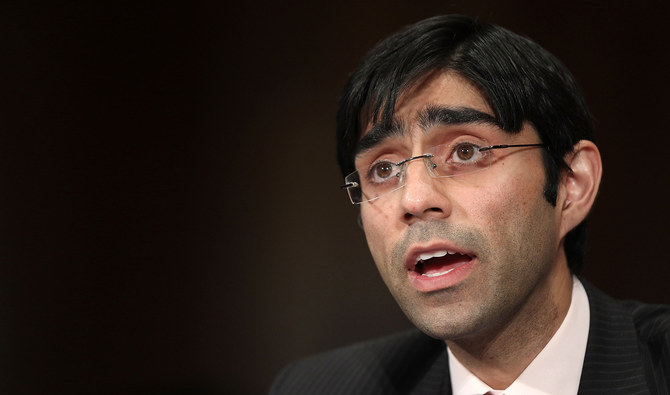
Moeed Yusuf during a hearing before the Senate Foreign Relations Committee at May 5, 2011 on Capitol Hill in Washington, DC. (AFP/File)
Short Url
Updated 12 February 2021
Follow

Pakistan wants 'truly bilateral relationship' with United States — national security advisor

  • The prime minister’s advisor on national security says no third country lens should be applied to the diplomatic ties between the two countries
  • Yusuf says Pakistan is pursuing economic security paradigm and the world should recognize that

ISLAMABAD: Special Assistant to Prime Minister on National Security and Strategic Policy Planning Dr. Moeed Yusuf said on Friday that Pakistan’s foreign policy was guided by its economic interests and his country was looking at its relationship with the United States from the same perspective. 

“Our goal is to get to a truly bilateral relationship with the US,” Yusuf told a ceremony arranged by a local think tank, Tabadlab, to launch a policy brief on the US-Pakistan ties via a video link. “No third country lens should be applied to this relationship. This has been the tragedy of this relationship for the past two decades and before that as well.” 

He said there had been a shift in his country’s diplomatic approach and the international community should recognize that. 

“We are decidedly on an economic security paradigm now which essentially means that we are focused on working with our geo-economic location more than the geostrategic element of that location,” he continued. “We want to operate as the melting pot for positive global economic interests.” 

Discussing the China-Pakistan Economic Corridor, Yusuf said it was not just about north-south connectivity, though Islamabad wanted economic dividends from its partnership with China. 

He noted that his country was “also open to eastward connectivity” with India while maintaining that the option was closed for now “because of where India stands.” 

The prime minister’s advisor said that Pakistan was looking for “development partnerships, not assistance,” and was open to every country in the world. 

“It’s critical that the world updates its narrative about Pakistan, especially the West where Pakistan has been the whipping boy for the longest period,” he added. 

Meanwhile, the policy paper prepared by Tabadlab, a local think tank, pointed out that American policies were undergoing a “significant shift” in South Asia since Washington was striving for greater strategic alignment with India. 

It also pointed out that US withdrawal from Afghanistan, along with other geopolitical realities, would require continuous American engagement with the region, particularly with Pakistan. 

“Building a closer relationship with Pakistan offers the US alternative pathways of furthering its own national interests such as contending with the growing influence of China,” it noted. “A more comprehensive engagement with Pakistan would also enable the US to further other goals of mutual interest with Pakistan as well as other regional countries, such as preventing conflict, terrorism, economic instability and contending with the threat of climate change.” 

The policy brief also observed that Pakistan’s role in negotiating peace in Afghanistan provided unique opportunities to policymakers in Islamabad to proactively explore means for establishing “a comprehensive and resilient bilateral relationship with the United States.” 


How do Pakistan and Taliban Afghan militaries stack up as tensions flare?

Updated 7 sec ago
Follow

How do Pakistan and Taliban Afghan militaries stack up as tensions flare?

  • Pakistan fields 660,000 active troops, 465 combat aircraft and 170 nuclear warheads, dwarfing Taliban forces
  • Afghan Taliban command about 172,000 personnel with limited air capability and no nuclear arsenal

Cross-border fighting between Pakistan and Afghanistan intensified ‌overnight, with both sides claiming heavy losses and the Pakistani defense minister saying his country was in an “open war” with its neighbor.

As tensions ​persist, here is a look at how Pakistan dwarfs Afghanistan’s military forces and arsenals, according to data from the London-based International Institute for Strategic Studies.

OVERVIEW
Pakistan’s armed forces benefit from good recruitment and retention, bolstered by equipment from its main defense partner China. Islamabad continues to invest in its military nuclear programs and is also modernizing its navy and air ‌force.

The capability of ‌the Afghan Taliban’s armed forces, meanwhile, ​is ‌declining, ⁠with ​a fall ⁠in their ability to use foreign equipment that the Islamist group seized when it returned to power in the landlocked country in 2021.
A lack of international recognition for the Taliban administration has also hurt military modernization.

PERSONNEL
Pakistan has 660,000 active personnel in its defense forces, of whom 560,000 are in the ⁠army, 70,000 are in the air force, and 30,000 ‌are in the navy.

The ‌strength of the Afghan Taliban’s military ​is thinner, with only 172,000 active ‌personnel. The group has, however, announced plans to expand ‌its armed forces to 200,000 personnel.

FIGHTING VEHICLES AND ARTILLERY
Pakistan has more than 6,000 armored fighting vehicles, and over 4,600 pieces of artillery.

The Afghan forces also possess armored fighting vehicles, including Soviet-era main battle tanks, ‌armored personnel carriers and autonomous underwater vehicles, but their exact number is unknown.

The precise number of ⁠artillery they ⁠possess, which is of at least three different types, is similarly not known.

AIR FORCE
Pakistan has a fleet of 465 combat aircraft and more than 260 helicopters that include multi-role, attack and transport choppers.

Afghanistan has no fighter jets and no real air force to speak of. It is known to possess at least six aircraft — some of them dating back again to the Soviet era — and 23 helicopters, although it is not possible to assess how many are ​in flying condition.

NUCLEAR ARSENAL
While Pakistan ​is a nuclear-armed country and has 170 warheads, Afghanistan does not have a nuclear arsenal.