



DUBAI: It’s about time someone shouted it from the rooftops: Ali Suliman is one of the best actors working today. Since his landmark role in Hany Abu Assad’s Oscar-nominated 2005 film “Paradise Now,” Suliman has had a career like few others — hopping back and forth between Hollywood blockbusters and intimate Middle Eastern arthouse cinema, imbuing each role with emotional complexity and deeply felt humanity, but all appearing so effortless that he has yet to get the credit he so richly deserves.
And he’s just turned in arguably the best performance of his career. In Ameen Nayfeh’s “200 Meters” — Jordan’s official submission to the 2021 Academy Awards — Suliman plays Mustafa, a man who lives on the opposite side of the separation barrier between Palestine’s West Bank and Israel from his wife and children. When his son is rushed to the hospital, Mustafa sets off on a journey to find a way across the barrier without a permit. It’s a tense 90-minute dramatic thriller free of melodrama, a zoomed-in character study of a man who chooses to risk everything for his family.

“200 Meters” is by Ameen Nayfeh.
“I saw real human need in this story. It was super-simple, without cliché or political statements. All he wanted is to feel free, without any of these obstacles in his daily life. That, for me, is what I really loved in this project,” Suliman tells Arab News.
Suliman, a father of three, struggled at points to comprehend the horror of being unable to reach one’s children, constantly thinking of his own family while trying to understand Mustafa’s plight, a plight shared by many people that Suliman and the crew met while filming in Palestine.
“Real people get separated from their families by the wall. Everyone was telling us, ‘This is my story.’ People were really emotionally involved with the story behind the camera,” says Suliman. “I still don't really understand what it is like, I feel. I'm currently filming a movie, and I'm away from my kids, and it’s a 15-hour flight to get here. But I can see them whenever I want. I can bring them here so that they can be with me. Mustafa cannot go whenever he wants to see his family. No matter how (much I might think) I understand it, I still don't. I'm not there to understand it.”
When Suliman approaches a role like Mustafa, he draws a line between his own emotions and the character’s. In a way, it’s the only method through which recover after shooting a film of such intensity as “200 Meters” without lingering emotional effects.
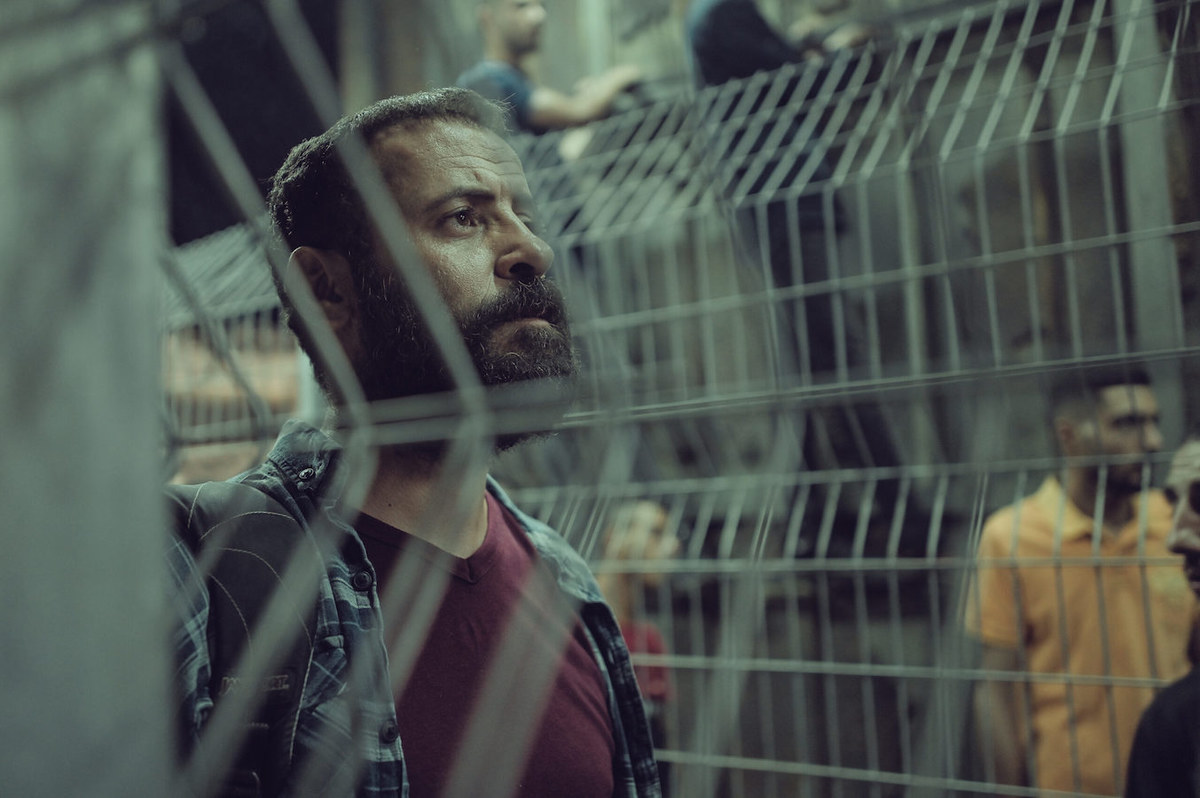
Ali Suliman plays Mustafa, a man who lives on the opposite side of the separation barrier between Palestine’s West Bank and Israel from his wife and children. (Supplied)
“I like to live in the world that the character lives in, to try to develop it, but make a clear line between my character and myself. To separate myself from the character, and at the same time, to be connected to them. It’s a thin line, but at the same time, it’s a thick line. You have to know that you’re an actor,” says Suliman. “(English actor) Laurence Olivier could cry his soul out and not feel anything. That’s technique. I took something very important from what he did and what he said. Sometimes I bring from technique, sometimes I bring things from my soul.”
Filmmakers in the region certainly recognize Suliman’s unique talent. From the moment that Nayfeh started writing “200 Meters,” seven years before approaching the actor, it was always Suliman — and only Suliman — he imagined portraying the film’s lead.
“He told me first thing that when he started to write the script, he was thinking of me. From there, I think there was, like, really great chemistry between me and him. He is really a big talent. I didn't feel for a moment that this was really his first feature film,” says Suliman.
Suliman has long been a champion of Arab cinema, believing that the region’s emerging talent — including Nayfeh, who marks his directorial debut with the film, or Sudan’s Amjad Abu Alala, who also released his first feature in 2020, “You Will Die at 20” — are driven to art as a means of expressing the struggles that they and many in the region go through on a daily basis.

“200 Meters” is Jordan’s official submission to the 2021 Academy Awards. (Supplied)
“Cinema, especially when it comes from the Arab world, is a mirror of ourselves. It reflects where we come from. You see the thirst in these filmmakers to tell stories. The circumstances that we are living in create the need of creativity. Film is a tool to express yourself,” says Suliman.
Part of that struggle continues outside of the Arab world as well, as Arab actors in Hollywood are still routinely offered roles that are based on stereotypes. While Suliman has accepted numerous roles in Hollywood — including Peter Berg’s “The Kingdom” (2007) and “Lone Survivor” (2013), Ridley Scott’s “Body of Lies” (2008), as well as Amazon’s “Jack Ryan” series with John Krasinski in the title role — he has turned down scores more on principle, including the high-profile Netflix series “The Spy.”
“I say no to stereotypes. Of course, if I get any character I do like to (use things) from my own perspective for the character, but if it's really a super-stereotype I (turn it down),” he explains.
There are signs that things are changing, however. As Suliman speaks to Arab News, he is on the set of the upcoming Mark Wahlberg (with whom he starred in “Lone Survivor”) film “Arthur the King,” playing a part that he would never have been offered in the past, as it was not written explicitly for an Arab.

Ali Suliman stars in “Lone Survivor.” (Supplied)
“I was reading about my character’s blue eyes, and I said, ‘Ok, this is not me. I don't have blue eyes.’ But things have changed, and they offered me this role, even though the character was written with blue eyes. This character is really so different from me, and I never thought that I would do it,” says Suliman.
While Suliman is finally experiencing color-blind casting, he is also heartened that people from a multitude of backgrounds are entering the mainstream spotlight, including shows such as Ramy Youssef’s Emmy-winning “Ramy.”
“I think (Hollywood) is now aware of ‘the other’ and they can really be part of the global community. There are more projects that are talking about ‘the other’ in a better way, and more people have a platform that is much bigger than the stereotypes they were put in over the years.”
While Suliman’s star continues to rise, the actor is not satisfied yet. After two decades in front of the camera, Suliman quietly desires to be one of those filmmakers himself, not just to try to tell his own stories, but to know himself better.
“I have many ideas. I've been making much research about many things. The problem is that I need to find the time to really sit and translate these ideas into scripts. My priority is my work as an actor, but my dreams are there,” he says. “I know that one day it will come through whenever the timing is there, but I have to push it forward.”


