

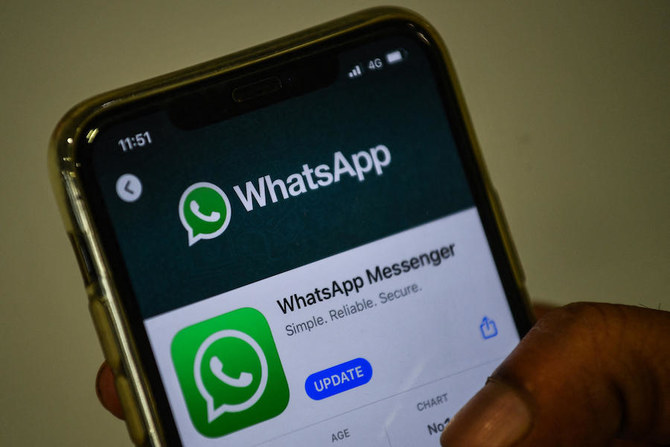

WASHINGTON: When WhatsApp users began to raise concerns about a new privacy policy being rolled out, members of a Washington pickup soccer group decided to switch their communications to rival messaging platform Signal, ditching the Facebook-owned service.
The shift was “about moving as many users away from the Facebook empire, which for my liking has become way too big and powerful,” said Bernhard Fleck, one of the players.
The flap over WhatsApp’s privacy policy — described by Facebook as a misunderstanding about efforts to bring businesses onto the platform — threatens to erode trust in the service which is increasingly important to the leading social network’s future.
The California giant last month delayed implementation of a new policy which critics said could expand data collection from some two billion WhatsApp users around the world.
Even with the delay in place, the policy caused an uproar and prompted a surge in interest in rival messaging services such as Signal and Telegram.
A WhatsApp blog post cited “confusion” over the policy update and maintained that it “does not expand our ability to share data with Facebook.”
The update concerns how merchants using WhatsApp to chat with customers can share data with Facebook, which could use the information for targeted ads, according to the social network. The policy will be reviewed and won’t be implemented before May 15, according to the company.
Ryan Calo, a privacy researcher with the University of Washington’s Tech Policy Lab, said that even though many users misinterpreted the new policy, the backlash is understandable.
“The original sin was purchasing WhatsApp and folding it into the business model of Facebook which monetizes all the data they have,” Calo said.
“The changes aren’t as dystopian as some people are thinking. But it is moving to a model that many people don’t trust.”
WhatsApp, acquired in 2014 for some $19 billion — the largest sale of a venture-backed firm at the time — is seen as a strategic asset for Facebook as it faces slowing growth for its core social network and looks to expand its offerings for connecting users and businesses.
The controversy comes as Facebook seeks to integrate its “family” of applications with a common technology and provide more ways for people and businesses to connect, while US antitrust enforcers meanwhile press to “unwind” Facebook’s acquisition of WhatsApp and Instagram.
Merrill Lynch analyst Justin Post said in a recent research note that “we continue to see WhatsApp as an important driver of potential future Facebook stock value” and predicted that the social media giant would overcome these issues as it did with the Cambridge Analytica political scandal.
With easy connections for voice and video calls, WhatsApp has a strong global user base but has not begun any meaningful monetization of the service, said Jasmine Enberg, senior analyst of global trends at the research firm eMarketer.
“It was only a matter of time before Facebook worked out a way to make it into a revenue stream,” Enberg said.
She added that since Facebook has apparently ruled out using WhatsApp for advertising, it is moving toward making it an e-commerce platform along the lines of China’s WeChat with business tools for customer service and support.
Privacy advocates point out that WhatsApp has in fact been sharing data with Facebook since it implemented a new policy in 2016, except from users who opted out at that time. Data from European Union users has also been excluded without affirmative consent under EU privacy laws.
Indicating that WhatsApp users could no longer opt out last month, “was a little insulting to people’s intelligence,” said Gennie Gebhart, a privacy researcher with the Electronic Frontier Foundation.
“A lot of people joined WhatsApp to get away from Facebook, but now they are seeing they are sharing their data with that company,” she said.
But Gebhart said users have limited options now because of the so-called “network effect” — with so many people on WhatsApp, it’s difficult to move away from the free service.
According to eMarketer data from last year, WhatsApp had more than 99 percent of mobile messaging app users in Brazil, 97 percent in India and 52 percent in the United States.
Enberg said the latest privacy dust-up is unlikely to slow momentum for WhatsApp and Facebook, especially since there is often a “disconnect” between what people say and what they do on privacy.
“Sure, many people left and more may leave,” she said,
“But it’s unlikely we will see a mass exodus. And WhatsApp’s user base is already so large, it would take precisely that to make a significant dent.”


