

Beekeeping thrives in Pakistan with $6 million in honey exports to Saudi Arabia, UAE, Kuwait

Beekeepers work on beehives in Chakwal, Pakistan on February 7, 2021. (AN photo by Aamir Saeed)
Short Url
Updated 10 February 2021
Follow

Beekeeping thrives in Pakistan with $6 million in honey exports to Saudi Arabia, UAE, Kuwait

  • Pakistan produces around 7,500 metric tons of honey annually with over 8,000 beekeepers rearing bees in one million beehives
  • PM Khan launched the “Billion Tree Honey Initiative” in December last year with the aim of increasing honey production to 70,000 metric tons in a year

ISLAMABAD: Commercial beekeeping is fast becoming a thriving business in Pakistan’s rural areas, providing new job opportunities to thousands of men and women and helping the country earn foreign exchange through exports, mainly to Middle Eastern countries, an industry body, researchers and honey traders said. 
The South Asian nation currently produces around 7,500 metric tons of honey annually, with more than 8,000 beekeepers rearing exotic species in one million beehives, according to the government’s Honeybee Research Institute in Islamabad (HBRI). Around $6 million in foreign exchange is earned annually through honey exports to Saudi Arabia, United Arab Emirates, and Kuwait.
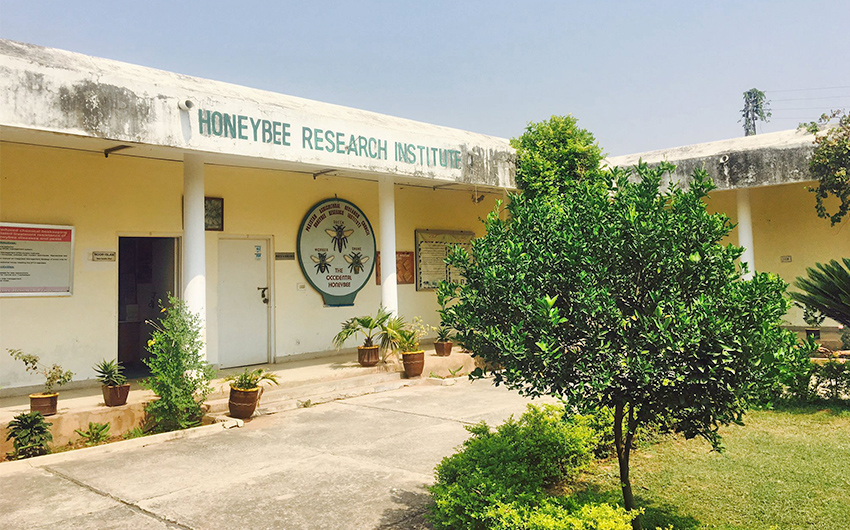


This undated picture shows the government’s Honeybee Research Institute (HBRI) in Islamabad, Pakistan. (Photo courtesy: Social media)

Prime Minister Imran Khan launched the “Billion Tree Honey Initiative” in December last year with the aim of increasing honey production to 70,000 metric tons in a year. The government estimates the project will help generate around 43 billion rupees ($268 million) for the national economy and provide about 87,000 green jobs. Under the program, the government has pledged to increase the plantation of specific trees and flora to improve the quality and production of honey, as well as grant interest-free loans to traders. 
Raza Khan, president of the All Pakistan Beekeepers Trade and Exporters Association, said Pakistan was producing “hundred percent organic” honey through modern bee farming, and demand was increasing, particularly in Middle Eastern countries like Saudi Arabia, UAE and Kuwait. 
In the financial year 2018-2019, Pakistan exported honey worth 966 million rupees ($5.8 million), about 260 million rupees more than the year before, according to the Honeybee Research Institute. Industry insiders predict the numbers will keep going up as the country’s beekeepers benefit from Pakistan’s ongoing push to reforest the country under its “10 Billion Tree Tsunami” project, launched in 2018.
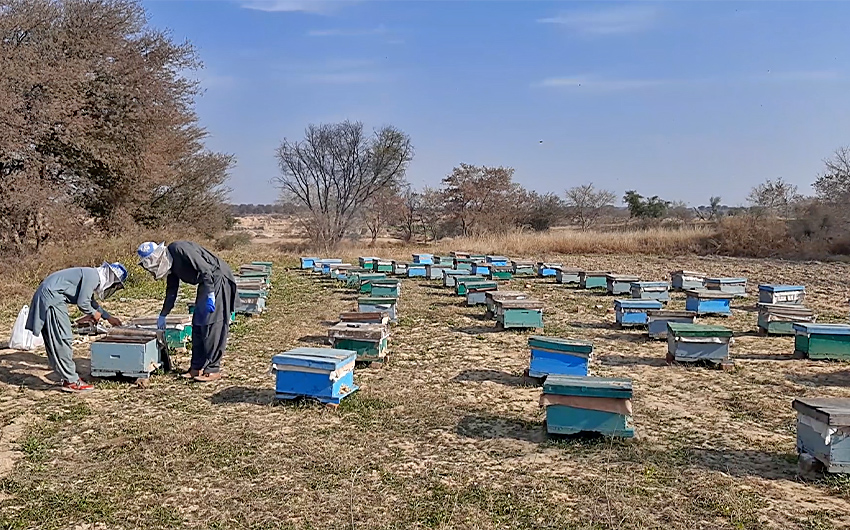


Beekeepers work on a bee farm in Chakwal, Pakistan on February 7, 2021. (AN photo by Aamir Saeed) 

“Our honey is unique in the world for its natural taste, color and texture,” Raza Khan said. “Therefore, its demand abroad is growing fast,” he added, urging the government to provide more incentives to boost the business and grant industry status to commercial beekeeping.
“The government should strengthen certification and quality standards of the honey so that we can also export it to the European market,” Khan said. 
For now, bee farming is gaining traction among unskilled laborers, students and growers in remote areas of the country because it requires minimal capital and skill. 
“This is an easy and profitable business as one can start it without getting any formal skills and education,” Ameer Ahmed, a university student who has set up 100 beehives on his farmland in Chakwal, told Arab News.
Ahmed started the bee farm as a part-time business with 30 beehives last year but has now turned the trade into his full-time job after making hefty profits.
“I am now encouraging my friends to get into this business too,” said Ahmed who recently had to hire two workers to look after his growing apiary. 
Globally, there has been a drastic decline in bee numbers, largely due to intensive agriculture, pesticide use and climate change, environmentalists say.


Bees in a hive in Chawkal, Pakistan on February 7, 2021. (AN photo by Aamir Saeed) 

A study published in the journal Science in April last year found that the world’s population of land-dwelling insects is falling by almost one percent every year.
In Pakistan too, experts say honey production can increase only if the government takes strict measures to curb deforestation and pesticide use in agriculture.
Noor Islam, a senior scientific officer at the Honeybee Research Institute, said pesticide and antibiotics residue in honey was also a major obstacle in its export to the United States and Europe.
“We don’t have the capacity and tools to gauge pesticide residue in our honey and this has limited our exports to the Middle Eastern countries only,” he told Arab News. “Beekeeping is a profitable business, but it still requires the government’s patronage and support to compete in the international market.”


Nearly 25% of Pakistan’s primary schools enrolling girls operate as single-teacher ones— report

Updated 13 sec ago
Follow

Nearly 25% of Pakistan’s primary schools enrolling girls operate as single-teacher ones— report

  • Pakistan needs over 115,000 more teachers in primary schools enrolling girls to meet global benchmark of one teacher per 30 students, says report
  • Sixty percent of Pakistani primary schools enrolling girls are overcrowded, while 32% lack clean drinking water or toilets, says Tabadlab report

ISLAMABAD: Nearly 25% of Pakistan’s primary schools that enrolls girls operate as single-teacher ones, a report by a leading think tank said this week, calling on the government to devolve teacher recruitment powers, upskill underutilized teachers and introduce reforms to hire and promote faculty members. 

Pakistan faces an acute education crisis which is reflected in the fact that it has the world’s second-highest number of out-of-school children, an estimated 22.8 million aged 5-16 who are not in educational institutions, according to UNICEF. 

While poverty remains the biggest factor keeping children out of classrooms, Pakistan’s education crisis is exacerbated by inadequate infrastructure and underqualified teachers, cultural barriers and the impacts of frequently occurring natural disasters. 

According to “The Missing Ustaani,” a report published by Islamabad-based think tank Tabadlab and supported by Malala Fund and the Pakistan Institute of Education (PIE), Pakistan needs over 115,000 more teachers in primary schools with girls’ enrolment to meet the basic international benchmark of ensuring one teacher per 30 children. Currently, the average Student-to-Teacher Ratio (STR) across Pakistan’s primary schools with girls’ enrolment is 39:1, it said. 

“Approximately 60% of these schools are overcrowded, necessitating the recruitment of over 115,000 additional teachers nationwide,” the report said on Monday. “Compounding this, nearly 25% of primary schools with girls’ enrolment operate as single-teacher schools, placing immense pressure on the quality of education.”

It said the situation is more dire in Pakistan’s poverty-stricken southwestern Balochistan province, where nearly 52% of the schools are single-teacher only ones while the percentage decreases slightly in the southern Sindh province to 51 percent. 

The report said while the STR improves to 25:1 at the middle school level, acute shortages of subject specialists emerge as the top-priority concern for quality education in these schools.

“Furthermore, around 32% of primary schools with girls’ enrolment and 18% of middle schools face ‘critical infrastructural shortages’— lacking clean drinking water or toilets in addition to high STRs— which significantly affects girls’ attendance and learning, particularly during adolescence,” the report said. 

The report cited a set of priority recommendations to address Pakistan’s systemic teacher deployment challenges and improve educational equity for girls. 

It urged the government to devolve recruitment authority to school or cluster levels to enable timely, context-specific hiring. It also called upon authorities to reform teacher transfer and promotion policies to introduce school-specific postings with minimum service terms. 

This, it said, would reduce arbitrary transfers and improving continuity in classrooms. The report advised authorities to upskill surplus or underutilized primary teachers to support instruction at the middle school level, helping address subject-specialist shortages.

“Together, these reforms offer a pathway toward a more equitable, efficient, and responsive teaching workforce— one capable of improving learning outcomes and ensuring that every girl in Pakistan has access to a qualified teacher,” the report said. 

To tackle Pakistan’s education crisis, Prime Minister Shehbaz Sharif declared an ‘education emeregency’ in September 2024, stressing the importance of education for all.