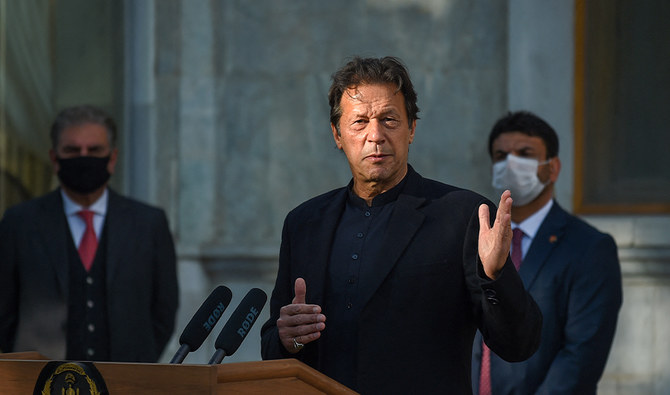
COLOMBO: Prominent representatives of Sri Lanka’s Muslims have said they hope Prime Minister Imran Khan will take up their concerns in meetings with top government officials when he visits the island country in South Asia later this month.
Muslim groups say they have received dozens of complaints from across Sri Lanka about people from the community being harassed at workplaces, including government offices, hospitals and in public transport, since militants killed over 250 people in churches and hotels across the country in Easter Sunday attacks in 2019.
Muslims make up nearly 10 percent of Sri Lanka’s population of 22 million, which is predominantly Buddhist. The Indian Ocean island was torn for decades by a civil war between separatists from the mostly Hindu Tamil minority and the Sinhala Buddhist-dominated government. The government stamped out the rebellion over 10 years ago.
In recent years, Buddhist hard-liners, led by the Bodu Bala Sena (BBS) or “Buddhist Power Force”, have stoked hostility against Muslims.
“The community wishes to welcome a great Muslim leader [Khan] who is coming as his country’s prime minister for the first time,” N. M. Ameen, president of the Sri Lanka Muslim Council, told Arab News. “He is in a vantage position to speak on behalf of the Sri Lankan Muslims.”
Khan is slated to arrive in Sri Lanka on February 23 on a two-day visit in which he will hold talks with President Gotabaya Rajapaksa, Prime Minister Mahinda Rajapaksa and Foreign Minister Dinesh Gunawardena. He will also address the Lankan parliament — only the third Pakistani head of state to do so after former President General Mohammed Ayub Khan in 1953 and Prime Minister Zulfikar Ali Bhutto in 1973.
Rishath Bathuideen, former minister and leader of the All-Ceylon Makkal Congress, a Muslim political party, met with the charge d’affaires of the Pakistan High Commission in Colombo on Tuesday, and told Arab News: “We have expressed the concerns of the Muslim community, especially regarding the forced cremation policy of the government.”
Sri Lanka’s government has insisted on the cremation of all coronavirus victims, rejecting international pleas and recommendations by its own experts to allow the Muslim minority to bury their dead.
In 2018, Sri Lanka’s government imposed a nationwide state of emergency after angry mobs made up of the majority Sinhalese ethnic group attacked dozens of Muslim businesses and houses and at least one mosque in Kandy. At least one person was killed.
“Prime Minister Khan must use his visit to assist in our struggles for human rights, justice and accountability for all in Sri Lanka,” Shreen Saroor, a women’s rights activist and co-founder of the Women’s Action Network, told Arab News.


![]()

Muslims hope Pakistani PM will ‘speak’ for them during Sri Lanka visit
Short Url
https://arab.news/yduzm
Muslims hope Pakistani PM will ‘speak’ for them during Sri Lanka visit
- Khan is slated to arrive in Sri Lanka on Feb, 23 on a two-day visit in which he will hold talks with top leaders and address Lankan parliament
- Muslims make up nearly 10% of Sri Lanka’s population of 22 million, in recent years Buddhist hard-liners have stoked hostility against them
Latest updates


© 2026 SAUDI RESEARCH & PUBLISHING COMPANY, All Rights Reserved And subject to Terms of Use Agreement.