

Pakistan offers 80,000 jobs during pandemic under ‘10 Billion Tree Tsunami Program’

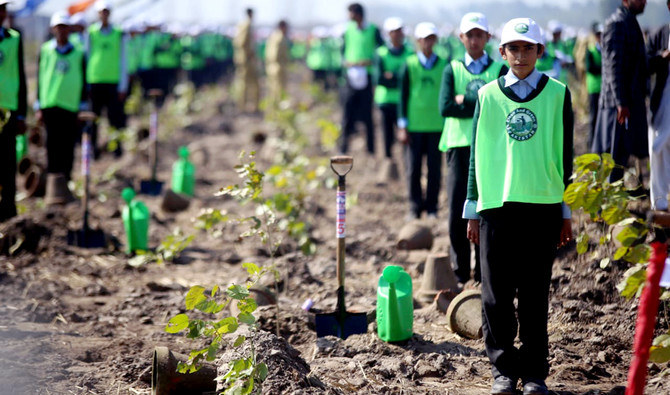
Volunteers participate in the Spring Plantation drive in Nankana Sahib, Pakistan, on February 9, 2019. (Photo courtesy: Ministry of Climate Change)
Short Url
Updated 08 February 2021
Follow

Pakistan offers 80,000 jobs during pandemic under ‘10 Billion Tree Tsunami Program’

  • Unemployed day laborers given new jobs as “jungle workers,” planting saplings during coronavirus lockdown
  • Pakistan contributing less than one percent to global emissions, emission growth nine percent below baseline, officials tell PM

ISLAMABAD: Pakistani officials said on Monday 80,000 jobs had been offered in the country since March under the nationwide 10 Billion Tree Tsunami Program.

Since Pakistan locked down starting March 23 to try to stem the spread of COVID-19, unemployed day laborers have been given new jobs as “jungle workers,” planting saplings as part of the country’s 10 Billion Tree Tsunami program.

“The meeting was informed that 80,000 jobs were offered during the COVID-19 under 10 BTT project,” a press release from the prime minister’s office said, referring to a meeting chaired by Prime Minister Imran Khan of the Committee on Climate Change. “Pakistan’s emission growth is 9% below Business as Usual baseline and also below the NDC (Nationally determined commitments).”

“This climate friendly shift has been made possible due to increased forest cover as a result of the successful Billion Tree Tsunami project in Khyber Pakhtunkhwa and the ongoing Ten Billion Tree Tsunami Programme across the country,” the statement said. “Deforestation rate has significantly been reduced from 12000 hectares/year to 8000 ha/y from 2012-2016 and will further fall with 10BTT success … Pakistan was contributing less than 1% in global emission.”

German think tank, Germanwatch, in its latest report last month described Pakistan as the eighth most vulnerable country to climate change, having witnessed 173 extreme weather events and suffered an estimated loss of $3.8 billion as a consequence between 2000 and 2019.


Pakistan assembly speaker warns opposition against anti-state remarks in parliament

Updated 17 January 2026
Follow

Pakistan assembly speaker warns opposition against anti-state remarks in parliament

  • Ayaz Sadiq says criticism of judiciary and armed forces will not be allowed on assembly floor
  • He calls violence during protests unacceptable, vows neutrality as National Assembly speaker

ISLAMABAD: Pakistan’s National Assembly Speaker Sardar Ayaz Sadiq said on Saturday that opposition lawmakers would not be allowed to speak against Pakistan, the judiciary or the armed forces on the floor of parliament, calling such remarks unacceptable.

Speaking to reporters during a visit to the eastern city of Lahore, Sadiq said parliamentary debate must remain within constitutional and legal limits, while reiterating his commitment to act impartially as speaker.

“No one will be allowed to speak against Pakistan, the judiciary or the armed forces on the floor of the National Assembly,” Sadiq said. “Negative or controversial remarks about judges or the armed forces are unacceptable.”

His comments come amid heightened political tensions after opposition groups held protests in the past, criticizing state institutions and targeting government and military properties.

The speaker said peaceful protest was a democratic right but drew a sharp line at violence and vandalism.

“Protest is the right of every citizen in a democratic society, but it must remain peaceful and within the bounds of the constitution and the law,” he continued, adding that arson, damage to property and the use of sticks or weapons in the name of protest were “unacceptable” and posed a threat to the rule of law.

“No opposition lawmaker will be allowed to speak on the National Assembly floor if they speak against Pakistan,” Sadiq said.

The speaker also noted the country’s economic indicators were gradually improving, citing an increase in foreign exchange reserves, and said Pakistan had further strengthened relations with countries including the United States, China, Russia, Türkiye and Saudi Arabia.