

DP World sees global container demand remain stable

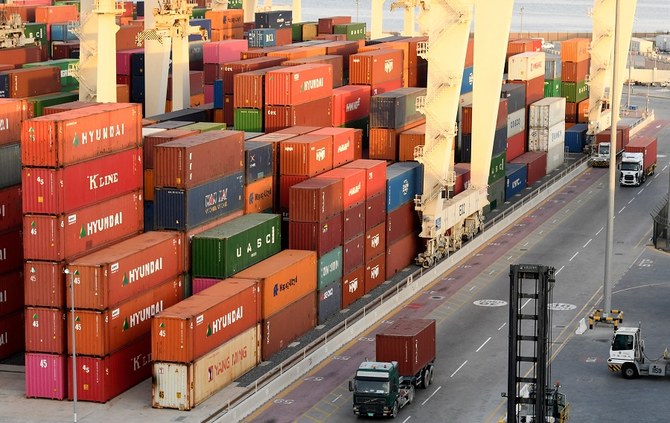
While demand for the year remained stable, the fourth quarter showed positive signs. (File/AFP)
Short Url
Updated 08 February 2021
Follow

DP World sees global container demand remain stable

  • Figures in Q4 2020 showed growth, but Dubai company believes 2021 outlook still ‘uncertain’

DUBAI: Dubai-based global ports operator DP World handled 71.2 million container units in 2020, a 0.2 percent rise like-for-like, in contrast to figures last week from the International Air Transport Association (IATA) that found demand for global air freight had nosedived to its lowest level since 1990.

While demand for the year remained stable, the fourth quarter showed positive signs, with DP World handling 19.1 million containers — or 20-foot equivalent units (TEUs) — across its global portfolio, a like-for-like increase of 6.5 percent.

Jebel Ali port in Dubai handled 3.4 million TEUs in the fourth quarter, up 0.3 percent year-on-year.

“This strong end to the year resulted in flat growth in 2020 which compares favourably against an industry that is estimated to be down 2.1 percent,” Sultan Ahmed bin Sulayem, group chairman and CEO of DP World, said in a statement.

“Looking ahead, while 2021 has started encouragingly, the outlook remains uncertain given the continued issues surrounding the pandemic, geopolitical uncertainty in some parts of the world and the ongoing trade war,” he added.

“We remain focused on containing costs to protect profitability, managing growth capex to preserve cashflow and are confident of meeting our 2022 targets.”

The stable position held by the container shipping industry is in sharp contrast to demand for global air freight services, which nosedived 10.6 percent over the same period, the biggest drop since 1990.

Feeling the brunt of the impact from the coronavirus pandemic, global air cargo capacity shrunk by 23 percent year-on-year as many airlines grounded aircraft due to a slump in passenger demand due to travel restrictions introduced to stop the spread of the disease.

IATA said Middle Eastern carriers reported a decline in demand of 9.5 percent year-on-year in 2020, and a 20.9 percent drop in capacity.

However, similar to DP World’s figures, there was some optimism in December as demand was up 2.3 percent, even though capacity was still down 18.2 percent.


European gas prices soar almost 50% as Iran conflict halts Qatar LNG output

Updated 02 March 2026
Follow

European gas prices soar almost 50% as Iran conflict halts Qatar LNG output

  • Analysts warn prolonged disruption could push prices higher
  • Some shipments of oil, LNG through Strait of Hormuz suspended
  • Benchmark Asian LNG price up almost 39 percent

LONDON: ​Benchmark Dutch and British wholesale gas prices soared by almost 50 percent on Monday, after major liquefied natural gas exporter Qatar Energy said it had halted production due to attacks in the Middle East.

Qatar, soon to cement its role as the world’s second largest LNG exporter after the US, plays a major role in balancing both Asian and European markets’ demand of LNG.

Most tanker owners, oil majors and ‌trading houses ‌have suspended crude oil, fuel and liquefied natural ​gas shipments ‌via ⁠the ​Strait of ⁠Hormuz, trade sources said, after Tehran warned ships against moving through the waterway.

Europe has increased imports of LNG over the past few years as it seeks to phase out Russian gas following Russia’s invasion of Ukraine.

Around 20 percent of the world’s LNG transits through the Strait of Hormuz and a prolonged suspension or full closure would increase global competition for other ⁠sources of the gas, driving up prices internationally.

“Disruptions to ‌LNG flows would reignite competition between ‌Asia and Europe for available cargoes,” said ​Massimo Di Odoardo, vice president, gas ‌and LNG research at Wood Mackenzie.

The Dutch front-month contract at the ‌TTF hub, seen as a benchmark price for Europe, was up €14.56 at €46.52 per megawatt hour, or around $15.92/mmBtu, by 12:55 p.m. GMT, ICE data showed.

Prices were already some 25 percent higher earlier in the day but extended gains ‌after QatarEnergy’s production halt.

Benchmark Asian LNG prices jumped almost 39 percent on Monday morning with the S&P Global ⁠Energy Japan-Korea-Marker, widely used ⁠as an Asian LNG benchmark, at $15.068 per million British thermal units, Platts data showed.

“If LNG/gas markets start to price in an extended period of losses to Qatari LNG supply, TTF could potentially spike to 80-100 euros/MWh ($28-35/mmBtu),” Warren Patterson, head of commodities strategy at ING, said. The British April contract was up 40.83 pence at 119.40 pence per therm, ICE data showed.

Europe is also relying on LNG imports to help fill its gas storage sites which have been depleted over the winter and are currently around 30 percent full, the latest data from Gas Infrastructure ​Europe showed. In the European carbon ​market, the benchmark contract was down €1.10 at €69.17 a tonne