


JERUSALEM: Israel’s Prime Minister Benjamin Netanyahu arrived in court on Monday to formally respond to corruption charges, as his trial enters an intensified phase six weeks before he faces re-election.
Netanyahu, the first Israeli premier to be indicted in office, was charged last year over allegations that he accepted improper gifts and sought to trade regulatory favor with media moguls in exchange for positive coverage.
The combative 71-year-old prime minister, who has blasted the charges as “fabricated and ludicrous,” was at the Jerusalem court conferring with his legal team shortly before the hearing was due to start.
Repeatedly suggesting the charges against him have been trumped up, Netanyahu has taken direct aim at his hand-picked attorney general, Avichai Mandelblit.
At the Monday hearing, which was pushed back multiple times due to coronavirus restrictions, Netanyahu is compelled to deliver the defendant’s formal response to the allegations.
This marks the last pre-trial hearing with upcoming sessions focused on testimony and evidence.
The trial schedule may force Netanyahu to appear in court multiple times a week, as he campaigns ahead of Israel’s fourth election in less than two years to be held on March 23.
When Netanyahu last appeared in court nine months ago, he was fresh off a political victory, forming a coalition government with his election rival Benny Gantz, following three inconclusive votes.
But that fraught coalition proved short-lived and collapsed in December, with Gantz branding Netanyahu as serially dishonest.
It is unclear whether the cloud of the trial will hurt the premier’s re-election chances in March.
Israel’s parliament speaker and Netanyahu loyalist Yariv Levin insisted the court must “postpone” the trial’s upcoming phase.
Proceeding now “will be lending a hand to blatant meddling in the elections,” he told the right-wing Israel Hayom newspaper on Sunday.
Levin charged that it was unfair for the prosecution to present its case during the election campaign, while the defense rebuttals are scheduled for after election day.
Several recent polls show that Netanyahu’s right-wing Likud remains the strongest party by a comfortable margin, but it is far from certain that it will be able to form a 61-seat majority with its conservative and religious allies.
For the first time in his political career, Netanyahu is also facing a challenge from a prominent Likud defector: Gideon Saar, who broke with the prime minister to form his own New Hope party.
The charges against Netanyahu are divided into three separate cases.
The most serious – known as Case 4,000, in which the premier is accused of bribery, fraud and breach of trust – centers on the allegation that he negotiated with Shaul Elovitch of the telecommunications giant Bezeq to secure positive coverage on his Walla! news site in exchange for policies benefiting Bezeq.
Elovitch and his wife were also indicted.
Case 2,000 concerns allegations Netanyahu sought a deal with the owner of the Yediot Aharonot newspaper that would have seen it give him more favorable coverage.
Case 1,000 involves allegations Netanyahu and his family received gifts, including luxury cigars, champagne and jewelry estimated to be worth more than 700,000 shekels ($213,000), from wealthy individuals, in exchange for financial or personal favors.
The prime minister denies wrongdoing.
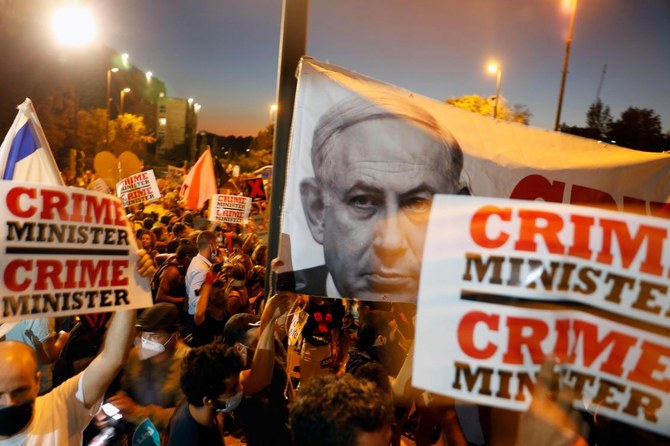
Weekly protests against him have rumbled on for months, with demonstrators focusing on the graft allegations.
Others have protested against the government’s handling of the pandemic.
A crowd of protesters, at least one waving a placard emblazoned with the words “Crime Minister,” was outside the courtroom on Monday as Netanyahu’s motorcade arrived.


