

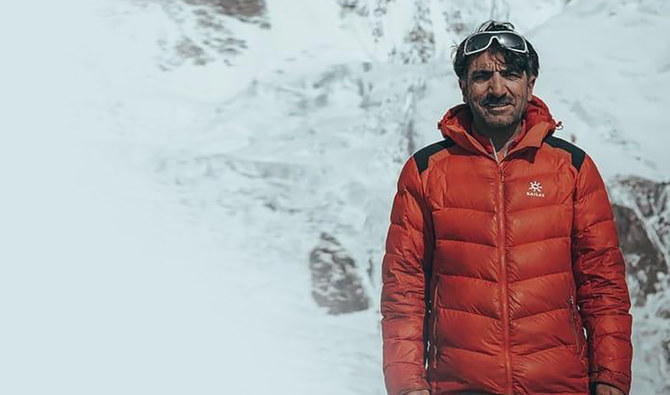

SKARDU/LAHORE: Mountaineers and rescue officials in Skardu said on Sunday it was a ‘near certainty’ that Pakistan’s Ali Sadpara and two other members of his expedition to summit K2 in winter had attained the coveted mountaineering prize before they went missing on Friday.
Last month, a team of climbers from Nepal became the first mountaineers in history to successfully complete a winter attempt on the summit of K2, the world’s second tallest peak.
Sadpara, John Snorri from Iceland and Chile’s JP Mohr, were also attempting the winter summit and were last seen at 11 am on Friday by Sadpara’s son Sajid at the top of the infamous K2 ‘bottleneck,’ just a few hundred metres from the summit.
Officials said Sajid had to turn back after his oxygen regulator malfunctioned. He is reported to have reached the K2 base camp on Saturday evening after waiting for the other three climbers at Camp 3 for over 20 hours.
“The most technical part of K2 is the ‘bottle-neck’ at about 8,200 m,” Sajid Sadpara told media in Skardu on Sunday, a few hours after his return from base camp.
“They were there at 11 am. I am sure they summited, and on the way back they had some kind of accident,” he said.
In 2019, in an interview with Alpinist magazine, Sadpara, who was the first climber to reach the summit of Nanga Parbat in winter in 2016, was asked what his future dreams were. He confessed two: a sewing machine for his wife, and a winter ascent of K2 for himself.
According to many in Gilgit’s tight-knit mountaineering community, Sadpara in all probability, got that wish on Friday afternoon.
“Seeing all the facts, 300-400 metres for Ali is nothing,” Asghar Ali Porik, a close friend of Sadpara's and the head of rescue missions under the Pakistan Association of Tour Operators, told Arab News. “And he wasn’t alone. He had other experienced climbers with him. I know his will and determination."
"I know with near certainty... with over 90 percent certainty... that whatever happened to them, happened on the way back. Ali completed his ascent of K2,” Porik said.
The top of the K2 bottleneck is at over 8,000 m, according to Porik. The summit from there would not have taken long.
“His son’s last meeting with him was after the bottleneck beyond 8000 meters,” Porik said. “From there it wouldn’t have taken him more than two hours [to summit].”
Sadiq Sadpara, an uncle of Ali Sadpara, and a mountaineer who has summited K2 himself, said beyond the 'bottleneck,' it would have been “no problem” for Sadpara to summit.
“After the bottleneck, there is no problem on the way up,” he said. “Whatever happened was on the way down. I can give a 100 percent guarantee that Ali sahib completed his summit.”
“We have been up there so many times, with foreigners and on our own,” Saqib said. “The problem is not the ascent. The problem is the descent. We have no energy coming down, we are not in the right state of mind. We can barely get our footing right.”
A helicopter rescue mission for the missing mountaineers restarted on Sunday morning, after almost a daylong search on Saturday - but there was no sign of the climbers.
“Today two army helicopters [along with Sajid and I] made a search flight... for an hour up to its maximum limit: 7,800 m again to locate the missing climbers," Chhang Dawa Sherpa of Seven Summit Treks, wrote on his Facebook page late on Sunday afternoon. "Unfortunately, no trace at all."
On Sunday, it was reported that the rescue operation to locate the three climbers was temporarily suspended after it failed to locate the mountaineers.


