
DUBAI: On Aug. 4, two explosions erupted in the port of Beirut, sending shockwaves across the city and beyond.
The impact was felt more than 150 miles away, with people in neighboring island Cyprus reporting the noise.
The devastating blast destroyed Lebanese homes, businesses and full city blocks. Thousands were injured and required immediate care, while more than 200 people lost their lives.
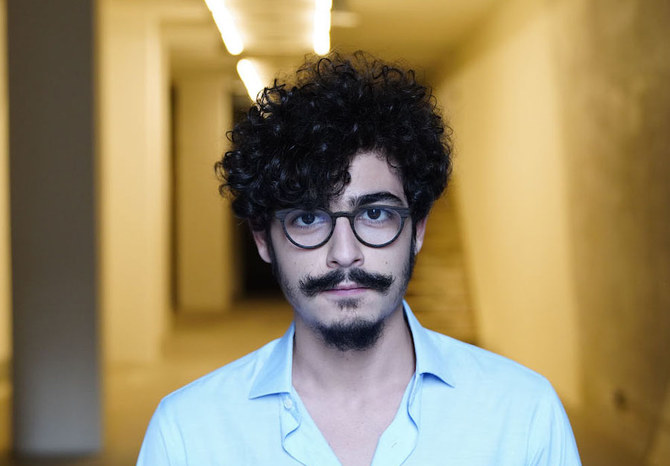
Among those who fell victim to the catastrophic event was Zeid El-Amine’s father, Iyad El-Amine, who the young gallerist is honoring through his newly launched Août gallery, situated in the now-damaged neighborhood of Gemmayze, where his dad passed away.
“I always knew I wanted to open my own art gallery, and after the blast, I realized how short life is,” El-Amine told Arab News of his decision to launch Août, which means August in French — a nod to the anniversary of the explosion as well as the month of closure for museums, institutions and art galleries around the world.
“When you lose the person that is most precious to you, you really notice what you truly care and don’t care about,” he said, adding that before the tragic event, he was considering leaving Beirut amid the political and economic crisis to pursue his studies abroad.
“The death of my father changed everything. After the explosion, I got attached to Gemmayze, and I didn’t want to leave anymore.”
Before launching his very own art space, El-Amine was working at Lebanon’s Ramzi and Saeda Dalloul Art Foundation, which he joined shortly after obtaining a fine arts and business degrees from the Lebanese American University in Beirut.
On Aug. 4, El-Amine had left work at 5 p.m. and went to his mother’s house, just an hour before the explosion happened. While the building that houses the art space, which includes more than 4,000 works by about 400 artists from across the Arab world, was impaired, the galleries remained intact.
However, other art galleries situated near Beirut’s port were not so fortunate, and sustained heavy damage.
Speaking on resilience and hope despite economic collapse, civil unrest, coronavirus, and now homelessness and food shortages in the wake of the disaster, El-Amine said that the newly launched art space is a way to not only honor his late father, but to commemorate the cultural landscape and revive the reeling art scene.
“I want to start a dialogue between the wounded city and the rest of the world,” he said.
“The aim is to give people hope because most people decided to leave after the blast. I think the launch of Août could be very inspiring to others who gave up on Lebanon and on the art scene.”
Believing and rebuilding are a part of the Lebanese DNA. The space that houses the new gallery was completely decimated when El-Amine first scouted it out. He would go on to rebuild the entire venue, a process that took three months and which he is very proud of.
“Everyone, not just the people in Lebanon, but also the international artists I’ve reached out to, think it’s a great initiative,” he said. “People are so happy with the project.”
The gallery was initially set to open this month, however, due to coronavirus restrictions, the opening has been delayed until the nationwide lockdown is lifted.
“It’s a full lockdown in Lebanon right now,” said El-Amine. “You need permission just to go to a pharmacy. Hospitals and offices and so on are open, but restaurants, galleries and museums are completely closed.”
Of course, launching a gallery in the midst of a pandemic is not the easiest task. Factor in Lebanon’s worsening economic and political crisis, plus the destruction brought about by the explosions, and it might as well be impossible. However, El-Amine has managed to overcome all obstacles and do just that.
“These days, I really like challenges because they help me take my mind off what happened. So I welcome the challenge,” he said.
And what can visitors expect when the gallery opens?
“The gallery will feature emerging contemporary artists from around the world in a way to start the dialogue between Beirut and the rest of the world,” El-Amine said. “So we have artists from China, South Korea, Japan; from all around Europe, from the US and from Lebanon,” he added.
El-Amine discovered many of the featured artists through social media platforms such as Instagram, including Jin Han Lee from South Korea, Lebanon’s Sara Tohme, Natalie Wadlington from the US, Santiago-born painter Pablo Benzo and Ralph Kokke from the Netherlands.
He said that the theme of the show, “Young Dreams,” is unrelated to the local and global issues that people have endured, such as the pandemic and Beirut blast.
Rather, it is a way to forget those troubles. “I think with everything happening around us right now, we just need a moment to fantasize and dream.”