

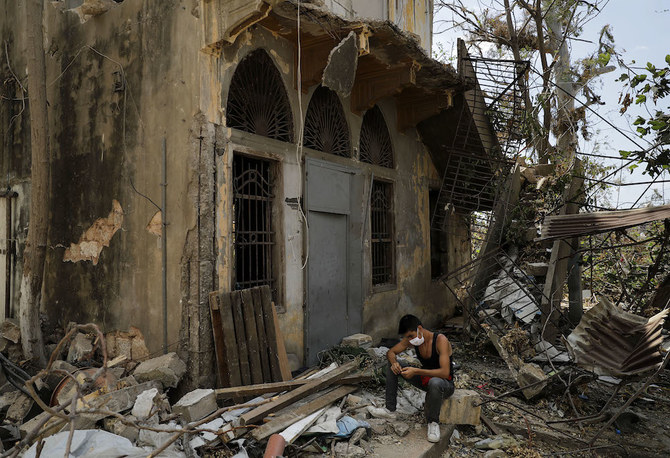

BEIRUT: As Syrian refugees, Moayad Obeid and his family had it hard even before the massive explosion that tore through Beirut last August, killing his 26-year-old brother Ayman. In the six months since, life has become all but impossible.
As well as supporting his own family, Obeid, who makes the equivalent of about $100 a month working odd jobs in Beirut, now sends money to his brother’s widow and baby daughter, who returned to Syria after the blast, unable to make ends meet.
Six months on, he has still received no aid.
“Everyone’s story is harder than the other, Lebanese or Syrian, we are all suffering,” Obeid told the Thomson Reuters Foundation. “But I will do anything, even sit on the street and beg, if it means I can feed my brother’s daughter.”
Syrian refugees were among those worst hit by the Aug. 4 port explosion that killed 200 people, injured 6,000 and left 300,000 homeless.
They made up a significant proportion of those killed in the blast, with 41 confirmed dead and two still missing, according to Kayan Tlais, who represents the victims’ families.
Most received little aid and struggled to afford food and shelter even before the blast. Now, with many Lebanese families also having lost everything, aid agencies say what little help was available is having to stretch even further.
Fadi Hallisso is the director of Basmeh and Zeytouneh, an organization that has helped 4,000 families, most of them Syrian, after the blast.
Since the explosion, he said, his organization had been getting hundreds of new calls every day from people desperate for food, rent and medical aid. Demand has been so great, it risks running out of funds by the end of this month.
“The situation is dire,” he said. “We’re witnessing a new phenomenon of Syrian and Lebanese men abandoning their families because they can’t provide for them anymore. There’s a lot more cases of women telling us their husbands have disappeared.”
Many Lebanese were hit by a financial crisis that began in 2019 and has sent prices soaring, and some have become less tolerant of the Syrians who have boosted the population by about 1.5 million to some 6 million.
About a quarter of the country’s Syrian refugee population lives in the capital, a city that has suffered the triple whammy of economic crisis, a major explosion and a pandemic.
Half the Syrian families in Lebanon said they went short of food in 2020, nearly twice as many as in 2019, according to a December survey by the United Nations refugee agency (UNHCR).
A nationwide COVID-19 lockdown with a round-the-clock curfew has only made things more difficult for those trying to help, while further squeezing those in need.
A government ban on work during the lockdown has meant Basmeh and Zeytouneh has completed work on just 110 of the roughly 200 homes it received funding to refurbish after the blast. Many still have no windows, doors or insulation.
The Norwegian Refugee Council estimates that some 9,000 of a total 200,000 homes damaged or destroyed in the blast still require repairs.
“Syrians were often the last ones who had houses renovated, and many still haven’t been refurbished,” said Nabil Khalouf, a Syrian relief worker with Edinburgh Direct Aid who spent months working in the worst-affected areas.
Basmeh and Zeytouneh prioritizes widows and other families headed by women, as they are especially vulnerable.
But with 75% of the Lebanese population now needing some form of aid, according to outgoing Social Affairs Minister Ramzi Moucharaifeh, Basmeh and Zeytouneh and other organizations like it are under intense pressure.
“It’s looking very grim,” Hallisso said. “By the end of February, we will spend every last penny we have and there is nothing on the horizon, so I’m not sure if we’ll be able to continue.”


