

In Pakistan’s ‘lonely’ cartoon industry, women find a voice on social media

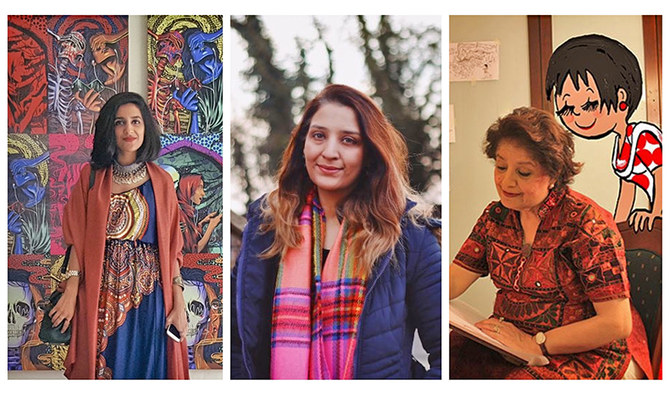
This collage shows Pakistani artists Shehzil Malik (left), Saadia Gardezi (center), and Nigar Nazar, a cartoonist who runs Gogi Studios in Islamabad, Pakistan. (Photo courtesy: Shehzil Malik, Saadia Gardezi and Nigar Nazar)
Short Url
Updated 05 February 2021
Follow

In Pakistan’s ‘lonely’ cartoon industry, women find a voice on social media

  • Nigar Nazar, Pakistan’s first female cartoonist, says lack of opportunities in newspapers and magazines had pushed cartoonists to self-publish or use social media
  • Shehzil Malik, one of Pakistan’s most recognizable digital artists, says social media had become the choice for many artists who wanted to find an audience

RAWALPINDI: Nigar Nazar, Pakistan’s first female cartoonist, whose famed character Gogi was first published in 1970, says lack of opportunities on traditional platforms like newspapers and magazines had pushed many of the country’s emerging cartoonists, and a pioneer like herself, to self-publish or turn to social media.
The much-loved Gogi character, a progressive, educated Pakistani woman who wears polka-dotted dresses, has been Nazar’s mouthpiece for decades to speak about social issues and contradictions in society.
But now, the cartoonist said, “whenever I have something I want to say about society, or what is happening, I publish on my own social media.”
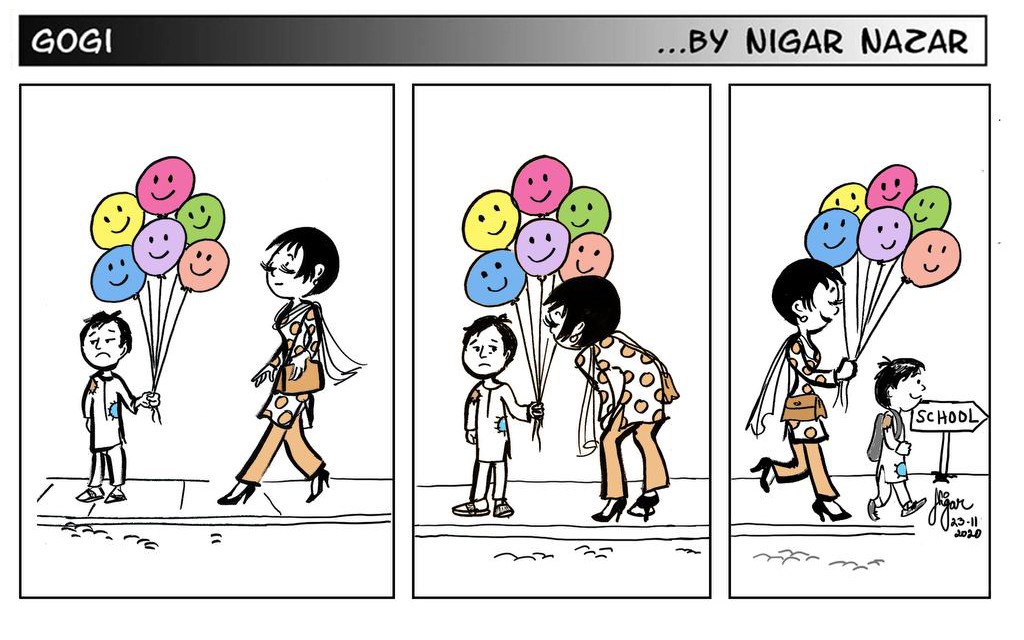


A comic strip for International Children's Day of Gogi, a character created and drawn by artist Nigar Nazar on November 24, 2020. (Photo courtesy: Gogi Studios/Facebook)

“What the newspapers could have been doing for their contributors is support the form of cartoons,” Nazar said in a phone interview on Wednesday. “Majority are not. I don’t see any jobs with newspapers for cartoonists and even illustrators — even for people like me, whose work has been there for a long time.”
Nazar, who said she hasn’t been published on a traditionI platform for a “long time now,” has moved to making cartoons for hospitals and on public buses.

“And I am doing books now, and I’m doing programs for, you know, creative art and craft programs on my YouTube channel. So that’s what I moved on to,” she said. “When I do get affected by the existing current affairs or situations which are not necessarily political, you know social, socio-economic, then I do make comic strips and publish them on my own social media.”
“It’s a very lonely industry,” she added.

Saadia Gardezi, the editorial cartoonist for The Nation newspaper, said she was glad many of her colleagues still had jobs at traditional platforms “even as we are seeing greater digitization.”

“I do think it is a narrowing field that is not attractive to young artists because of the high demand from work and meager salaries, more so than because of a lack of adaptation to digital formats,” Gardezi said.
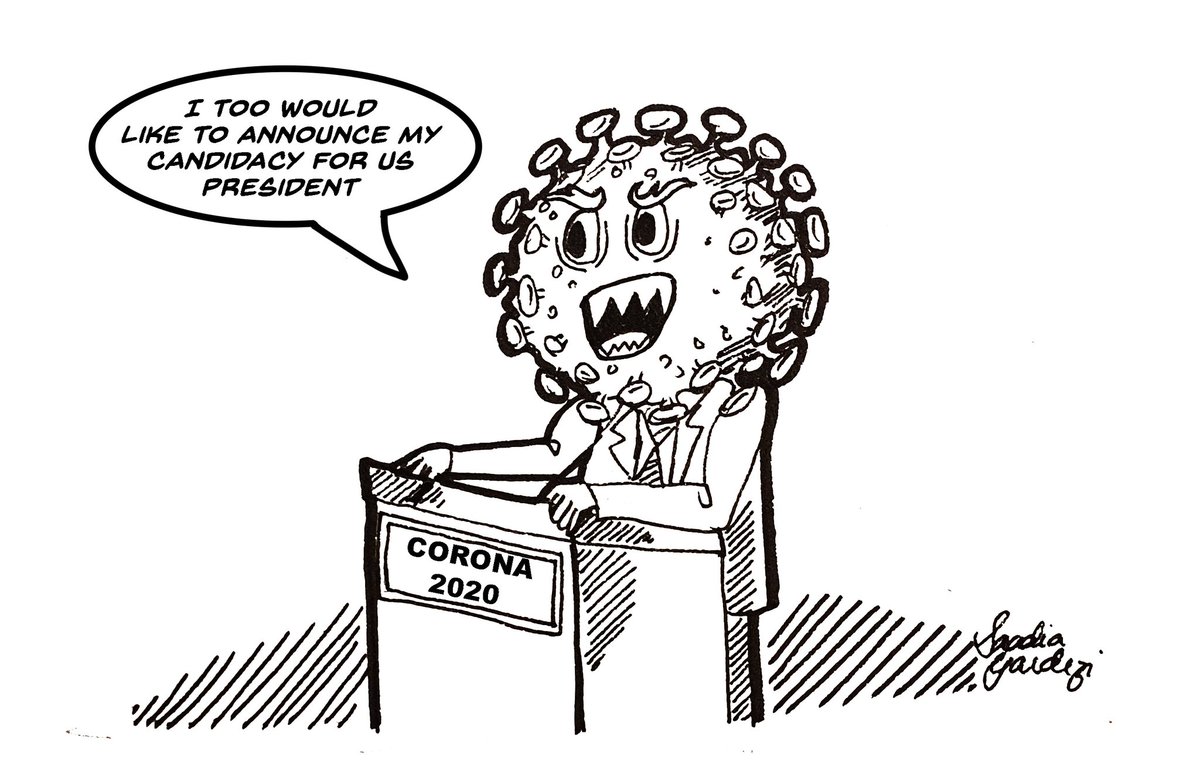


This caricature of the coronavirus is drawn by the cartoonist, Saadia Gardezi, on July 14, 2020 (Photo courtetsy: Saadia Gardezi/Twitter)

Shehzil Malik, one of Pakistan’s most recognizable digital artists, said because so many people were using social media now, it had become the choice platform for many artists, including cartoonists, to try to find an audience.
“There are Pakistani women artists on Twitter with massive followings because they regularly post art on what they’re into — it could be anime or their original characters — and find a fan base,” Malik told Arab News.
Another bonus for women cartoonists and digital artists, she said, was that social media gave them the option to often remain anonymous when speaking about taboo topics like divorce and abuse that often rankle hard-liners and conservatives.
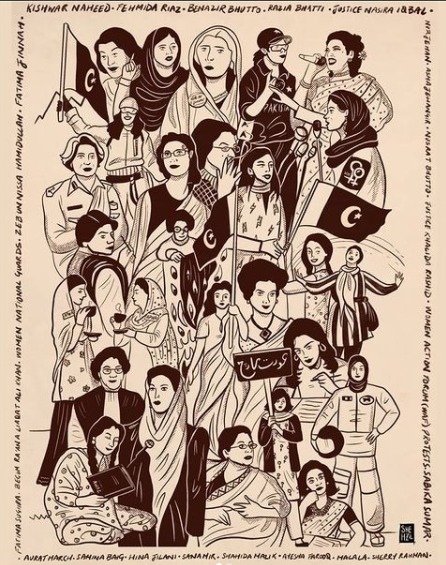


This undated illustration, drawn by Shehzil Malik, shows famous female icons of Pakistan. (Photo courtetsy: Shehzil Malik/Instagram)

“Digital platforms are without traditional gatekeepers like in art circles and galleries,” said Malik. “We [digital artists] don’t have physical spaces to exhibit illustrations or what is thought of as ‘low brow’ or not ‘fine art’.”
But she said this was changing, and social media had helped to “democratize” the field.
Karachi journalist Reem Khurshid, 34, an editorial cartoonist for Dawn, also said social media was an equalizer.
“These platforms did not exist when I was first starting out, everything was much more limited,” Khurshid told Arab News over the phone. “This new digital world allows for building communities within your country, your city, and outside of it. I think it’s been really good in terms of sort of challenging mainstream culture through a feminist perspective.”


This picture shows a cartoon on 'fake news', sketched by Reem Khurshid on December 6, 2020. (Photo courtesy: Dawn)

While Khurshid works in both the print medium and social media, she said “the online is fast becoming the place for cartoons and comics from Pakistan to thrive.”


Pakistan opposition rallies in Khyber Pakhtunkhwa to demand release of Imran Khan

Updated 07 December 2025
Follow

Pakistan opposition rallies in Khyber Pakhtunkhwa to demand release of Imran Khan

  • PTI-led gathering calls the former PM a national hero and demands the release of all political prisoners
  • Government says the opposition failed to draw a large crowd and accuses PTI of damaging its own politics

ISLAMABAD: Pakistan’s opposition led by the Pakistan Tehreek-e-Insaf (PTI) party demanded the release of jailed former prime minister Imran Khan at a rally in the northwestern Khyber Pakhtunkhwa province on Sunday, describing him as a national hero who continues to command public support.

The gathering came days after a rare and strongly worded briefing by the military’s media chief, Lt. Gen. Ahmed Sharif Chaudhry, who dismissed Khan as “narcissistic” and “mentally ill” on Friday while responding to the former premier’s allegations that Pakistan’s chief of defense forces was responsible for undermining the constitution and rule of law.

He said that Khan was promoting an anti-state narrative which had become a national security threat.

The participants of the rally called for “civilian supremacy” and said elected representatives should be treated with respect.

“We, the people of Pakistan, regard Imran Khan as a national hero and the country’s genuinely elected prime minister, chosen by the public in the February 8, 2024 vote,” said a resolution presented at the rally in Peshawar. “We categorically reject and strongly condemn the notion that he or his colleagues pose any kind of threat to national security.”

“We demand immediate justice for Imran Khan, Bushra Bibi and all political prisoners, and call for their prompt release,” it added, referring to Khan’s wife who is also in prison. “No restrictions should be placed on Imran Khan’s meetings with his family, lawyers or political associates.”

Addressing the gathering, Sohail Afridi, the chief minister of Khyber Pakhtunkhwa, denied his administration was not serious about security issues amid increased militant activity. However, he maintained the people of his province had endured the worst of Pakistan’s conflict with militancy and urged a rethinking of long-running security policies.

The resolution asked the federal government to restore bilateral trade and diplomatic channels with Afghanistan, saying improved cross-border ties were essential for the economic stability of the region.

The trade between the two neighbors has suffered as Pakistan accuses the Taliban administration in Kabul of sheltering and facilitating armed groups that it says launch cross-border attacks to target its civilians and security forces. Afghan officials deny the claim.

The two countries have also had deadly border clashes in recent months that have killed dozens of people on both sides.

Some participants of the rally emphasized the restoration of democratic freedoms, judicial independence and space for political reconciliation, calling them necessary to stabilize the country after years of political confrontation.

Reacting to the opposition rally, Information Minister Attaullah Tarrar said the PTI and its allies could not gather enough people.

“In trying to build an anti-army narrative, they have ruined their own politics,” he said, adding that the rally’s reaction to the military’s media chief’s statement reflected “how deeply it had stung.”

“There was neither any argument nor any real response,” he added, referring to what was said by the participants of the rally.