Kuwaiti company to invest in solar and water schemes, cattle breeding in Pakistan’s Sindh

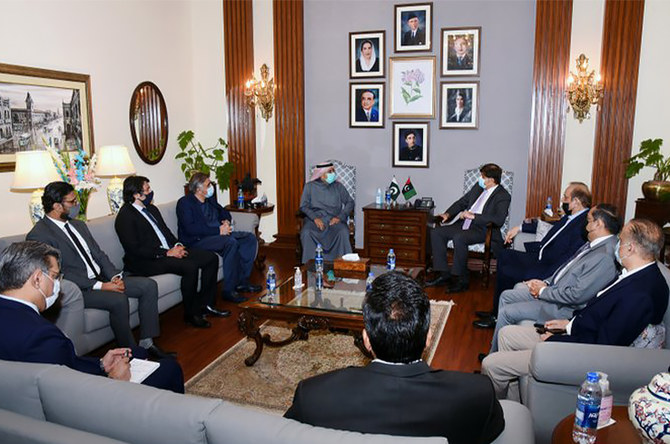
Pakistan’s Sindh Chief Minister, Syed Murad Ali Shah (center right), meets the delegation of Enertech led by its CEO, Abdullah Al Mutairi (center left), at CM House, Sindh, on February 3, 2021. (Photo courtesy: Chief Minister House, Sindh)
Short Url
Updated 04 February 2021
Follow

Kuwaiti company to invest in solar and water schemes, cattle breeding in Pakistan’s Sindh

  • Sindh chief minister meets delegation led by CEO of Kuwaiti state-owned firm EnerTech
  • Company CEO says ready to make direct investments and work on a public-private partnership basis

KARACHI: The CEO of Kuwaiti state-owned firm EnerTech said on Wednesday the firm wanted to invest in Pakistan’s southern Sindh province, especially in the areas of water distribution, solar systems, and cattle breeding for the export of halal meat.
He said this while leading a delegation to meet Sindh Chief Minister Syed Murad Ali Shah, and other energy-related senior Pakistani officials. 
EnerTech is a fully-owned subsidiary of Kuwait’s National Technology Enterprises Company (NTEC).
“Established in 2012, EnerTech’s mission is to initiate its own development projects and participate in projects within the energy, clean technology, recycling, water, waste management and renewable energy sectors,” the company said on its website.
The visiting delegation told the chief minister the firm was interested in working with the provincial government in the water sector.
“Our company would make direct investment and where necessary they would work on PPP [public-private partnership] mode,” CEO Abdullah Al Mutairi was quoted as saying in a statement from the Sindh CM’s office. 
Mutairi thanked the chief minister for giving his company an opportunity to work in Sindh and said his firm was already working in the southwestern Balochistan province. 
Shah said there were multiple opportunities for investment in the Thar desert region, inviting the delegation to visit the area.
He said his government had a comprehensive plan to boost the agriculture sector in the province by installing solar tube wells and introducing calf breeding for export.
“This initiative would be made with the support of the private sector or on a public-private partnership basis,” the CM said, adding that his government was launching a water scheme to provide tap water in different districts of Karachi and calling on the Kuwaiti company to launch a water distribution system in the city.
Currently, much of Karachi’s water needs are met either by the informal private sector or controlled by organized crime.
Shah said the provincial agriculture department had vast cattle farming centers and he would welcome EnerTech to work with the agriculture department to promote and rear new calf breeds for the export of halal meat. 
He also invited the Kuwaiti company to become involved in a project to install solar tube wells in the province.


Pakistan says illegal immigration to Europe down 47 percent amid major crackdown

Updated 6 sec ago
Follow

Pakistan says illegal immigration to Europe down 47 percent amid major crackdown

  • Over 1,700 human smugglers arrested nationwide this year, interior ministry says
  • EU praises Pakistan’s efforts as Brussels, Islamabad agree to deepen cooperation 

ISLAMABAD: Pakistan has achieved a 47 percent drop in illegal immigration to Europe this year, with more than 1,700 human smugglers arrested as part of an expanded nationwide crackdown, the interior ministry said on Thursday. 

The announcement followed Interior Minister Mohsin Naqvi’s meeting in Brussels with European Union Commissioner for Home Affairs and Migration Magnus Brunner, where both sides discussed efforts to curb human smuggling and strengthen migration cooperation.

Pakistan intensified action against illegal migration in 2023 after hundreds of migrants, including 262 Pakistanis, drowned when an overcrowded vessel sank off the Greek town of Pylos, one of the deadliest boat disasters in the Mediterranean. Authorities say they continue to target networks sending citizens abroad through dangerous routes, following heightened scrutiny at airports and a series of arrests involving forged documents.

“Commissioner Magnus Brunner paid strong tribute to the Government of Pakistan for achieving a 47 percent reduction in attempts to reach Europe through illegal ‘dunki’ routes during the past year and described Pakistan’s measures as exemplary,” the interior ministry said in a statement.

“Dunki routes” refer to irregular migration paths used by smugglers to move people across multiple borders toward Europe, the United Kingdom and the United States.

Pakistani authorities say the routes are controlled by transnational criminal networks that also engage in document fraud and other illicit activities.

“Mohsin Naqvi stated that 1,770 human smugglers and their agents have been arrested in Pakistan this year, which clearly reflects the government’s zero-tolerance policy against illegal immigration,” the interior ministry said. 

It added that Pakistan and the EU agreed to coordinate future strategies against illegal immigration, human smuggling and drug trafficking, including deeper information-sharing between law enforcement bodies. Brunner would soon visit Pakistan to acknowledge the country’s efforts and discuss next steps in reducing irregular migration flows, the statement said. 

It also quoted Naqvi as saying that the nexus between smuggling networks, drug mafias and militant groups posed a major challenge to Pakistan and required “international cooperation to confront it.”

Earlier in December, Pakistan announced it would roll out an AI-based immigration screening system in Islamabad from January next year to detect forged travel documents and prevent illegal departures.

In September, Pakistan’s Federal Investigation Agency released a list of more than 100 of the country’s “most wanted” human smugglers as part of its ongoing nationwide operation, identifying major hubs of trafficking activity across Punjab and the capital.