Turkey court tries RSF representative on ‘terror’ charge

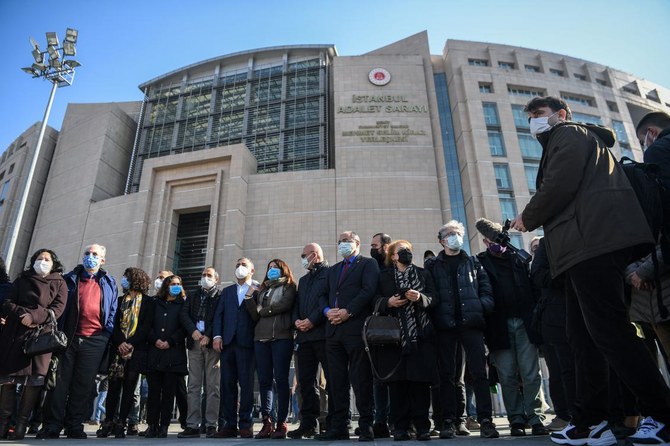
Turkish-French journalist Erol Onderoglu (3R), Reporters Without Borders (RSF) representative in Turkey and activists gather to speak to the press in front of Istanbul's courthouse building on February 3, 2021, before his trial for "terrorist propaganda". (AFP)
Short Url
Updated 03 February 2021
Follow

Turkey court tries RSF representative on ‘terror’ charge

  • RSF’s Turkey representative Erol Onderoglu and his co-defendants each risk being jailed for 14.5 years
  • Onderoglu’s hearing is one of several high-profile trials being watched for signs of whether Erodgan is ready to relent his attacks on dissent

ISTANBUL: Turkey on Wednesday opened the retrial of the country’s Reporters Without Borders (RSF) representative and two other human rights defenders on terror charges that their supporters call “judicial harassment.”
RSF’s Turkey representative Erol Onderoglu and his co-defendants each risk being jailed for 14.5 years for joining a campaign to support a newspaper that was shut in 2016 for having alleged links to outlawed Kurdish militants.
The Ozgur Gundem paper fell victim to a furious crackdown President Recep Erdogan unleashed against opposition media and his political rivals after he survived a failed coup in July 2016.
The 51-year-old Onderoglu is being tried together with journalist Ahmet Nesin and Sebnem Korur Fincanci of the Human Rights Foundation of Turkey.
The three were acquitted of charges of “propagating terrorism” in 2019. An appeals court overturned that ruling last November and ordered a new trial.
Seventeen press freedom and human rights organizations — including the New York-based Committee to Protect Journalists (CPJ) and the London-based PEN International — signed a petition demanding that the charges be dropped.
The retrial “is a dreadful illustration of the witch-hunt waged by President Erdogan’s government against its media critics,” they said in the joint statement.
“The judicial harassment of Erol is part of a broad crackdown on freedom of expression in Turkey,” Article 19 human rights group’s Sarah Clarke said.
Onderoglu told AFP after Wednesday’s opening hearing that the trial will resume in Istanbul on May 6.
“This hearing today is like a sword of Damocles over my head,” he said.
The campaign in support of Ozgur Gundem involved Onderoglu and dozens of others taking turns editing the paper for a day to help it survive Erodgan’s crackdown.
The Turkish-language paper was popular in the country’s large Kurdish community but denied links to militants who have been waging an insurgency against the state since 1984.
Tens of thousands have been jailed in Turkey or stripped of their government jobs during Erdogan’s post-coup crackdown.
The assault on civil liberties has damaged Turkey’s relations with its Western allies and turned Erdogan into a target of constant criticism from rights groups.
Onderoglu’s hearing is one of several high-profile trials being watched for signs of whether Erodgan is ready to relent his attacks on dissent.


Gabon cuts off Facebook, TikTok after protests

Updated 33 sec ago
Follow

Gabon cuts off Facebook, TikTok after protests

Libreville, Gabon: Facebook and TikTok were no longer available in Gabon on Wednesday, AFP journalists said, after regulators said they were suspending social media over national security concerns amid anti-government protests.
Gabon’s media regulator on Tuesday announced the suspension of social media platforms until further notice, saying that online posts were stoking conflict.
The High Authority for Communication imposed “the immediate suspension of social media platforms in Gabon,” its spokesman Jean-Claude Mendome said in a televised statement.
He said “inappropriate, defamatory, hateful, and insulting content” was undermining “human dignity, public morality, the honor of citizens, social cohesion, the stability of the Republic’s institutions, and national security.”
The communications body spokesman also cited the “spread of false information,” “cyberbullying” and “unauthorized disclosure of personal data” as reasons for the decision.
“These actions are likely, in the case of Gabon, to generate social conflict, destabilize the institutions of the Republic, and seriously jeopardize national unity, democratic progress, and achievements,” he added.
The regulator did not specify any social media platforms that would be included in the ban.
But it said “freedom of expression, including freedom of comment and criticism,” remained “a fundamental right enshrined in Gabon.”

‘Climate of fear’

Less than a year after being elected, Gabonese President Brice Oligui Nguema has faced his first wave of social unrest, with teachers on strike and other civil servants threatening to do the same.
School teachers began striking over pay and conditions in December and protests over similar demands have since spread to other public sectors — health, higher education and broadcasting.
Opposition leader Alain-Claude Billie-By-Nze said the social media crackdown imposed “a climate of fear and repression” in the central African state.
In an overnight post on Facebook, he called on civil groups “and all Gabonese people dedicated to freedom to mobilize and block this liberty-destroying excess.”
The last action by teachers took place in 2022 under then president Ali Bongo, whose family ruled the small central African country for 55 years.
Oligui overthrew Bongo in a military coup a few months later and acted on some of the teachers’ concerns, buying calm during the two-year transition period that led up to the presidential election in April 2025.
He won that election with a huge majority, generating high expectations with promises that he would turn the country around and improve living standards.
A wage freeze decided a decade ago by the Bongo government has left teachers struggling to cope with the rising cost of living.
Authorities last month arrested two prominent figures from the teachers’ protest movement, leaving teachers and parents afraid to discuss the strike in public.