

Hundreds of Yemeni patients dial into tele-clinic launched by Pak-Saudi venture

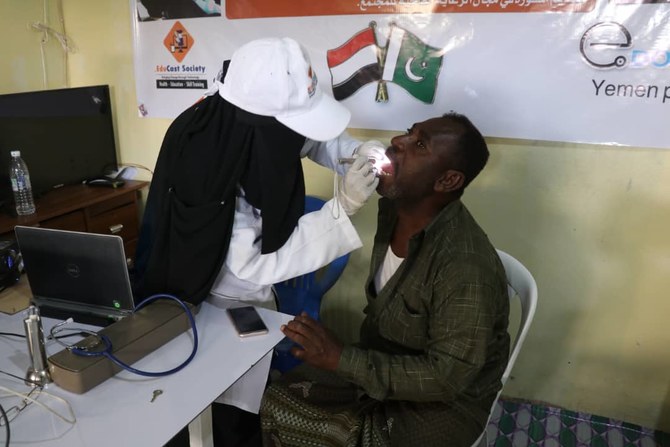
A paramedic at an Educast telemedicine centre examines a patient at a facility in Abyan, Yemen in this undated photo. (Photo courtesy: Educast)
Short Url
Updated 02 February 2021
Follow

Hundreds of Yemeni patients dial into tele-clinic launched by Pak-Saudi venture

  • Educast runs Pakistan’s eDoctor project that re-trains and returns to the health care industry hundreds of Pakistani women doctors who never join the profession or stop practicing 
  • Now, the Pakistani doctors located in over a dozen countries around the world are providing free online consultation at Educast’s Maternal and Child Telecenter in Yemen

KARACHI: Over two hundred patients in the Abyan Governorate of Yemen have visited a pilot telemedicine center in less than one week since its launch by Educast Society, the not-for-profit arm of a Saudi-Pakistan online platform, officials at the company said. 
Educast is an online training and education platform that runs Pakistan’s eDoctor project, launched in 2019 to re-train and return to the health care industry hundreds of Pakistani women doctors who never joined the profession due to family pressure or stopped practicing once they got married or relocated abroad. 

Now, the doctors, located across Pakistan and 15 other countries, including Saudi Arabia, Oman, Qatar, Canada, and the UAE, provide free online consultation at Educast’s Maternal and Child Telecenter in Yemen. 

“Educast ... has established multipurpose telecenters in deeply affected areas of Abyan, Marib and Hadhramaut,” Educast CEO Abdullah Butt told Arab News on Sunday. “The facility, inaugurated on Wednesday, is offering live tele-consultation to women and children through remote Pakistani female doctors using high-tech medical equipment like tele-fetal dopplers, digital stethoscopes, portable ultrasound, live consultation platform, and skin and eye examiners.” 


In this undated photo, women and children attend a consultation session at a newly-inaugurated telemedicine center in the Abyan Governorate of Yemen. (Photo courtesy: Educast)

Maryam Abdullah Saleh Ahmed, an operator nurse at the Yemeni facility, said the clinic had seen an “overwhelming response” since the start of operations.
“We have provided consultancy and treatment to over 200 patients within a week,” Ahmed said. 

The telemedicine clinic in Yemen is linked with a high-tech backup center in Karachi where a go-between, fluent in Arabic and English, coordinates between patients who visit the Yemeni facility and doctors residing in different countries.
Ghulam Mustafa Tabbasum, the Aden-based head of Yemen operations, told Arab News the facility was also focused on mental health, for which a Pakistani doctor living in Canada had been engaged. 
According to the World Health Organization, one in five people living in conflict zones have mental health conditions, ranging from stress, depression, anxiety, post-traumatic stress disorder to psychosis.. 
 
“We will be providing information sessions about post exposure stress syndromes, which would be in the native language for better understanding and greater outcomes,” said Dr. Tayyiba Khan, a mental health specialist based in Calgary. “These information sessions will allow the participants to express their concerns and get answers to their questions as they need to be heard. We will explain the normal responses to war zone stress, psychiatric symptoms, and practical coping strategies.”
 
Midwives are also being trained at the Yemen facility and online teaching offered to local female health workers.

Doctors associated with the program said helping the people of Yemen in this difficult time was an ‘honorable thing.”
 
“Serving poor women in Yemen and providing them and their children health care services is a major achievement,” said Dr. Rehana Din Muhammad, who is based in Muscat, Oman. 
 
“Serving the people of Yemen in their difficult times, when they are passing through a crisis, is an honorable thing to do,” said Dr. Saima Shamim Ahmed, who is based in Dubai. “I feel excited and elated.”

“The war-torn country and its people need our help,” Saudi-based Dr. Mishaal Tanvir said. “I am honored to extend my services.”


Man who filmed viral girl cricketer released after abduction in Pakistan’s tribal region 

Updated 10 sec ago
Follow

Man who filmed viral girl cricketer released after abduction in Pakistan’s tribal region 

  • Video of 10-year-old bowler Aina Wazir drew national praise and sports franchise offer
  • Backlash highlights tensions over girls’ visibility in conservative northwest

PESHAWAR: The man who filmed a viral video of a young girl playing cricket in Pakistan’s tribal North Waziristan has been released after a brief abduction, a local activist said on Saturday, in an incident underscoring lingering tensions over women’s public presence in the conservative northwestern region.

The clip showed 10-year-old Aina Wazir bowling confidently in North Waziristan, a district once dominated by militant groups and long closed to girls’ sports and schooling. The footage spread widely across Pakistani social media this week, prompting praise from users and an offer of support from Pakistan Super League franchise Peshawar Zalmi.

But shortly after the video gained attention, the man who recorded it, Zafran Wazir, was abducted from the remote Tehsil Shewa area on Friday evening, police confirmed.

“The person who made the video has been abducted by unknown persons in the evening [Friday],” the District Police Officer of North Waziristan told Arab News earlier. “The locality is far and hard to reach, and we are trying to recover the missing person.”

Local activist Ibrahim Pashteen, who was involved in efforts to secure his release, said Wazir was freed following mediation.

“He has been released after the involvement of a jirga,” Pashteen told Arab News.

Authorities did not identify the abductors and no group has claimed responsibility.

Zafran also posted a video message on his Facebook page on Friday late evening in which he is seen sitting on the floor of a dimly lit room in which he was purportedly being held.

“She was a minor girl and her bowling impressed, but the video went too viral,” he said in the clip, adding that some people viewed the footage as contrary to religion and Pashtun social customs.

“I am now with unknown persons,” he said. “I have done mistake and will not use social media this way again.”

Residents and activists say public reactions to the video since it surfaced were sharply divided, reflecting conservative social norms among the Pashtuns — an ethnic group dominant in northwest Pakistan whose traditional code of honor places strong restrictions on female public visibility — in a region that only recently emerged from years of insurgency and military operations.

North Waziristan lies along the Afghan border and was for years a stronghold of militant factions who enforced strict social codes, including bans on women’s mobility and recreation. Although security has improved since large-scale military campaigns in the late 2010s, local society remains deeply traditional, particularly regarding girls appearing in public or online.

Meanwhile, Aina’s family has relocated her to another location due to safety concerns, a relative told Arab News on condition of anonymity.

“We have moved Aina Wazir out of Shewa and to a safer place.”

Before the backlash, Peshawar Zalmi owner Javed Afridi had announced on social media that the girl would be included in the franchise’s upcoming women’s league initiative.

“We will ensure she is provided with all necessary cricket equipment and proper facilities so she gets the opportunity she truly deserves to grow and shine,” Afridi wrote on X this week.