New archeological finds made in Egypt/node/1800996/middle-east
New archeological finds made in Egypt
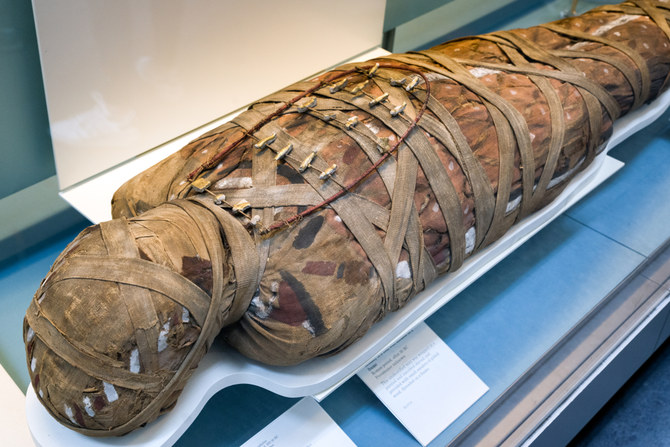
The archaeological team said the most important finds were two mummies that preserved the remains of scrolls and parts of the cartonnage layer. (Shutterstock/File Photo/Illustrative purposes only)
Team said most important finds were two mummies that preserved remains of scrolls and parts of cartonnage layer
Updated 30 January 2021
Mohammed Abu Zaid
CAIRO: The Egyptian-Dominican mission of the Santo Domingo University, headed by Kathleen Martinez and which has been working at the Tabosiris Magna Temple in western Alexandria, has uncovered 16 stone-carved burials.
The mission has revealed several mummies in a poor state of preservation but that nonetheless highlight the characteristics of mummification in Greco-Roman antiquity.
Amulets of gold foil in the form of tongues were placed in the mouths of the mummies as part of a special ritual to ensure the ability of the dead to speak in the other world.
Martinez said the most important finds were two mummies that preserved the remains of scrolls and parts of the cartonnage layer.
The first has remnants of gilding that depict Osiris, god of the other world, while the other wears the Atef crown, decorated with horns and a cobra on the forehead. On the chest is a wide necklace bearing a falcon head, symbol of the deity Horus.
Khaled Abu Al-Hamd, director-general of Alexandria Antiquities, said that during this season, the mission has come across several archaeological finds, the most important of which is a funeral mask for a woman, eight golden flakes, and eight marble masks dating back to classical antiquity.
The items found by the mission in the last 10 years have changed popular perception of the Temple of Tabosiris Magna, where coins bearing the name and image of Queen Cleopatra VII were found.
The foundation panels of the temple suggested it was built by King Ptolemy IV.
Young Palestinian boy drowns in muddy water flooding his Gaza tent camp, UN says
Updated 4 sec ago
JERUSALEM: The UN said Thursday that a Palestinian boy in the Gaza Strip drowned in floods that engulfed his tent camp, with videos showing rescuers trying to pry his body out of muddy waters by pulling him by the ankle. It was the latest sign of the miseries that winter is inflicting on the territory’s population, with many left homeless by the devastation from two years of war. Health officials also reported the death of another 9 year-old boy in Gaza Thursday, but the circumstances were not clear. Meanwhile, in the West Bank, Israeli forces carried out a sweep of arrests, seizing around 50 Palestinians, many from their homes, a Palestinian group representing prisoners said. As 2026 begins, the shaky 12-week-old ceasefire between Israel and Hamas has largely ended large-scale Israeli bombardment of Gaza. But Palestinians are still being killed almost daily by Israeli fire, and the humanitarian crisis shows no signs of abating. At least three Israeli soldiers have died in Gaza since the ceasefire came down, killed by militant attacks or explosive detonations. Young boy drowned from flooding UNICEF said Thursday that 7-year-old Ata Mai had drowned Saturday in severe flooding that engulfed his tent camp in Gaza City. Mai’s was the latest child death reported in Gaza as storms, cold weather and flooding worsen already brutal living conditions. Almost the entire population of more than 2 million people have lost their homes, and most are living in squalid tent camps with little protection from the weather. UNICEF said Mai had been living with his younger siblings and family in a camp of around 40 tents. They lost their mother earlier in the war. Video from Civil Defense teams, shown on Al Jazeera, showed rescue workers trying to get Mai’s body out of what appeared to be a pit filled with muddy water surrounded by wreckage of bombed buildings. The men waded into the water, pulling at the boy’s ankle, the only part of his body visible. Later, the body is shown wrapped in a muddy cloth being loaded into an ambulance. Over past weeks, cold winter rains have repeatedly lashed the sprawling tent cities, causing flooding, turning Gaza’s dirt roads into mud and causing buildings damaged in Israeli bombardment to collapse. UNICEF says at least six children, including Mai, have now died of weather-related causes, including a 4-year-old who died in a building collapse. The Gaza Ministry of Health says three children have died of hypothermia. “Teams visiting displacement camps reported appalling conditions that no child should endure, with many tents blown away or collapsing entirely,” said Edouard Beigbeder, regional director for UNICEF’s Middle East and North Africa division. West Bank arrest raid The Palestinian Prisoner’s Society said Israeli troops had arrested at least 50 Palestinians across the West Bank and interrogated many of them overnight. Most of the arrests occurred in the Ramallah area, said the group, which is an official body within the Palestinian Authority. “These operations were accompanied by widespread raids, abuse and assault against detainees and their families, in addition to extensive acts of vandalism and destruction inside citizens’ homes,” the group alleged. Israel’s military did not immediately comment on the raid. The society says that Israel has arrested 7,000 Palestinians in the West Bank and Jerusalem this year, and 21,000 since the war began Oct. 7, 2023. The number arrested from Gaza is not made public by Israel. Violence in the West Bank has surged during the war in Gaza, with the Israeli military carrying out large-scale operations targeting militants that have killed hundreds of Palestinians and displaced tens of thousands. There has also been a rise in Israeli settler violence and Palestinian attacks on Israelis. Boy in Gaza dies
A nine-year-old boy, Youssef Shandaghi, died in Jabaliya in northern Gaza, not far from the so-called “Yellow Line,” the ceasefire demarcation between the more than half of the Gaza Strip still held by the Israeli military and the rest of the territory, where most of the population lives. Two officials from Gaza’s Shifa Hospital, Director Mohammed Abu Selmiya and Managing Director Rami Mhanna, said the boy was killed by Israeli gunfire coming from across the Yellow Line. Abu Selmiya cited the report from the doctor who received Shandaghi’s body. Israel’s military said it had no knowledge of the incident. But an uncle of the boy said he was killed by unexploded ordnance he had come across while playing. It was not immediately possible to reconcile the conflicting accounts. Israeli troops almost daily open fire on Palestinians who come too close to the Yellow Line, often killing or wounding some, according to medical personnel and witnesses. The Israeli military says it fires warning shots if someone crosses the line and fires at anyone judged to be posing a threat to troops. It has acknowledged some civilians have been killed, including young children. Since the ceasefire began, 416 Palestinians have been killed and 1,142 wounded in Gaza, according to the Health Ministry. The overall Palestinian death toll from the war is at least 71,271. The ministry, which does not distinguish between militants and civilians in its count, is staffed by medical professionals and maintains detailed records viewed as generally reliable by the international community.