EU approves AstraZeneca jab as worries grow over virus strains

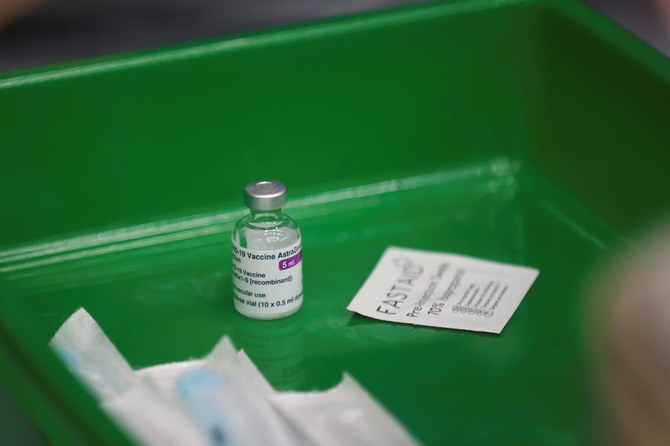
A vial of the AstraZeneca's vaccine for the coronavirus disease (COVID-19) is pictured at the Derby Arena velodrome in Derby, Derbyshire, Britain, January 29, 2021. (Reuters)
Short Url
Updated 29 January 2021
Follow

EU approves AstraZeneca jab as worries grow over virus strains

  • The company admitted it will only be able to deliver a fraction of the doses promised to the EU in the short term
  • That has come as a huge blow to Europe’s already struggling rollout

AMSTERDAM: The European Union on Friday approved the Oxford-AstraZeneca coronavirus vaccine for use on all adults, as concerns grow around the world over the effectiveness of different jabs against new strains of Covid-19.
Brussels’ announcement after a green light from the European Medicines Agency (EMA) marks the third vaccine approved for use in the EU, following the jabs made by Pfizer/BioNTech and Moderna.
The pharma giant’s chief executive Pascal Soriot said approval “underscores the value of AstraZeneca’s Covid-19 vaccine,” noting it is “easy to administer” — with the Pfizer/BioNTech and Moderna alternatives requiring storage at ultra-low temperatures.
But even as she announced the approval, European Commission chief Ursula von der Leyen referred indirectly to a mounting row with AstraZeneca over deliveries of the shots.
“I expect the company to deliver the 400 million doses as agreed,” von der Leyen tweeted.
The British-Swedish company has admitted it will only be able to deliver a fraction of the doses promised to the EU in the short term due to production problems.
That has come as a huge blow to Europe’s already struggling rollout, while setting the EU on a collision course with former member Britain as they jostle for AstraZeneca’s limited supplies.
In a sign of the growing tensions, the EU on Friday released a redacted version of its contract with AstraZeneca, while announcing a mechanism that could allow it to deny the export of vaccines made on European soil.
World Health Organization chief Tedros Adhanom reiterated a warning against “vaccine nationalism,” saying there is “real danger that the very tools that could help to end the pandemic — vaccines — may exacerbate” global inequality.
There is also controversy over the jab within the EU itself, with the EMA saying it was suitable for adults of all ages.
But Germany’s vaccines panel on Friday upheld advice it should not be used on over-65s due to insufficient evidence that it works.
French President Emmanuel Macron also said the AstraZeneca shot appeared “quasi-ineffective” for that age group, while leaving any final decision on its use in the country to health authorities.
Beyond Europe, scientists are concerned that the coronavirus variant first detected in South Africa may elude some vaccines — a potential stumbling block to the global strategy of taming Covid-19 through mass inoculation.
With the global death toll close to 2.2 million, the fight against the pandemic has been further complicated by the emergence of more contagious variants first detected in Britain and Brazil as well as South Africa.
Mozambique’s President Filipe Nyusi has warned that hospitals across southern Africa are “rapidly reaching the limit of their capacities,” in part down to the new variant.
New data on Thursday and Friday showed average effectiveness of 89.3 and 66 percent for shots from American biotech firm Novavax and Johnson & Johnson.
But while Novavax’s jab was highly effective against the British variant, both were less effective against the South African strain.
Johnson & Johnson is quickly expected to apply for a US emergency authorization, and the EMA said it expected an application for use in the EU “shortly.”
Pfizer and Moderna have said their vaccines are effective against the variants.
Citing concerns over the new strains, Germany on Friday said it would ban travel from countries where the variants are prevalent starting this weekend, while Canada announced hotel quarantine for all new arrivals.
“Now is just not the time to be flying,” Prime Minister Justin Trudeau said after airlines agreed to cancel flights to sunbelt destinations until the end of April.
In the EU, Hungary became the first member state to approve the Chinese-made Sinopharm vaccine, saying it had agreed to buy five million doses.
The Chinese “know the most” about Covid-19, Prime Minister Viktor Orban said, adding: “When I choose, I will want the Chinese vaccine.”
Until governments achieve widespread immunity through vaccinations, restrictions such as lockdowns remain among the few options available — but they are deeply unpopular among many.
In France, Prime Minister Jean Castex’s office told AFP he would announce new restrictions after days of speculation about a third lockdown.
Africa’s largest film festival, the Pan-African Festival of Cinema and Television of Ouagadougou, known by its acronym in French of FESPACO, has also had to be postponed due to the pandemic, Burkina Faso’s government said.
And in sport, the Oman Open golf tournament was postponed along with all other sporting events.
But there was good news for New Yorkers as Governor Andrew Cuomo said indoor dining could resume at 25 percent capacity from February 14, just in time for Valentine’s Day.
In Japan, Prime Minister Yoshihide Suga has shrugged off growing doubts over the fate of the Tokyo Olympics — scheduled to start on July 23 — insisting they will go ahead as “proof of mankind’s victory over the virus and as a symbol of global unity.”


Trump takes unconventional approach to communicating to the public about war in Iran

Updated 5 sec ago
Follow

Trump takes unconventional approach to communicating to the public about war in Iran

Typical of an unconventional presidency, the Trump administration waited more than 48 hours to make any live, public communication to the American people about why it had decided to go to war with Iran.
President Donald Trump discussed why he launched the attack prior to a White House ceremony honoring military heroes on Monday but took no questions from reporters. Earlier in the day, Defense Secretary Pete Hegseth and Joint Chiefs of Staff Chairman Dan Caine briefed journalists at the Pentagon.
The two days previous, Trump delivered two pretaped statements that were released on Truth Social, the social media site owned by the president’s media company, and granted telephone interviews to more than a dozen journalists — several of which produced fragmented responses that, to some, clouded as much as they cleared up.
The communications strategy opened Trump to criticism that he hadn’t done enough to explain the rationale and objectives of the war, even as the American military suffered its first casualties. By contrast, Israeli Prime Minister Benjamin Netanyahu, who has teamed with the US against Iran, delivered two statements the day the war began and addressed reporters Monday at the site of a missile attack that killed nine people. The Israeli military has held multiple press briefings each day.
“The American people need a commander in chief, and he has been absent in that role,” Rahm Emanuel, White House chief of staff under President Barack Obama, said on CNN Monday. Emanuel, a Democrat, is contemplating a run for the presidency in 2028.
An unconventional strategy leads to criticism
Peter Baker, chief White House correspondent for The New York Times, wrote on social media that “after Trump launched a new war on Iran, he did not rush back to the White House to make an Oval Office address to rally the nation as other presidents have done. He stayed at Mar-a-Lago to attend a glitzy political fundraiser.”
That post provoked a response from Steven Cheung, White House communications director. “Imagine being a reporter so consumed with Trump Derangement Syndrome that he wants President Trump to mimic the failed policies of the past. The truth is that President Trump spent the majority of his time monitoring the situation in a secure facility, in constant contact with world leaders, and made multiple addresses to the nation that garnered hundreds of millions of views. He also took dozens of calls with reporters.”
The calls included one with Baker’s colleague at The Times, Zolan Kanno-Youngs. Trump’s mobile phone number is known to many of the reporters who cover him, and the president often takes their calls for on-the-spot interviews. Besides The Times, he spoke in the aftermath of the attack to journalists for ABC, CBS, NBC, CNN, CNBC, Fox News Channel, The Atlantic, The Washington Post, Axios, Politico and an Israeli television station.
Most of the calls were brief and marginally illuminating; Politico’s Dasha Burns said Trump answered but said he was too busy to talk. The public couldn’t hear what Trump said in the interviews and was dependent upon what the journalists chose to report on the conversations.
“I spoke to President Trump today and he told me that the operation in Iran is going to go very fast,” Libby Alon, a reporter for Channel 14 News in Israel, wrote about her interview on X. “It’s doing very well, and (will) make the people of Israel very happy, and the people of the world very happy.”
The Times reported that in its six-minute chat, Trump “offered several seemingly contradictory visions of how power might be transferred to a new government — or even whether the existing Iranian power structure would run that government or be overthrown.”
In one of his two conversations with Trump, ABC News’ Jonathan Karl said when he asked about the death of Iranian Ayatollah Ali Khamenei, the president said: “I got him before he got me. They tried twice. Well I got him first.” CNN’s Jake Tapper went on the air minutes after his conversation Monday, saying Trump told him “the big one is coming soon,” an apparent reference to a future attack.
Asked for comment, White House spokeswoman Anna Kelly said: “President Trump is the most transparent and accessible president in American history. The American people have never had a more direct and authentic relationship with a president of the United States than they have with President Trump.”
Hegseth briefing concentrates on friendly reporters
Pentagon reporters learned late Sunday about Hegseth’s briefing. Reporters from The Associated Press, Reuters, ABC, CBS, NBC, CNN, Fox News Channel and Stars & Stripes were permitted into the briefing room, but Hegseth did not call on them. Instead, he took questions from NewsNation and Trump-friendly outlets like the Daily Caller, Daily Wire, One America News and the Christian Broadcasting Network. Most mainstream news outlets left their regular stations at the Pentagon last fall rather than agree to Hegseth’s rules restricting their work.
Hegseth denounced the “foolishness” of people wanting to know details of the operation in advance, such as whether Americans would commit to more than air power, and said the operation would continue as long as it took to achieve objections. He initially ignored NBC News’ Courtney Kube when she called out a question: “President Trump put a four-week time limit on it. Are you saying he’s wrong?”
Later, Hegseth denounced Kube for asking “the typical NBC sort of gotcha-type question. President Trump has all the latitude in the world to talk about how long it might take — four weeks, two weeks, six weeks, it could move up, it could move back. We’re going to execute at his command the objectives he set out to achieve.”
Unlike Pentagon briefings in past administrations, reporters were given assigned seats, with the Trump-friendly outlets seated in front. Jennifer Griffin, Hegseth’s former colleague at Fox News Channel who left the Pentagon with other reporters after not accepting his new rules, was seated in the last row.