

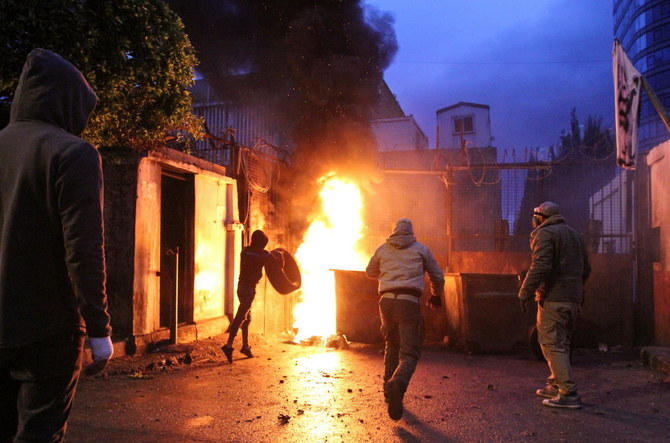

TRIPOLI, Lebanon: Lebanon’s caretaker prime minister and its president on Friday condemned overnight violence in the city of Tripoli, where protesters angry over a strict lockdown clashed with security forces and set the municipality building on fire.
Thursday was the fourth straight night of unrest in one of Lebanon’s poorest cities, after the Beirut government imposed a 24-hour curfew to curb a surge in the COVID-19 pandemic that has killed more than 2,500 people and compounded an economic crisis.
“The criminals who set the municipality on fire and attempted to burn the court...represent a black hatred for Tripoli,” Prime Minister Hassan Diab said in a statement.
“The challenge now is in defeating these criminals by arresting them one by one and referring them to the judicial system.” President Michel Aoun also condemned the violence.
Flames engulfed the Tripoli municipal government building after it caught fire just before midnight on Thursday. Police had been firing tear gas at protesters hurling petrol bombs.
A funeral for a man who died from a gunshot wound on Wednesday night had given fuel to protesters. Security forces said they had fired live rounds to disperse rioters trying to storm the government building.
Diab’s statement did not mention the killing; Human Rights Watch has called for it to be investigated.
“We promise to work quickly to restore the municipality building of Tripoli so that it remains an expression of its dignity and pure heritage,” Diab said.
The lockdown against the coronavirus, in effect since Jan. 11, is piling extra hardship on the poor, now more than half the Lebanese population who get little government aid.
“We are demanding a state, we are demanding a country and we are demanding an improvement to the social and political conditions in Tripoli,” said Rabih Mina, a Tripoli resident who joined the anti-government protests.
The financial meltdown gripping Lebanon could render people more dependent on political factions for aid and security, in a throwback to the 1975-90 civil war era of dominant militias.
Some analysts have warned that security forces, their wages fast losing value, would not be able to contain rising unrest.
Najib Mikati, a billionaire businessmen and former premier who is from Tripoli, warned on Friday that should the army prove unable to control the situation in his city quickly enough, dangerous disorder could set in.
“I may have to carry arms to protect myself and my institutions,” Mikati told local media.
Lebanon has been in the throes of its worst financial crisis since 2019 and anger has escalated into street unrest over the economy, endemic state corruption and political mismanagement.
A currency crash has raised the spectre of widespread hunger but Lebanese leaders have yet to launch a rescue plan or enact reforms to unlock aid, prompting rebukes from foreign donors.
Diab is steering the government in a caretaker role as fractious politicians remain unable to agree on a new government since his quit in the aftermath of the Aug. 4 Beirut port explosion, leaving Lebanon rudderless as poverty spreads.


