

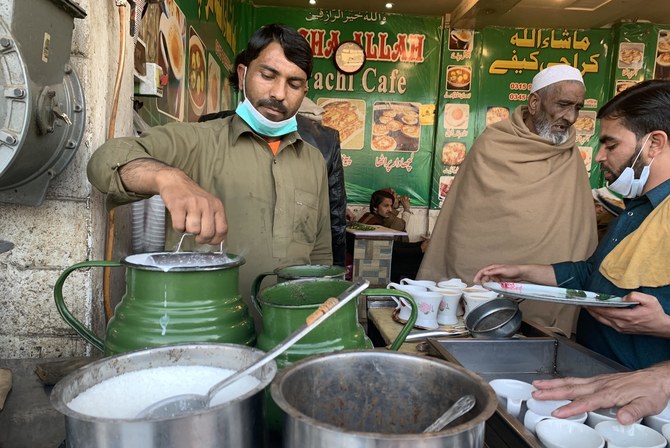

PESHAWAR: In the narrow streets of Peshawar’s historic storyteller’s bazaar, the city’s famed tea stalls have survived the economic onslaught of the pandemic thanks to the coming of a harsh winter, which has sent groups of men thronging to get their hands on a hot cup of tea.
Dozens of tea stalls line Qissa Khwani (storyteller) bazaar in the northwestern city, with men lazing on carpets as they sip tea and talk. The narrow alleyways are the historic site of a 1930 clash between British troops and locals, where hundreds of people are estimated to have been killed on a spring day.
“I don’t have actual data about the tea cups I sell, but approximately, I sell up to 1,000 kettles per day,” Asmat Ullah, who has owned a tea stall in the bazaar for 25 years, told Arab News. Five tea runners and servers work with him from morning to night, serving customers without a break.
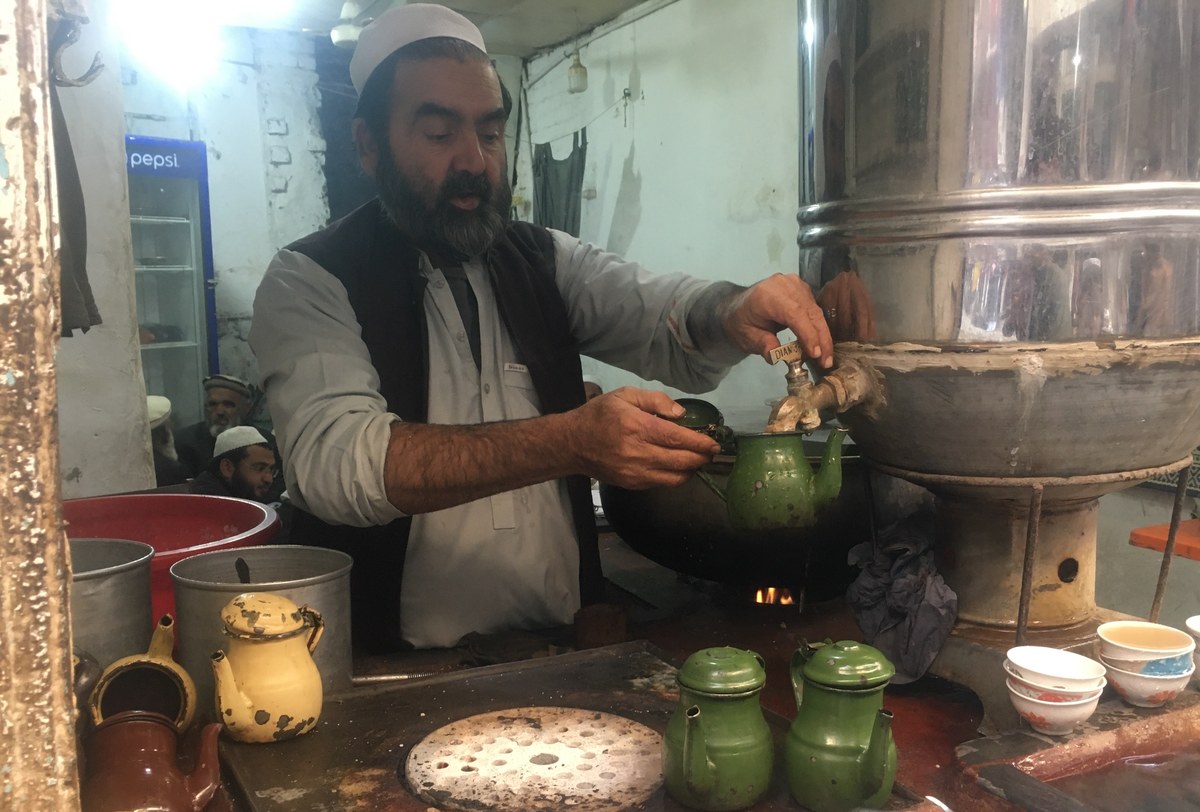
Asmat Ullah making tea at his Peshawar joint in the historic Qissa Khwani (storyteller) bazaar on January 25, 2021. (AN photo)
Here, water boils in metal urns called samovars all day long, as people linger for warmth and a conversation, pushing aside coronavirus fears as cases have surged in the city this month. No business transaction is complete without tea on offer. The stalls stay packed with men, young and old, discussing personal business and politics.
More than 500 tea stalls in Peshawar are registered with an organization called Anjuman Pukhta Chai Faroshan (Organization of Tea Stalls), according to the president of the group, Aman Ullah Khan.
“Hundreds of family economies are related to the business,” Khan said.
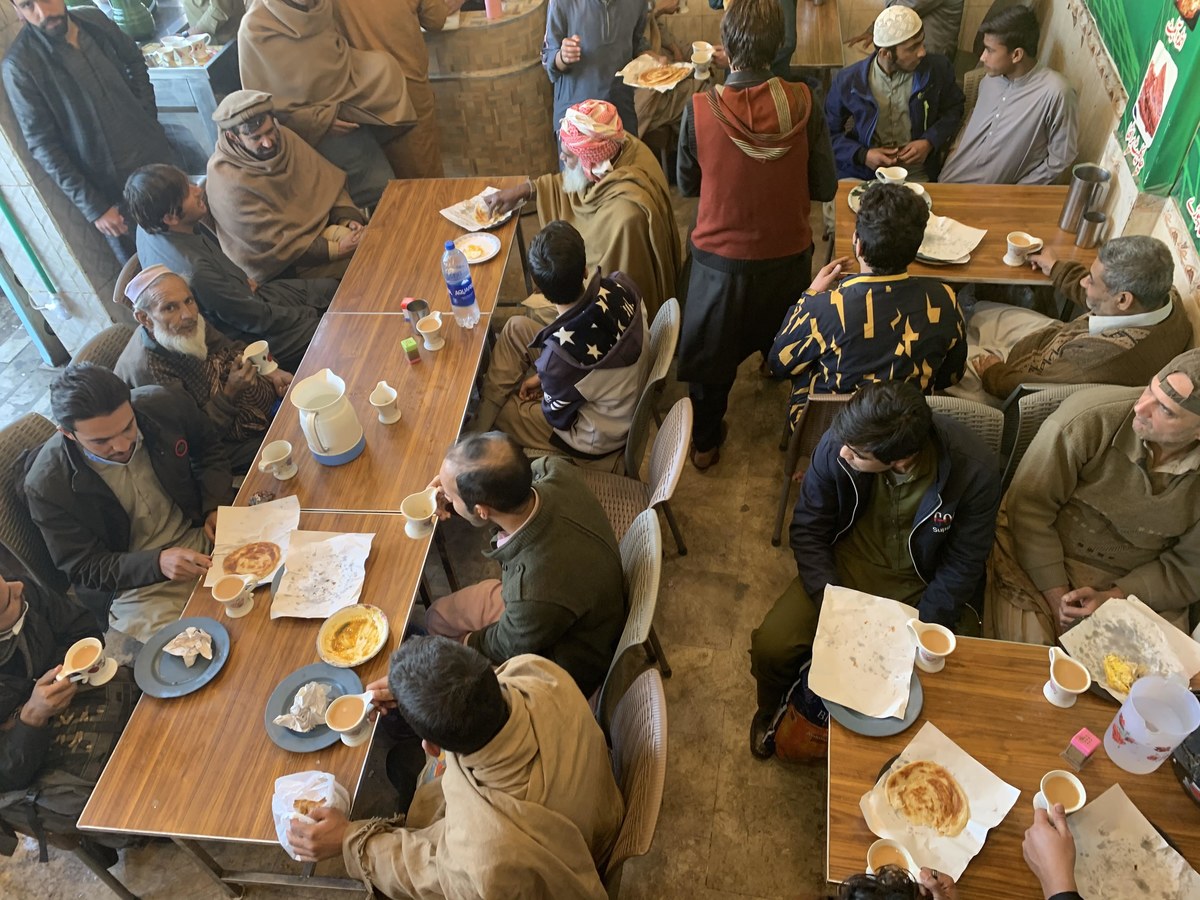
A packed tea stall remain in Peshawar on January 25, 2021. (AN photo)
“We never shut our stalls, they are open year round,” he continued. “But coronavirus lockdowns compelled us to close for the very first time in my 35 years in this business.”
“We were in terrible financial crises, many were unable to pay rent and they lost their tea selling businesses,” he continued.
Despite the winter surge in tea demand, not everybody made it that far into the year.
Tea stall owner Burhan Khan was forced to close down a profitable tea stall in Peshawar cantonment because of failure to pay rent. He now works as a daily wager at a small supermarket cafe.
“Coronavirus changed our fate from very good to very bad,” Khan told Arab News.
“Our tea business was going smoothly, but during lockdown at home, I spent all my savings.”
Earlier this week, Peshawar recorded over half the total fatalities in Khyber Pakhtunkhwa, with the positivity rate at 11.2 percent, the highest in the country, according to a government report.
But the case figures aren’t discouraging people from going out and about.
Sitting with friends at the Mash Allah Karachi Cafe in Hashtnagri Gate, a few minutes down the road from Qissa Khwani Bazaar, Peshawar resident Azlan Khan said he couldn’t go a day without the city’s sweet black tea.
“It’s difficult to spend a day without chai,” Khan smiled.
“Three to four strong cups of Peshawar tea in a day is compulsory to remain fresh.”
The tea making technique is unique. After the water boils, it is put into a customary green kettle, tea and sugar is mixed in, and the kettle is put back on the boil for a few more minutes before it’s served.
“Tea making is as ancient an art in Peshawar as the city is old,” Aman Ullah Khan said. “For centuries, the people of this region are in the tea business and they know how to make the best one.”
The average price of one cup of tea, is Rs20 or $0.12.

Azlan Khan is a regular tea customer at Peshawar’s many tea stalls on January 25, 2021. (AN photo)
“Peshawar water is perfect for tea making,” Said Shah, who has been making tea in the city for eight years, told Arab News.
“There are many varieties including Kashmiri and Coffee Chai, but we only offer Peshawar black tea because thats what the locals prefer,” he said.
Zia-ur-Rahman, a visitor to Peshawar from Batagram, said he had come to the market especially to have Qissa Khwani tea.
“I had read about this story telling bazaar,” he said and smiled as he looked around him.
“I’m amazed to find people still narrate their stories and gossip over a cup of tea.”


