Activists fear 'implementation' problems with northwest province's new domestic abuse law

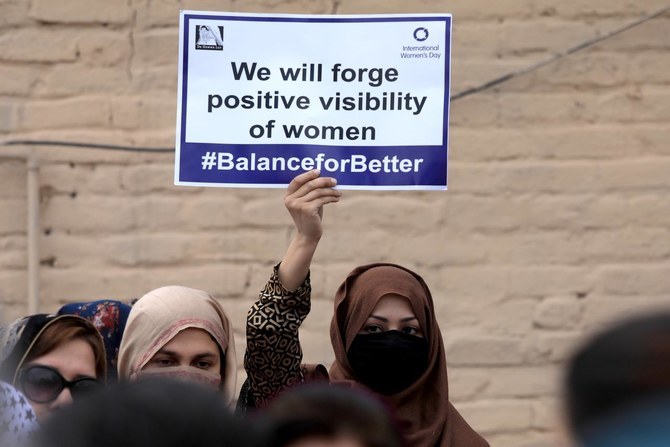
A participant carries a sign during a rally to mark International Women's Day in Peshawar, Pakistan March 8, 2019. (REUTERS)
Short Url
Updated 28 January 2021
Follow

Activists fear 'implementation' problems with northwest province's new domestic abuse law

  • Female provincial lawmakers say the legislation was delayed due to ‘staunch opposition from religious quarters’
  • Women rights activists believe the implementation of the law will be difficult due to the patriarchal mindset in the area 

PESHAWAR: Politicians and women’s rights activists warned on Wednesday that a recently passed bill by the Provincial Assembly of Khyber Pakhtunkhwa (KP) to prevent domestic violence against women could fail to produce the desired result since its implementation would not be easy in the culturally conservative region. 

The bill that was tabled by Social Welfare Minister Hisham Inamullah Khan this month proclaimed that anyone found guilty of committing domestic violence against women would be imprisoned from one to five years and forced to pay certain financial penalty. 

A female lawmaker from the Pakistan Peoples Party (PPP), Nighat Orakzai, told Arab News that KP was the only province that did not have a law against domestic abuse of women since the legislation was “stalled by religious parties.” 

She said that her political faction, along with the Pakistan Muslim League-Nawaz (PML-N) and Awami National Party (ANP), had been working in this direction since 2010. However, they could not get the draft approved “due to staunch opposition from religious quarters.” 

“The crucial phase of the bill is its implementation,” Orakzai added, “since it will be extremely hard if not entirely impossible. I don’t think the sitting government will be able to do it at a time when it is even finding it difficult to pay the salaries of university teachers.” 

Syeda Nudrat, a gender specialist at the provincial social welfare department, said that domestic violence had become a major challenge to the province. 

“More than 5,000 women are living in shelter homes in Khyber Pakhtunkhwa,” she said. “These facilities provide them free food, boarding and lodging. Most of the women arrive in shelter homes with complaints of domestic violence, forced marriages and rapes. We provide them psychological counselling and legal aid.” 

According to the bill, a 10-member protection committee will be formed in every district that will be headed by a female lawmaker and include a gynecologist, psychologist and prayer leader. 

“Each district protection committee shall submit a biannual report to the Chairperson of Provincial Commission on the Status of Women,” according to one of the clauses of the law. 

Noreen Mehsud, a law graduate from South Waziristan tribal district, hoped that the long-awaited bill would help prevent domestic violence against women, though she said there were plenty of hurdles in its effective implementation. 

“We have a male-dominated society where women are thought to have limited rights,” she said. “We should first educate our people, acquaint them with the salient features of the law and then expect positive outcomes.” 

Naila Altaf, a female social activist from Kurram tribal district, agreed with the assessment. 

“This bill will help reduce violence once the government launches an awareness campaign at the grassroots level to educate the masses,” she said. 

According to clause 3 (1) of the bill, no person shall commit, aid and abet any act of domestic violence. 

“Any person, who commits an act pursuant to sub-section (1), shall be deemed to have committed an offense under this Act and shall be liable to be punished for such imprisonment and fine as provided for the said offense in the Pakistan Penal Code, 1860,” it stated. 

Sobia Khan, a female legislator belonging to the PML-N, said that her party, along with the PPP and ANP, had made a huge contribution in getting the bill approved since they managed to build intense pressure on the government. 

“However, its implementation is difficult since we need to educate the society about women’s rights,” she added. “The government needs to work hard to change people’s mindset, put an end to gender discrimination and enhance literacy rate.” 


Pakistan says defense pact with Saudi Arabia elevated brotherly ties to ‘new heights’

Updated 25 February 2026
Follow

Pakistan says defense pact with Saudi Arabia elevated brotherly ties to ‘new heights’

  • Pakistan, Saudi Arabia signed strategic defense pact last year pledging aggression against one will be treated as attack on both
  • Deputy PM Ishaq Dar says enduring bonds with Islamic and Arab nations form vital pillar of Pakistan’s foreign policy 

ISLAMABAD: Deputy Prime Minister Ishaq Dar said on Wednesday that Pakistan’s defense pact with Saudi Arabia elevated its brotherly ties with the Kingdom to “new heights,” stressing that close ties with Arab and Islamic nations form a key pillar of Islamabad’s foreign policy. 

Pakistan and Saudi Arabia signed a Strategic Mutual Defense Agreement on Sept. 17 last year, pledging that aggression against one country would be treated as an attack on both, enhancing joint deterrence and formalizing decades of military and security cooperation.

Both nations agreed in October 2025 to launch an economic cooperation framework to strengthen trade and investment ties. 

“In the Middle East, our landmark Strategic Mutual Defense Agreement with Saudi Arabia has elevated our brotherly ties to new heights,” Dar said while speaking at the Pakistan Governance Forum 2026 event in Islamabad. 

The Pakistani deputy prime minister was speaking on the topic “Navigating International Relations Amidst Changing Geo-Politics.”

Dar noted that Pakistan has reinforced partnerships with other Middle Eastern nations such as the UAE, Qatar, Jordan, Oman, Egypt and Bahrain. He said these partnerships have yielded “concrete agreements” in investment, agriculture, infrastructure, and energy sectors. 

“Our enduring bonds with Islamic and Arab nations form a vital pillar of our foreign policy, and we will continue to expand our partnerships across Asia, Latin America, and Africa,” he said. 

Dar pointed out that the presidents of Kazakhstan, Uzbekistan and Kyrgyzstan have undertaken visits to Pakistan in recent months, reflecting Central Asian nations’ desire to boost cooperation with Islamabad.

On South Asia, the Pakistani deputy PM said Pakistan has successfully transformed its fraternal ties with Bangladesh into “a substantive partnership.”

“Similarly, the trilateral mechanism involving China, Pakistan, and Bangladesh has been launched with a view to expanding and deepening regional cooperation and synergy,” the Pakistani minister said. 

He said Islamabad has strengthened its “all-weather” partnership with China via the second phase of the multi-billion-dollar China-Pakistan Economic Corridor agreement and “unwavering support” from both sides for each other’s core interests. 

Dar said Pakistan had also reinvigorated its partnership with the US, advancing cooperation in trade, technology, investment, and regional stability. 

“This calibrated approach has enhanced our ability to navigate complexity with skill and confidence, ensuring that our national interests are served without compromising our core foreign policy principles,” he said.