

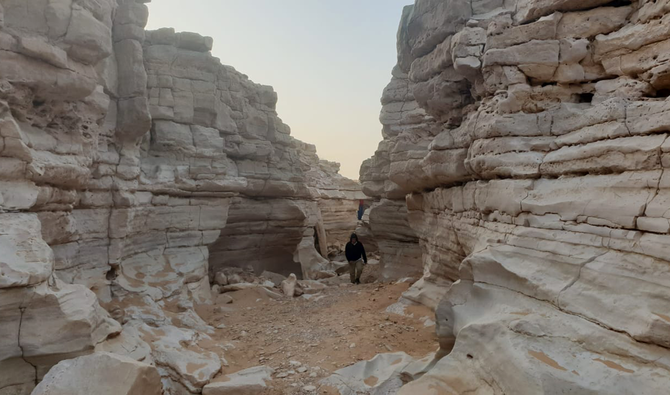


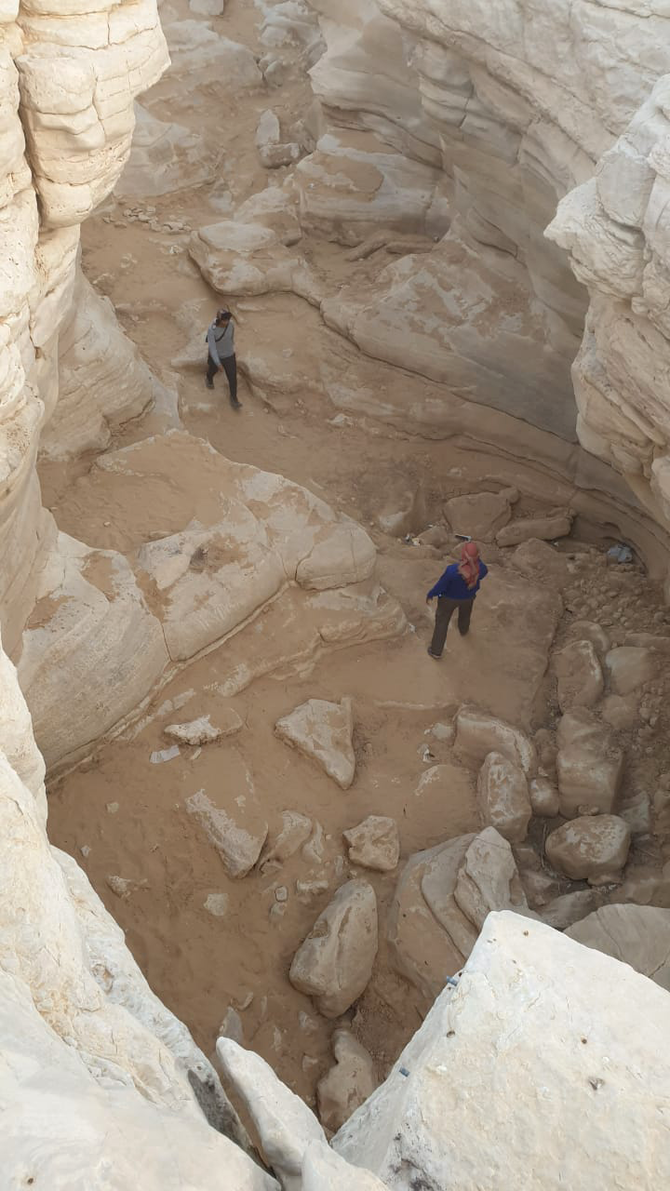


MAKKAH: The hidden Mawan Valley is considered to be one of the most important archaeological sites in Saudi Arabia.
Located near the city of Ad-Dilam, south of Riyadh, it is also an area of stunning natural beauty.
Dr. Abdul Aziz Al-Ghazzi, a history professor and archaeologist, told Arab News: “There are two types of valleys: Ones that cannot be seen from a distance but only by standing at its head, such as Mawan Valley, and those that can be seen from a distance such as Wadi Al-Rummah, Al-Tiri and Al-Shawki.”
The majestic view of the valley consists of two stone structures on both sides. There are also remains of forts and castles and a pair of watchtowers reflect the strategic importance of the area due to its vegetation and water resources.
He said the valley cut west to east through a high plateau and was known for its depth and meanders.
“There are fortifications that are still standing at the main points of the valley. Along the valley there are flowing springs, crests, and bodies of water in solid lands that last for a long period of the year,” he added.
As well as Mawan, several other towns are dotted along the valley. Al-Ghazzi said: “We don’t know whether the town was named after the valley or the other way around. But, for sure, the valley existed before the town. However, the archaeological sites in the valley and on its sides have not yet been studied.”
Dr. Salma bint Mohammed Hawsawi, an associate professor of ancient history at King Saud University, told Arab News: “Archaeological missions revealed that human presence in the region dates back to the Paleolithic Age and the Upper Paleolithic Age — approximately 100,000 years ago.”
She said that Mawan, according to Arabic sources, meant place of shelter and pointed out that numerous Arab tribes, including the Hazzan and Rabi’ah, had lived in the area.
FASTFACTS
• The majestic view of the valley consists of two stone structures on both sides.
• There are also remains of forts and castles and a pair of watchtowers.
• The valley cut west to east through a high plateau and was known for its depth and meanders.
The valley was also mentioned in pre-Islamic Arabic poetry by writers such as Ibn Duraid, Imru’ Al-Qais, and Orwa ibn Al-Ward Al-Absi. “Poets wrote about it and the animals that were in the area, such as camels, zebras, and horses. The poets’ describing fresh water flowing in the area is evidence that humans inhabited it,” Hawsawi said.
Pottery vessels, bracelets, and soapstone (steatite) pots have been found in the area in addition to forts and watchtowers on the valley sides.
“There are two forts built of rocks and mud, and it is clear that the mud was brought from the floor of the valley, and the rocks were cut from the surface of the edge which extends to the south.”
She noted that the fort located in the southern part of the valley was a wall that resembled the Arabic letter “Baa.”
“The foundations of the wall were supported by stone slabs that are 60 to 80 centimeters high cut from the adjacent land. The wall is 6 meters high or even more. The towers are conical in shape, with their centers open to the bottom, and they seemed to be without a roof.
“As for the tower located in the eastern corner, it consists of two floors, each with its own function,” she added.
The building on the northern side consists of a yard surrounded by four connected but irregular walls, which also include a number of towers, she said, adding that some may date back to the first Saudi state.
Hawsawi said the watchtowers were used as observation posts to monitor the area and send military signals to the forts. The defensive fortifications were built to protect the region from foreign invaders.
Arabs used to move from one region to another in search of water, pasture, and stability. The apparent difference in the geographical nature of the Arab countries is the reason for the existence of two types of population: The Bedouins (nomads) lived in the desert, while the Hadaris preferred cities and worked in agriculture, trade, and industry, she added.
“We must preserve these relics to introduce future generations to the cultural heritage of our ancestors,” Hawsawi said.


