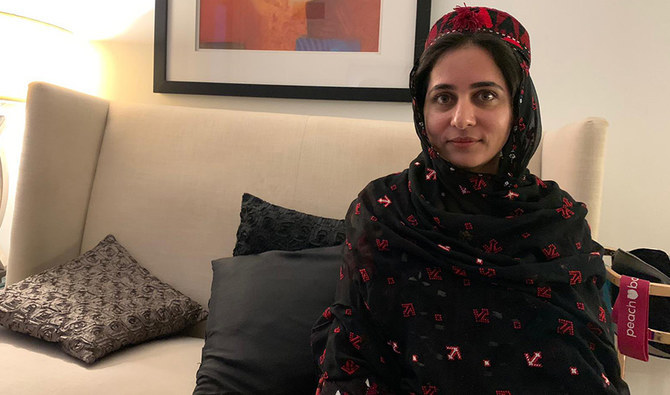
QUETTA: A Pakistani dissident and woman rights activist who died in exile in Canada last month was brought home and laid to rest in her home village in the southwestern Balochistan province under tight security, activists said Monday.
Only the immediate family of 37-year-old Karima Baloch were allowed to attend her funeral on Sunday in the village of Tump in Balochistan.
Her supporters claim troops had sealed off the village and prevented them from attending her burial. Her remains were brought to Pakistan from Canada earlier on Sunday.
There was no immediate comment from the government, but a video that surfaced on social media shows soldiers turning back several mourners who are heard in the footage saying they wanted to pay their last respects to Baloch.
Her body was found on December 22 near Toronto’s downtown waterfront, a place that she liked and often visited, a day after she was reported missing. Toronto police have not treated her death as suspicious though there were allegations by her supporters that she was killed. They have offered no evidence to support their claims.
A fierce critic of Pakistani security agencies, Baloch was granted asylum in Canada in 2016. Her death has raised suspicions among rights activists, who on Monday denounced authorities for holding the funeral in near secrecy.
“It is not difficult to understand how this will deepen the divide and fuel separatism,” Mohsin Dawar, a lawmaker from Pakistan’s former tribal regions who campaigns for Pashtun minority rights, tweeted.
Angered over the situation, a Baloch nationalist group — the Baloch Solidarity Committee — issued a call for a daylong strike and complete shutdown in Baluchistan on Monday. On Sunday, hundreds of Baluch activists rallied in Karachi, demanding justice for Baloch, who they say was a “voice of the Baloch people” that was “silenced.” The activists insisted she did not die a natural death though they offered no evidence to support their allegation.
Balochistan has for years been the scene of a low-level insurgency by small separatist groups and nationalists who complain of discrimination and demand a fairer share of their province’s resources and wealth. The Pakistani state denies these allegations.


Baloch activist who died in exile in Canada buried in Pakistan amid high security
https://arab.news/ysjwh
Baloch activist who died in exile in Canada buried in Pakistan amid high security

- Karima Baloch’s body was found on December 22 near Toronto’s downtown waterfront a day after she was reported missing
- Toronto police have not treated her death as suspicious, her supporters say she was killed but have provided no evidence for their claims

Pakistan to begin first phase of Hajj 2026 trainings from today
- Training programs to be held in phases across Pakistan till February, says religion ministry
- Saudi Arabia allocated Pakistan a total quota of 179,210 pilgrims for Hajj 2026
ISLAMABAD: Pakistan’s religious affairs ministry has said that it will begin the first phase of mandatory Hajj 2026 training for pilgrims intending to perform the pilgrimage from today, Thursday.
The one-day Hajj training programs will be held in phases across the country at the tehsil level until February. The ministry directed intending pilgrims to bring their original identity cards and the computerized receipt of their Hajj application to attend the training sessions.
“Pilgrims should attend the one-day training program according to their scheduled date,” Pakistan’s Ministry of Religious Affairs (MoRA) said in a statement.
The ministry said training schedules are being shared through the government’s Pak Hajj 2026 mobile application as well as via SMS. It added that details of the schedule are also available on its website.
According to the ministry, training programs will be held in Abbottabad on Jan. 2; Ghotki, Thatta and Kotli on Jan. 3; and Tando Muhammad Khan and Khairpur on Jan. 4.
Hajj training sessions will be held in Rawalakot, Badin and Naushahro Feroze on Jan. 5, while pilgrims in Fateh Jang, Dadu and Tharparkar will receive the training on Jan. 6.
The ministry said training programs will be conducted in Umerkot and Larkana on Jan. 7, followed by sessions in Mirpurkhas, Shahdadkot and Mansehra on Jan. 8.
Pakistan’s religious affairs ministry has previously said these trainings will be conducted by experienced trainers and scholars using multimedia.
It said the training has been made mandatory to ensure that intending pilgrims are fully aware of Hajj rituals and administrative procedures.
Saudi Arabia has allocated Pakistan a quota of 179,210 pilgrims for Hajj 2026, of which around 118,000 seats have been reserved under the government scheme, while the remainder will be allocated to private tour operators.
Under Pakistan’s Hajj scheme, the estimated cost of the government package ranges from Rs1,150,000 to Rs1,250,000 ($4,049.93 to $4,236), subject to final agreements with service providers.


