

Oxford University to test potential COVID-19 ‘wonder drug’ Ivermectin

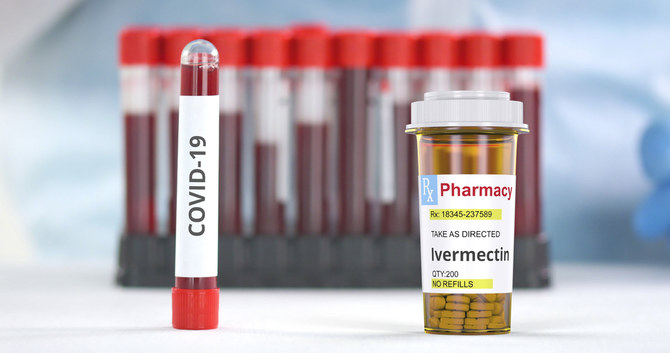
The trial is assessing Ivermectin, a medicine used on livestock and people who have been infected by parasitic worms, which has been hailed by some as a “wonder drug” with the potential to save thousands of lives. (Shutterstock/File Photo)
Short Url
Updated 23 January 2021
Follow

Oxford University to test potential COVID-19 ‘wonder drug’ Ivermectin

  • Medicine used for parasitic worm infections
  • Other scientists said the drug had not been assessed properly

LONDON: Oxford University researchers are planning to trial a drug that has shown signs of reducing COVID-19 deaths in developing countries.

The Principle trial is aiming to find a drug that works soon after virus symptoms appear in a patient, and one that is most effective during the primary stages of the illness, The Times reported.

The trial is assessing Ivermectin, a medicine used on livestock and people who have been infected by parasitic worms, which has been hailed by some as a “wonder drug” with the potential to save thousands of lives, the report added.

Other scientists said the drug had not been assessed properly and that the full extent of its efficacy was not yet known.

“It has potential antiviral properties and anti-inflammatory properties and there have been quite a few smaller trials conducted in low and middle- income countries, showing that it speeds recovery, reduces inflammation and reduces hospitalisation,” said Chris Butler, professor of primary care at Oxford and co-chief of the Principle trial. “But there’s a gap in the data. There’s not been a really rigorous trial.”

The medicine works by blocking the entry of a protein into a cell’s nuclei, limiting the replication capacity of the virus, and initial analysis from the World Health Organization has shown promising signs.

“It could save thousands of lives a day,” said Paul Marik, from the Eastern Virginia Medical School. “The data is compelling: across Mexico, India and South America, mortality has fallen.”

Peter Horby, the Oxford University professor who helped to set up the UK’s largest COVID-19 trials, said this month the latest data was “interesting, perhaps encouraging, but not yet convincing.”

Most breakthroughs in coronavirus treatments to date work on patients who are already suffering in the later stages of the illness, but Butler and his team are hoping to find a medicine that can prevent the virus from taking hold within its host.

The trial is looking for people aged 65 and over, or those aged over 50 who have underlying health conditions, through general practitioners, online, and through the UK’s NHS Test and Trace system, The Times said.


SpaceX acquires xAI in record-setting deal as Musk looks to unify AI and space ambitions

Updated 7 sec ago
Follow

SpaceX acquires xAI in record-setting deal as Musk looks to unify AI and space ambitions

  • The deal is the biggest M&A transaction of all time
  • Deal values xAI at $250 billion, SpaceX at $1 trillion

Elon Musk said on Monday ​that SpaceX has acquired his artificial-intelligence startup xAI in a record-setting deal that unifies Musk’s AI and space ambitions by combining the rocket-and-satellite company with the maker of the Grok chatbot. The deal, first reported by Reuters last week, represents one of the most ambitious tie-ups in the technology sector yet, combining a space-and-defense contractor with a fast-growing AI developer whose costs are largely driven by chips, data centers and energy. It could also bolster SpaceX’s data-center ambitions as Musk competes with rivals like Alphabet’s Google, Meta, Amazon-backed Anthropic ‌and OpenAI in the ‌AI sector.
The transaction values SpaceX at $1 trillion, and ‌xAI ⁠at $250 ​billion, according ‌to a person familiar with the matter.
“This marks not just the next chapter, but the next book in SpaceX and xAI’s mission: scaling to make a sentient sun to understand the Universe and extend the light of consciousness to the stars!” Musk said. The purchase of xAI sets a new record for the world’s largest M&A deal, a distinction held for more than 25 years when Vodafone bought Germany’s Mannesmann in a hostile takeover valued at $203 billion ⁠in 2000, according to data compiled by LSEG. The combined company of SpaceX and xAI is expected to price shares ‌at about $527 each, another person familiar with the matter said. ‍SpaceX was already the world’s most ‍valuable privately held company, last valued at $800 billion in a recent insider share sale. ‍XAI was last valued at $230 billion in November, according to the Wall Street Journal. The merger comes as the space company plans a blockbuster public offering this year that could value it at over $1.5 trillion, two people familiar with the matter said.
SpaceX, xAI and Musk did not immediately respond ​to requests for comment.
The deal further consolidates Musk’s far-flung business empire and fortunes into a tighter, mutually reinforcing ecosystem – what some investors and analysts informally ⁠call the “Muskonomy” – which already includes Tesla, brain-chip maker Neuralink and tunnel firm the Boring Company. The world’s richest man has a history of merging his ventures together. Musk folded social media platform X into xAI through a share swap last year, giving the AI startup access to the platform’s data and distribution. In 2016, he used Tesla’s stock to buy his solar-energy company SolarCity.
The agreement could draw scrutiny from regulators and investors over governance, valuation and conflicts of interest given Musk’s overlapping leadership roles across multiple firms, as well as the potential movement of engineers, proprietary technology and contracts between entities.
SpaceX also holds billions of dollars in federal contracts with NASA, the Department of Defense and intelligence agencies, which all have some authority ‌to review M&A transactions for national security and other risks.