

Pakistan expects to save about $8 million on LNG procurement

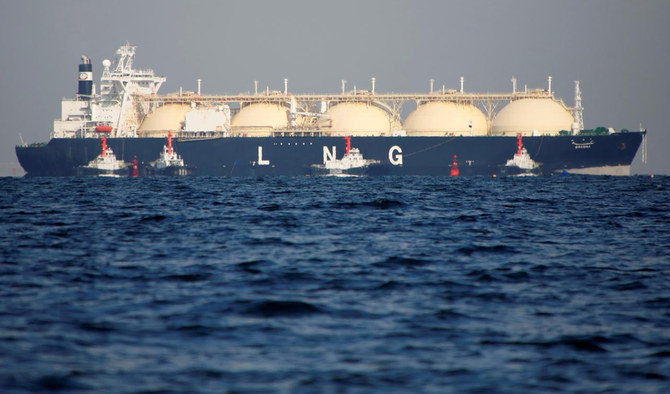
A liquefied natural gas (LNG) tanker is tugged towards a thermal power station in Futtsu, east of Tokyo on Nov. 13, 2017. (REUTERS/File)
Short Url
Updated 02 March 2021
Follow

Pakistan expects to save about $8 million on LNG procurement

  • Energy experts believe the country should secure long-term contracts with foreign companies to ensure continuity of economic activities
  • Pakistan’s energy managers need to understand the dynamics of LNG trading, say experts

KARACHI: Pakistan expects to save about $8 million by importing low-cost liquefied natural gas (LNG) after Dubai’s Emirates National Oil Company Limited (ENOC) defaulted on its supply commitment last week, a senior official confirmed while talking to Arab News on Saturday. 

Pakistan LNG Limited (PLL), a state-owned entity that procures and imports the commodity, said on Friday it had arranged one more LNG cargo at low price for the month of February by floating an urgent tender. 

“The price is approximately 22% lower than the price of the bidder that withdrew its bid earlier,” said the PLL statement. 

Pakistan is expected to benefit from the situation since it may be able to save around $8 million on the cargo, according to a senior PLL official. “We will know the actual price after Brent of January is closed,” the official, who declined to be named, said. 

Last week, ENOC refused to deliver the cargo when spot LNG prices increased to an all-time high of $32.50 per mmbtu from an all-time low of $1.825 per mmbtu in April 2020. The prices cooled down this week, however, after Japan, China and South Korean reduced their procurements from the spot market.

The spot LNG market rates now hover around $6 per mmbtu which is 12 percent of Brent for April contracts.

“Japan, China and South Korea have procured what they wanted,” said Muhammad Riazuddin, former CEO of the Khyber Pakhtunkhwa Oil and Gas Company Limited. “What is left in the market is the residue, which is why the prices are dropping.” 

Pakistan faces gas shortages in winter due to its growing demand. This is usually managed by diverting the supplies to domestic consumers from industries, fueling stations and captive power plants. Experts believe, however, that only long-term contracts can provide viable solution to the problem.

“The government should realize the gravity of the situation and try to secure long-term contracts with companies,” Riazuddin said. “The price is only one dimension of the problem. A bigger consideration relates to the working of industry and economy that cannot be imperiled.” 

“Countries cannot just rely on spot market which is about 10-12 percent of the bulk market,” he continued, adding: “Pakistan’s energy managers need better understanding of the dynamics of LNG trading.”


Pakistan destroyed seven TTP camps in Afghanistan strikes, 80 militants killed — official

Updated 5 sec ago
Follow

Pakistan destroyed seven TTP camps in Afghanistan strikes, 80 militants killed — official

  • Saturday’s airstrikes followed a series of attacks inside Pakistan amid a surge in militancy
  • The Afghan Taliban authorities accuse Pakistani forces of killing civilians in the airstrikes

ISLAMABAD: Pakistan’s airstrikes in Afghanistan destroyed seven Tehreek-e-Taliban Pakistan (TTP) camps and killed over 80 militants, a Pakistani security official said on Sunday, with the Afghan Taliban accusing Pakistani forces of killing civilians in the assault.

Saturday’s airstrikes followed a series of attacks inside Pakistan amid a surge in militancy. Authorities say the attacks, particularly in Khyber Pakhtunkhwa province and the Pakistani capital of Islamabad, were carried out by the TTP and allied groups that Islamabad alleges are operating from sanctuaries in Afghanistan. Kabul denies this.

According to Pakistan’s information ministry, recent incidents included a suicide bombing at a Shiite mosque in Islamabad, separate attacks in Bajaur and Bannu, and another recent incident in Bannu during the holy month of Ramadan, which started earlier this week. The government said it had “conclusive evidence” linking the attacks to militants directed by leadership based in Afghanistan.

“Last night, Pakistan’s intelligence-based air strikes destroyed seven centers of Fitna Al-Khawarij TTP in three provinces of Nangarhar, Paktika and Khost, in which more than eighty Khawarij (TTP militants) have been confirmed killed, while more are expected,” a Pakistani security official, who spoke on condition of anonymity, told Arab News.

An earlier statement from Pakistan’s information ministry said the targets included a camp of a Daesh regional affiliate, the Islamic State Khorasan Province (ISKP), which claimed a suicide bombing at an Islamabad Shiite mosque that killed 32 people this month.

In an X post, Afghan government spokesperson Zabihullah Mujahid said Pakistani forces had violated Afghan territory.

“Pakistani special military circles have once again trespassed into Afghan territory,” Mujahid said. “Last night, they bombed our civilian compatriots in Nangarhar and Paktika provinces, martyring and wounding dozens of people, including women and children.”
 
The Afghan Taliban’s claims of civilian casualties could not be independently verified. Pakistan did not immediately comment on the allegation that civilians had been killed in the strikes.

In a post on X, Afghanistan’s foreign ministry said it had summoned Pakistan’s charge d’affaires to Afghanistan Ubaid-ur-Rehman Nizamani and lodged protest through a formal démarche in response to the Pakistani military strikes.

“IEA-MoFA (The Islamic Emirate of Afghanistan’s Ministry of Foreign Affairs) vehemently condemns the violation of Afghanistan’s airspace and the targeting of civilians, describing it as a flagrant breach of Afghanistan’s territorial integrity & a provocative action,” it said in a statement.

“The Pakistani side was also categorically informed that safeguarding Afghanistan’s territorial integrity is the religious responsibility of the Islamic Emirate of Afghanistan; henceforth, the responsibility for any adverse consequences of such actions will rest with the opposing side.”

Tensions between Islamabad and Kabul have escalated since the Afghan Taliban returned to power in 2021. Pakistan says cross-border militant attacks have increased since then and has accused the Taliban of failing to honor commitments under the 2020 Doha Agreement to prevent Afghan soil from being used for attacks against other countries. The Taliban deny allowing such activity and have previously rejected similar accusations.

Saturday’s exchange of accusations marks one of the most direct confrontations between the two neighbors in recent months and risks further straining already fragile ties along the volatile border.