

Pakistani journalists blame 'nexus' between government, media owners for censorship, layoffs

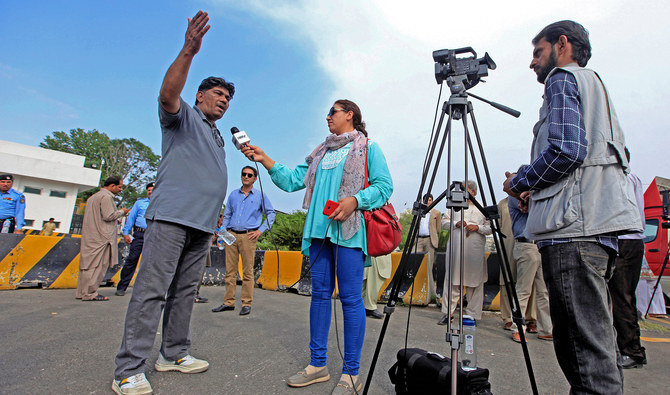
Journalists work during a demonstration to mark World Press Freedom Day in Islamabad on May 3, 2018. (REUTERS/File)
Short Url
Updated 23 January 2021
Follow

Pakistani journalists blame 'nexus' between government, media owners for censorship, layoffs

  • The government has denied allegations of any 'unholy alliance' with media owners
  • Media owners say the layoffs are part of ‘cost cutting’ decisions in the face of dwindling advertisement revenues

ISLAMABAD: An association of Pakistani journalists has announced a protest march on Islamabad in the first week of April to “force the government and media owners” to protect the rights of media workers and respect their freedom of expression. 

Journalists and rights groups say the government’s relations with the press have become strained since Prime Minister Imran Khan took office in 2018. The ruling Pakistan Tehreek-e-Insaf (PTI) administration denies that it censors the media. 

Journalists complain that editors and producers are not only forced to suppress opposition voices but also prevented from running critical content against the country's civil and military leadership. 

Many of them accuse the authorities of hindering the transmission and circulation of recalcitrant news channels and publications, saying the media outlets that refuse to play the official game begin to face problems with their advertisement revenues. 

The Pakistan Federal Union of Journalists (PFUJ) said in a statement on Sunday that newspapers and channels across the country had sacked more than 8,000 media workers in the last three years. Media owners defend such measures as “cost cutting” measures in response to a reduction in their revenues. 

“The anti-worker alliance and nexus between the government and the media industry owners is causing censorship and mass layoffs,” Shahzada Zulfiqar, PFUJ president, told Arab News on Thursday. 

He said that journalists would press the government to ensure full implementation of the country’s labor laws to protect their rights by staging a sit-in in front of the Parliament House in April. 

“The media owners have surrendered their independence to the government as part of an unholy alliance to violate labor laws and sack journalists with impunity,” he added. 

However, media owners reject the allegations, saying that the news industry works independently and follow all relevant laws of the country. 

“No such nexus exists between the government and media owners,” Shakeel Masud Hussain, secretary-general of Pakistan Broadcasters Association, told Arab News. 

He continued that the revenue of media organizations had significantly declined due to the COVID-19 pandemic and about Rs3 billion of advertisement revenue was pending with the government. 

“Journalists aren’t laid off under any specific plan,” he said. “This is a cost cutting measure as our revenues have shrunk due to the pandemic." 

Pakistan ranked 145th out of 180 countries on the World Press Freedom Index released by Reporters Sans Frontières (RSF) in April last year. 

Arif Nizami, president of the Council of Pakistan Newspapers Editors, endorsed the PFUJ demand of timely disbursement of salaries to journalists and protection of their rights under the country’s labor laws. 

“The government has devised a centralized media policy which means that it gives ads to its favorite news organizations, and this often leads to undeclared censorship as well,” he told Arab News. 

However, he maintained that only those media organizations were complicit “who have other businesses to protect.” 

“We fully support the genuine demands of working journalists and are ready to sit with them to resolve their issues,” Nizami said. 

However, the government said it was already “cognizant of the problems of working journalists” and blamed them on “the coercive policies of some media houses.” 

“The PTI administration does not have an ‘unholy alliance’ with media owners,” Faisal Javed Khan, who heads Senate Standing Committee on Information and Broadcasting, told Arab News. “This can be judged by the fact that our government initiated the process of bringing much needed changes in the media policies after coming into power to ensure safety of journalists and their job protection.” 

He added that he had personally tabled a bill in the Senate to improve the working of the local media industry. 

Meanwhile, the PFUJ president said that journalists would present a charter of demand to the government to ensure press freedom and job security for workers. 

“We are responsible and accountable [for our work], but we aren’t ready to compromise on freedom of press and freedom of expression,” Zulfiqar said. 


Nearly 25% of Pakistan’s primary schools enrolling girls operate as single-teacher ones— report

Updated 13 sec ago
Follow

Nearly 25% of Pakistan’s primary schools enrolling girls operate as single-teacher ones— report

  • Pakistan needs over 115,000 more teachers in primary schools enrolling girls to meet global benchmark of one teacher per 30 students, says report
  • Sixty percent of Pakistani primary schools enrolling girls are overcrowded, while 32% lack clean drinking water or toilets, says Tabadlab report

ISLAMABAD: Nearly 25% of Pakistan’s primary schools that enrolls girls operate as single-teacher ones, a report by a leading think tank said this week, calling on the government to devolve teacher recruitment powers, upskill underutilized teachers and introduce reforms to hire and promote faculty members. 

Pakistan faces an acute education crisis which is reflected in the fact that it has the world’s second-highest number of out-of-school children, an estimated 22.8 million aged 5-16 who are not in educational institutions, according to UNICEF. 

While poverty remains the biggest factor keeping children out of classrooms, Pakistan’s education crisis is exacerbated by inadequate infrastructure and underqualified teachers, cultural barriers and the impacts of frequently occurring natural disasters. 

According to “The Missing Ustaani,” a report published by Islamabad-based think tank Tabadlab and supported by Malala Fund and the Pakistan Institute of Education (PIE), Pakistan needs over 115,000 more teachers in primary schools with girls’ enrolment to meet the basic international benchmark of ensuring one teacher per 30 children. Currently, the average Student-to-Teacher Ratio (STR) across Pakistan’s primary schools with girls’ enrolment is 39:1, it said. 

“Approximately 60% of these schools are overcrowded, necessitating the recruitment of over 115,000 additional teachers nationwide,” the report said on Monday. “Compounding this, nearly 25% of primary schools with girls’ enrolment operate as single-teacher schools, placing immense pressure on the quality of education.”

It said the situation is more dire in Pakistan’s poverty-stricken southwestern Balochistan province, where nearly 52% of the schools are single-teacher only ones while the percentage decreases slightly in the southern Sindh province to 51 percent. 

The report said while the STR improves to 25:1 at the middle school level, acute shortages of subject specialists emerge as the top-priority concern for quality education in these schools.

“Furthermore, around 32% of primary schools with girls’ enrolment and 18% of middle schools face ‘critical infrastructural shortages’— lacking clean drinking water or toilets in addition to high STRs— which significantly affects girls’ attendance and learning, particularly during adolescence,” the report said. 

The report cited a set of priority recommendations to address Pakistan’s systemic teacher deployment challenges and improve educational equity for girls. 

It urged the government to devolve recruitment authority to school or cluster levels to enable timely, context-specific hiring. It also called upon authorities to reform teacher transfer and promotion policies to introduce school-specific postings with minimum service terms. 

This, it said, would reduce arbitrary transfers and improving continuity in classrooms. The report advised authorities to upskill surplus or underutilized primary teachers to support instruction at the middle school level, helping address subject-specialist shortages.

“Together, these reforms offer a pathway toward a more equitable, efficient, and responsive teaching workforce— one capable of improving learning outcomes and ensuring that every girl in Pakistan has access to a qualified teacher,” the report said. 

To tackle Pakistan’s education crisis, Prime Minister Shehbaz Sharif declared an ‘education emeregency’ in September 2024, stressing the importance of education for all.