

Saudi military acknowledges Pakistan's role for regional stability

A Pakistan Navy ship Aslat fires rounds during the multinational naval exercises 'AMAN-19' in the Arabian Sea near Pakistan's port city of Karachi on February 11, 2019. ( AFP/ File Photo)
Short Url
Updated 23 January 2021
Follow

Saudi military acknowledges Pakistan's role for regional stability

  • Pakistani naval chief Admiral Muhammad Amjad Khan Niazi is on his first official visit to Saudi Arabia
  • Visit expected to enhance cooperation between the two countries and their navies in particular

ISLAMABAD: Saudi military leaders have expressed their appreciation of Pakistan's contributions to regional peace and stability during the Pakistani naval chief's ongoing visit to Riyadh, the Pakistani Navy said on Friday.

Admiral Muhammad Amjad Khan Niazi arrived in Riyadh on Monday night on his first official visit to Saudi Arabia. He will remain in the kingdom until Saturday.

According to a statement by the Pakistani Navy, he has met with Saudi Arabia’s Chief of the General Staff Gen. Fayyad bin Hamed Al-Ruwaili and the commander of the Royal Saudi Naval Forces, Vice Admiral Fahd bin Abdullah Al-Ghufaili.  


The photograph released by the Pakistan Navy on Jan. 22, 2021, shows Pakistani naval chief Admiral Muhammad Amjad Khan Niazi, left, and commander of the Royal Saudi Naval Forces, Vice Admiral Fahd bin Abdullah Al-Ghufaili, during their meeting in Riyadh. (Photo courtesy: Pakistan Navy)

"The dignitaries acknowledged brotherly relations between Pakistan & Saudi Arabia and appreciated the contributions of Pakistan in spearheading various initiatives for maintaining peace and stability in the region," the Pakistani Navy said.

Admiral Niazi has received a guard of honor upon his arrival at the Royal Saudi Naval Forces (RSNF) headquarters in Riyadh, where he also visited the RSNF command and control center.
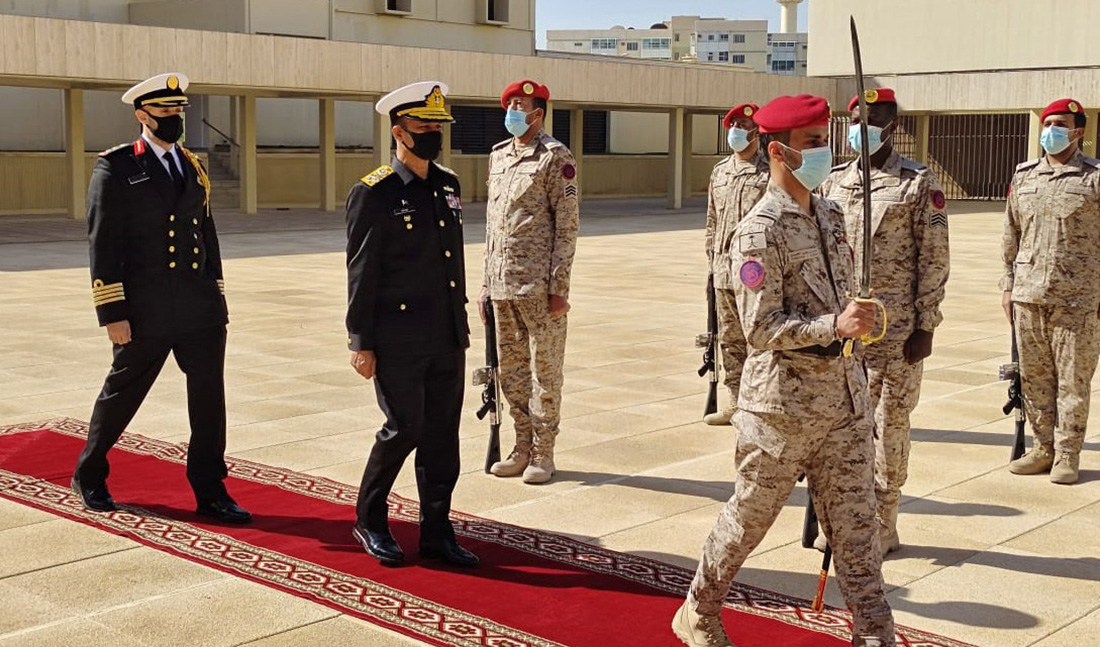


The photograph released by the Pakistan Navy on Jan. 22, 2021, shows Pakistani naval chief Admiral Muhammad Amjad Khan Niazi, second left, receiving a guard of honor upon his arrival at the Royal Saudi Naval Forces (RSNF) headquarters in Riyadh. (Photo courtesy: Pakistan Navy)

During his meetings with Gen. Al-Ruwaili and Vice Admiral Al-Ghufaili, "matters of mutual interest and bilateral defense ties were discussed," the Pakistani Navy said, adding that the role of Pakistan in training the RSNF was also appreciated.

"This visit is expected to greatly enhance the bilateral cooperation between both the countries in general and navies in particular," the statement read.

The Pakistani and Saudi navies have enjoyed close relations for decades. The Pakistani Navy provided training to Saudi officers and sailors during the Saudi Navy’s formative years, while Saudi Arabia has given the Pakistan Navy free-of-cost fuel on many occasions.


Pakistan’s deputy PM says country will not send forces to Gaza to disarm Hamas

Updated 27 December 2025
Follow

Pakistan’s deputy PM says country will not send forces to Gaza to disarm Hamas

  • Ishaq Dar says Pakistan open to peacekeeping but Gaza’s internal security is Palestinian responsibility
  • Pakistan’s top religious clerics from different schools have warned against sending forces to Palestine

ISLAMABAD: Deputy Prime Minister Ishaq Dar said on Saturday Pakistan was willing to contribute to an international peacekeeping force in Gaza, though it would not deploy troops to disarm or de-weaponize Hamas.

The statement follows media reports saying Washington views Pakistan as a potentially significant contributor given its battle-hardened military and wants it to be part of International Stabilization Force (ISF), which is part of United States President Donald Trump’s 20-point framework for a Gaza peace plan.

The plan announced by Trump at the White House on September 29 was formally adopted at the Sharm El-Sheikh Peace Summit in October. Co-chaired by Trump and Egyptian President Abdel Fattah El-Sisi, the summit brought together leaders from 27 countries to sign the “Trump Declaration for Enduring Peace and Prosperity.”

Deployment of troops from Muslim-majority countries during a transitional stabilization phase is a key part of the plan before the war-ravaged Palestinian territory moves toward reconstruction and a longer-term political settlement.

“If they say that we should go and start fighting, disarm Hamas, de-weaponize them, and go and destroy the tunnels that Hamas has built until now, that is not our job,” Dar, who is also the country’s foreign minister, told reporters during a year-end briefing in Islamabad.

He emphasized there was clarity between Pakistan’s civil and military leadership over the matter.

“We have a very complete understanding on this matter that we cannot do that kind of work,” he added.

The deputy prime minister said Pakistan had been using the term “peacekeeping” and had never used the phrase “peace enforcement” while discussing the force.

“I have been very clear: Pakistan will be happy to join if the mandate is not peace enforcement and disarming and de-weaponizing Hamas.”

The government’s stance comes amid growing domestic pressure over the issue.

On Monday, a group of Pakistan’s top religious leaders, chaired by prominent scholar Mufti Taqi Usmani, warned the government against yielding to what they described as international pressure to send forces to Gaza.

In a joint statement from Karachi, the clerics — representing Deobandi, Barelvi, Ahl-e-Hadees and Shia schools of thought — said that Washington wanted Muslim countries to send their forces to Gaza to disarm Hamas.

“Several Muslim governments have already refused this, and pressure is being increased on Pakistan,” it added.

Addressing such concerns, Dar said Pakistan would not land its forces in Palestine to “fight Muslims.”

Israel has repeatedly called for the disarmament of Hamas as a precondition for any long-term settlement, and the United Nations Security Council has also endorsed the ISF framework in November.

However, Dar maintained during the media briefing the internal security of Gaza was the Palestinian responsibility.

“The Palestinian Authority, their government, it is their job, it is the job of their law enforcement agency,” he said

The deputy prime minister also highlighted Pakistan’s involvement in the “Arab Islamic Group of Eight,” including Saudi Arabia, Jordan, Egypt, the United Arab Emirates, Qatar, Turkiye and Indonesia, which has been coordinating on the crisis.

He said the efforts of these countries had brought some peace to Palestine and reduced bloodshed.

“Our declared policy is that there should be an independent two-state solution,” he continued while calling for pre-1967 borders.