

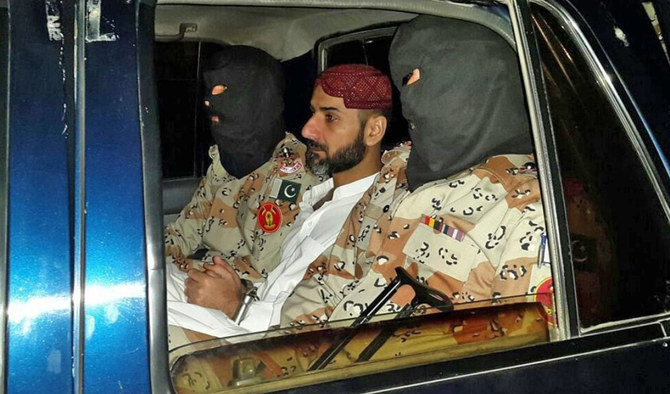

KARACHI: A document submitted in the Sindh High Court by the Pakistani military on Tuesday said gang lord Uzair Jan Baloch had been sentenced by a military court “on merit” after he was found guilty of working for an international spy agency.
Signed by an assistant judge advocate general of the army, the document was submitted in response to a petition filed by Baloch’s mother requesting the court to dismiss the case against him for being “devoid of merits.”
“The deep involvement of petitioner’s son in espionage activities against the state and working for foreign intelligence agencies/organizations has come on record during the joint investigation, an offence which is punishable under provisions of Official Secrets Act, 1923,” the document submitted by a senior army officer said.
An investigation report released by Pakistan’s provincial government in Sindh last July had said the Pakistani gang lord, long suspected of building a business empire through extortion, kidnapping and drugs, had confessed to spying for Iranian intelligence agencies in 2014.
Baloch was also convicted for spying last April by a military court and sentenced to 12 years in prison, according to a June 13 letter written by the senior superintendent of Karachi Central Jail to an anti-terrorism court that had ordered Baloch to be produced before it.
This is the first time the army has officially confirmed that Baloch was convicted on charges of espionage.
Last year in May, Razia Begum, Baloch’s mother, went to the Sindh high court to appeal her son’s conviction, saying he was convicted by a military court without jurisdiction or cogent evidence, adding that he had the right to a fair trial. Begum asked the court to set aside the military court’s judgment.
The army said in its reply that the petitioner’s son was given the opportunity to appoint a defense counsel but he declined.
“A defending officer was provided to him at the trial, free of cost, by the army,” the document said.
“I am of the view that the procedure prescribed for trial before military courts is not contrary to the concept of a fair trial in criminal case,” the military judge said, adding that the Military Act provided the opportunity to appeal “the conviction and sentence ... before [an] appellate forum.”
The document also cited last July’s joint investigation report saying that Baloch confessed to spying for Iranian intelligence agencies in 2014.
Baloch is currently nominated in about 55 criminal cases, according to police records, and kept at a makeshift prison at the office of the paramilitary Rangers force in Karachi.
In 2016, Baloch was interrogated by a Joint Investigation Team (JIT) comprising representatives of police, Rangers, and a number of civilian and military intelligence agencies during which he allegedly confessed to spying for Iran. The investigations also found him involved in 59 acts of murder, kidnapping, extortion and attacks on law enforcement agencies.
According to the report, Baloch had told the investigation team that he obtained a fake Iranian birth certificate in the late 1980s and an Iranian identity card and passport in 2006.
It further detailed how Baloch met a man named Hajji Nasir in Iran’s Chabahar city in 2014 who offered to arrange his meeting with Iranian intelligence officials.
“On the consent of the accused, a meeting with Iranian intelligence officers was arranged by Hajji Nasir in which the accused was asked to provide certain information about [Pakistani] armed forces officials,” the JIT report, which is publicly available, said.
It added: “The accused is found involved in espionage activities by providing secret information/sketches of Army installations and officials to foreign


