

Pakistani PM announces internet service, promises new jobs for impoverished northwest region

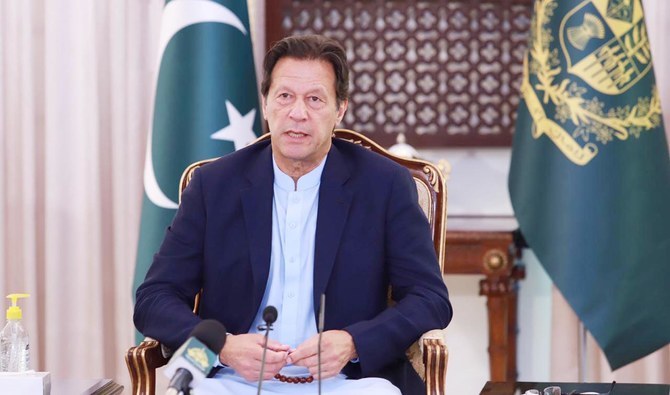
Prime Minister Imran Khan addresses the nation on Nov. 16, 2020. (PID/File)
Short Url
Updated 20 January 2021
Follow

Pakistani PM announces internet service, promises new jobs for impoverished northwest region

  • The prime minister vows to bring ‘olive revolution’ to the area, saying the tribal district has tremendous potential to produce the fruit
  • Khan’s visit to the area coincided with a wheel-jam strike in neighboring North Waziristan against recent incidents of violence 

PESHAWAR: Prime Minister Imran Khan on Wednesday announced a number of development initiatives while visiting South Waziristan district, saying his government would operationalize high-speed Internet service in the area from today. 

“I know the importance of 3G and 4G for education and development, and I talked to the army leadership about this,” he said while addressing a ceremony of tribal elders. “It was a pressing demand of the youth here.”

Last April, thousands of students protested across the tribal belt, including South Waziristan, due to the lack of Internet in the area after Pakistan’s Higher Education Commission directed universities to hold online classes amid virus-related lockdowns in the country. 

Khan said the Internet service was delayed in the area since there were some security concerns that online connectivity could benefit militant operations. 

Soon after his arrival in Wana, the headquarter of South Waziristan, the prime minister addressed tribal elders at a ceremony in which he also distributed checks among successful applicants of the Kamyab Jawan Loan Scheme and Youth Internship Program. 

Khan described the merger of the Federally Administered Tribal Areas with Khyber Pakhtunkhwa province as an uphill task, though he added that time would prove it to be the right decision since it would serve the interests of the tribal people. 

The prime minister also maintained that his administration was well aware of the established tribal traditions and would allow alternative dispute resolution to settle tribal feuds. He added that the implementation of the mechanism amounted to upholding the traditional jirga system in the area. 

“It is just the change of name,” he said. “You will take the decisions.” 

Khan noted that at least 70 percent of the people in South Waziristan lived below the poverty line, adding that his government was striving to help them by giving out cash stipends and scholarships. 

“Every family will get a health insurance card,” he continued, “that will enable its members to avail medical treatment of Rs700,000 from any hospital annually.” 

He said that South Waziristan had a huge potential to produce olives, adding that his government was working to trigger an “olive revolution” by planting saplings to generate more revenue and create greater employment opportunities. 

This, he added, would increase people’s income and the tribesmen would not have to travel abroad for jobs.

The prime minister said the residents of the tribal belt had sacrificed a great deal for the country during the war against religious militancy, adding that his government would promote education in the area by building schools, colleges and universities. He also inaugurated a project for the extension of Cadet College Wana. 

Meanwhile, people in neighboring North Waziristan district observed a wheel-jam strike against what they called a recent wave of target killings in the area. 

“We have already given a wheel-jam call against a latest series of violent incidents such as target killings in which an assistant professor, Dr. Waliullah Dawar, lost his life,” said a senior PTM leader, Saud Dawar, while talking to Arab News. “Our workers have also been harassed. All the main arteries leading to and from North Waziristan district are blocked today.” 


Sindh assembly passes resolution rejecting move to separate Karachi

Updated 21 February 2026
Follow

Sindh assembly passes resolution rejecting move to separate Karachi

  • Chief Minister Shah cites constitutional safeguards against altering provincial boundaries
  • Calls to separate Karachi intensified amid governance concerns after a mall fire last month

ISLAMABAD: The provincial assembly of Pakistan’s southern Sindh province on Saturday passed a resolution rejecting any move to separate Karachi, declaring its territorial integrity “non-negotiable” amid political calls to carve the city out as a separate administrative unit.

The resolution comes after fresh demands by the Muttahida Qaumi Movement (MQM) and other voices to grant Karachi provincial or federal status following governance challenges highlighted by the deadly Gul Plaza fire earlier this year that killed 80 people.

Karachi, Pakistan’s largest and most densely populated city, is the country’s main commercial hub and contributes a significant share to the national economy.

Chief Minister Syed Murad Ali Shah tabled the resolution in the assembly, condemning what he described as “divisive statements” about breaking up Sindh or detaching Karachi.

“The province that played a foundational role in the creation of Pakistan cannot allow the fragmentation of its own historic homeland,” Shah told lawmakers, adding that any attempt to divide Sindh or separate Karachi was contrary to the constitution and democratic norms.

Citing Article 239 of Pakistan’s 1973 Constitution, which requires the consent of not less than two-thirds of a provincial assembly to alter provincial boundaries, Shah said any such move could not proceed without the assembly’s approval.

“If any such move is attempted, it is this Assembly — by a two-thirds majority — that will decide,” he said.

The resolution reaffirmed that Karachi would “forever remain” an integral part of Sindh and directed the provincial government to forward the motion to the president, prime minister and parliamentary leadership for record.

Shah said the resolution was not aimed at anyone but referred to the shifting stance of MQM in the debate while warning that opposing the resolution would amount to supporting the division of Sindh.

The party has been a major political force in Karachi with a significant vote bank in the city and has frequently criticized Shah’s provincial administration over its governance of Pakistan’s largest metropolis.

Taha Ahmed Khan, a senior MQM leader, acknowledged that his party had “presented its demand openly on television channels with clear and logical arguments” to separate Karachi from Sindh.

“It is a purely constitutional debate,” he told Arab News by phone. “We are aware that the Pakistan Peoples Party, which rules the province, holds a two-thirds majority and that a new province cannot be created at this stage. But that does not mean new provinces can never be formed.”

Calls to alter Karachi’s status have periodically surfaced amid longstanding complaints over governance, infrastructure and administrative control in the megacity, though no formal proposal to redraw provincial boundaries has been introduced at the federal level.