

Antony Blinken: US must act urgently to stop Iran nuclear weapon

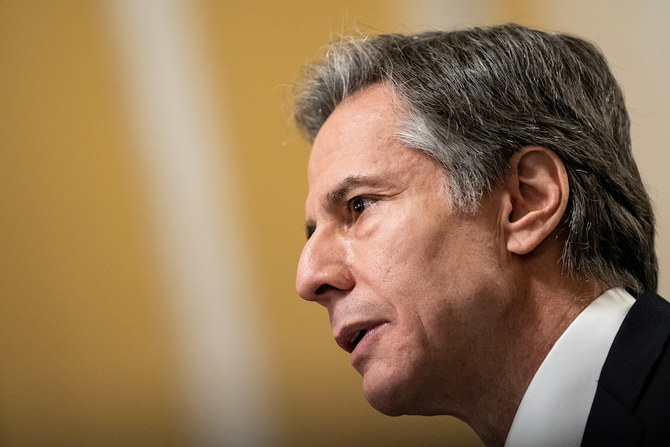
Secretary of State nominee Antony Blinken testifies during his confirmation hearing to be Secretary of State before the Senate Foreign Relations Committee on Tuesday. (AP)
Short Url
Updated 20 January 2021
Follow

Antony Blinken: US must act urgently to stop Iran nuclear weapon

  • Next secretary of state says Iran nuclear weapon could be produced in three to four months
  • New administration seeks "stronger, longer deal" that could tackle destabilizing activity

LONDON: A new nuclear deal could address Iran’s aggressive policies in the Middle East, America’s next top diplomat Antony Blinken said on Tuesday.
The secretary of state-designate told his confirmation hearing before the Senate Foreign Relations Committee that the administration of President-elect Joe Biden would seek a “longer and stronger deal.”
But he warned that the time needed for Iran to make enough fissile material for a single nuclear weapon had fallen to three or four months from more than a year since Donald Trump took office.
Trump withdrew the US from the 2015 nuclear deal with world powers, which Biden had helped negotiate under President Barack Obama.

Opinion

This section contains relevant reference points, placed in (Opinion field)


The deal, known as the Joint Comprehensive Plan of Action (JCPOA), stemmed Iranian nuclear activity in return for an easing of international sanctions. But it was criticized by Gulf countries and in the US for allowing Tehran to pursue aggressive policies in the region and ballistic missile development.
Blinken said the new administration had “an urgent responsibility” to do what it could to stop Iran acquiring a nuclear weapon.
“The breakout time - the time it would take Iran to produce enough fissile material for one weapon - has gone from beyond a year, as it was under the JCPOA, to about three or four months, based at least on public reporting,” Blinken said.
President Biden, he added, would rejoin the deal if Iran returned to complying with its terms.
“But we would use that as a platform with our allies and partners, who would once again be on the same side with us, to seek a longer and stronger agreement,” he said.
A new agreement could address Iran’s “destabilizing activities” in the region as well as its missiles, Blinken added.
On Israel and Palestine, Blinken said he backed a two-state solution but said he was doubtful that such a deal was possible soon.
“The only way to ensure Israel's future as a Jewish, democratic state and to give the Palestinians a state to which they are entitled is through the so-called two-state solution,” Blinken said. “I think realistically it's hard to see near-term prospects for moving forward on that.”
“What would be important is to make sure that neither party takes steps that make the already difficult process even more challenging,” he said.
In his farewell speech, President Donald Trump will highlight the Abraham Accords deals, which normalized ties between Israel and several Arab states.

*With AFP and Reuters


Soleimani’s shadow
Qassem Soleimani left a trail of death and destruction in his wake as head of Iran’s Quds Force … until his assassination on Jan. 3, 2020. Yet still, his legacy of murderous interference continues to haunt the region

Enter


keywords


Arab Coalition announces ‘limited’ airstrike targeting two ships that smuggled weapons to Yemen

Updated 14 sec ago
Follow

Arab Coalition announces ‘limited’ airstrike targeting two ships that smuggled weapons to Yemen

RIYADH: The Coalition to Support Legitimacy in Yemen on Tuesday said it conducted a “limited” airstrike targeting two ships that smuggled weapons and other military hardware into Mukalla in southern Yemen.

In a statement carried by the Saudi Press Agency (SPA), the Coalition Forces spokesman, Major General Turki Al-Maliki, said that two ships coming from the port of Fujairah in the United Arab Emirates entered the port of Mukalla without obtaining official permits from the Joint Forces Command of the Coalition. 

“The crews of the two ships disabled the tracking systems of the two ships and unloaded a large quantity of weapons and combat vehicles to support the Southern Transitional Council forces in the eastern governorates of Yemen (Hadramawt, Al-Mahra) with the aim of fueling the conflict. This is a clear violation of imposing a truce and reaching a peaceful solution, as well as a violation of UN Security Council Resolution No. (2216) of 2015 AD,” said the spokesman.

Google map showing the location of Mukalla in southern Yemen

Al-Maliki said the Coalition Forces acted on a request by Rashad Al-Alimi, the president of the Yemeni Presidential Leadership Council, “to take all necessary military measures to protect civilians in the governorates of Hadramawt and Al-Mahra.”

Al-Alimi, the president of the Yemeni Presidential Leadership Council, warned last week that unilateral actions by the STC were pushing the country toward a dangerous tipping point.

“Given the danger and escalation posed by these weapons, which threaten security and stability, the Coalition Air Forces conducted a limited military operation this morning targeting weapons and combat vehicles unloaded from the two ships at the port of Al-Mukalla. This was done after documenting the unloading, and the military operation was carried out in accordance with international humanitarian law and its customary rules, ensuring no collateral damage occurred,”  spokesman Al-Maliki said on Tuesday.


READ MORE: Analysis: The risks of carving up Yemen


He affirmed the Coalition’s "continued commitment to de-escalation and enforcing calm in the governorates of Hadramawt and Al-Mahra, and to prevent any military support from any country to any Yemeni faction without coordination with the legitimate Yemeni government and the Coalition. This is aimed at ensuring the success of the Kingdom and the Coalition’s efforts to achieve security and stability and prevent the conflict from spreading.”

Disregarding previous agreements with the Coalition, the group calling itself Southern Transitional Council, or STC, launched a sweeping military campaign early in December, seizing the governorates of Hadramaut along the Saudi border and the eastern governorate of Al-Mahra in Yemen’s border with Oman.

The UAE-backed STC forces captured the city of Seiyun, including its international airport and the presidential palace. They also took control of the strategic PetroMasila oilfields, which account for a massive portion of Yemen’s remaining oil wealth.

This prompted Saudi Arabia to issue a firm demand for the STC to withdraw and hand over the seized areas to the National Shield Forces, a Saudi-backed unit.

The coalition warned that any military movements undermining de-escalation efforts would be dealt with immediately to protect civilians, according to the Saudi Press Agency.

On Dec. 26, the UAE issued a statement welcoming Saudi Arabia’s efforts to support security and stability in Yemen.

The statement carried by state news agency WAM praised Saudi Arabia’s constructive role in advancing the interests of the Yemeni people and supporting their legitimate aspirations for stability and prosperity.