

Lockdowns double telecom services in Pakistan to the tune of $1.7 billion

Short Url
Updated 17 January 2021
Follow

Lockdowns double telecom services in Pakistan to the tune of $1.7 billion

  • The sector managed to withstand the impact of COVID-19 as broadband usage surged by 77 percent
  • According to the country’s telecom authority, 98 percent of households in the country own a mobile phone 

KARACHI: Despite a revenue decline of 2.4 percent, Pakistan’s telecom sector has contributed 128 percent more to the national economy and managed to withstand the impact of COVID-19, said the Pakistan Telecommunication Authority (PTA) in its annual report.

The official document revealed that 98 percent of Pakistani households own a mobile phone, adding that the mobile service penetration level reached about 81 percent toward the end of October with 172.3 million mobile subscriptions.

There was also an impressive growth trend of 17 percent in broadband subscriptions that crossed 90.1 million in October while 4G subscriptions registered an exponential increase of 60 percent during the same period. 

“By and large, the sector withstood the impact of COVID-19 and showed sustainable revenues of Rs537.2 billion ($3.3 billion) in FY2020 as compared to Rs550.4 billion in FY2019,” the PTA report said on Friday. 

“While the historic lockdowns during the COVID-19 pandemic slackened economic activity, vibrant telecommunication systems played a pivotal role in ensuring availability of essential services to the community,” it added. 

The report maintained that the data usage increased by 77 percent to 4,498 petabytes during FY20 compared to 2,545 petabytes consumed in FY19. The massive upsurge was caused by the work-from-home situation and shifting of academic activities to online platforms 

“The coronavirus pandemic has boosted the internet usage not just in Pakistan but also across the world since more and more people are beginning to do things online. Many of them have started using Zoom, Google and Skype etc. for meetings, and seminars,” Pervaiz Iftikhar, who is part of the prime minister’s taskforce on IT and telecom, told Arab News. 

The pandemic has also led to the rise of broadband penetration to 39.2 percent in FY20 from 33.8 percent in FY19. 

The telecom sector contributed Rs278.4 billion ($1.7 billion) to the national exchequer which is 128 percent higher than the previous year’s Rs121.9 billion. The contribution to the national economy came in the form of Rs41.5 billion on account of general sales tax and Rs141.1 billion in the shape of other PTA deposits, according to the report. 

“I believe the data usage may reduce a little since the work-from-home trend is gradually subsiding. The overall broadband penetration growth rate, however, is not likely to go down and will continue to increase further,” Shankar Talreja, who works with the Topline Securities, told Arab News. 
Officials believe that the broadband demand would continue to increase since many people have realized that they can accomplish much of their work by relying on online platforms. 

“The situation is not likely to normalize before at least a year,” said Iftikhar. “We should take advantage of the current opportunity and improve our internet quality, affordability and accessibility. Besides, we should also reduce the tax burden on telecom operators.” 

Pakistan is planning a commercial rollout of 5G services and has conducted its first trials.

With 5G planning underway, recommendations on its “Environmental Protection and Health Related Issues” have been drafted, said the report. 

Pakistan remembers Benazir Bhutto, first woman PM in Muslim world, on death anniversary

Updated 27 December 2025
Follow

Pakistan remembers Benazir Bhutto, first woman PM in Muslim world, on death anniversary

  • Bhutto was daughter of ex-PM Zulfikar Ali Bhutto who was hanged during reign of former military ruler Gen. Zia-ul-Haq
  • Year before assassination in 2007, Bhutto signed landmark deal with rival Nawaz Sharif to prevent army interventions

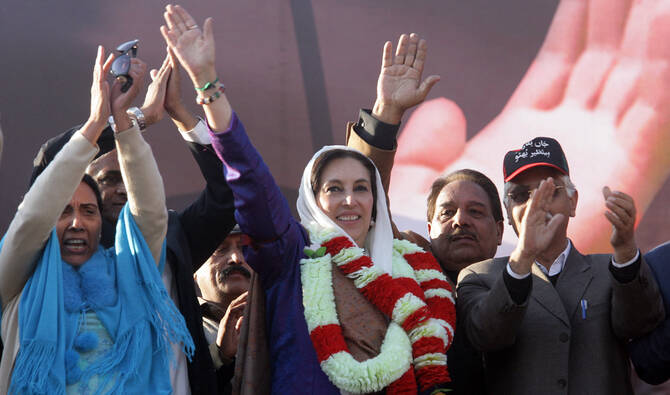
ISLAMABAD: Prime Minister Shehbaz Sharif and other Pakistani leaders on Saturday paid tribute to Benazir Bhutto, the first woman prime minister in the Muslim world who was assassinated 18 years ago in a gun and bomb attack after a rally in the city of Rawalpindi.

Born on Jun. 21, 1953, Bhutto was elected premier for the first time in 1988 at the age of 35. She was deposed in 1990, re-elected in 1993, and ousted again in 1996, amid allegations of corruption and mismanagement which she denied as being politically motivated.

Bhutto only entered politics after her father was hanged in 1979 during military ruler Gen. Zia-ul-Haq’s reign. Throughout her political career, she had a complex and often adversarial relationship with the now ruling Sharif family, but despite the differences signed a ‘Charter of Democracy’ in 2006 with three-time former PM Nawaz Sharif, pledging to strengthen democratic institutions and prevent military interventions in Pakistan in the future.

She was assassinated a year and a half later.

“Mohtarma Benazir Bhutto took exemplary steps to strengthen the role of women, protect the rights of minorities, and make Pakistan a peaceful, progressive, and democratic state,” PM Shehbaz Sharif, younger brother of ex-PM Nawaz Sharif, said in a statement on Saturday.

“Her sacrifices and services are a beacon of light for the nation.”

President Asif Ali Zardari, Bhutto’s widower, said Bhutto believed in an inclusive Pakistan, rejected sectarianism, bigotry and intolerance, and consistently spoke for the protection of minorities.

“Her vision was of a federation where citizens of all faiths could live with dignity and equal rights,” he said. “For the youth of Pakistan, her life offers a clear lesson: speak up for justice, organize peacefully and do not surrender hope in the face of adversity.”

Powerful families like the Bhuttos and the Sharifs of Pakistan to the Gandhis of India and the Bandaranaike family of Sri Lanka have long dominated politics in this diverse region since independence from British colonial rule. But none have escaped tragedy at the hands of rebels, militants or ambitious military leaders.

It was Zulfikar Ali Bhutto, Bhutto’s father, who founded the troubled Bhutto dynasty, becoming the country’s first popularly elected prime minister before being toppled by the army in 1977 and later hanged. Both his sons died in mysterious circumstances.

Before her assassination on Dec. 27, 2007, Bhutto survived another suicide attack on her motorcade that killed nearly 150 people as she returned to Pakistan after eight years in exile in October 2007.

Bhutto’s Oxford-educated son, Bilawal Bhutto-Zardari, now leads her Pakistan Peoples Party, founded by her father, and was foreign minister in the last administration of PM Shehbaz Sharif.

Aseefa Bhutto Zardari, Bhutto’s daughter who is currently the first lady of Pakistan, said her mother lived with courage and led with compassion in life.

“Her strength lives on in every voice that refuses injustice,” she said on X.

Pakistan has been ruled by military regimes for almost half its history since independence from Britain in 1947. Both former premiers Imran Khan and the elder Sharif, Nawaz, have alleged that they were ousted by the military after they fell out with the generals. The army says it does not interfere in politics.