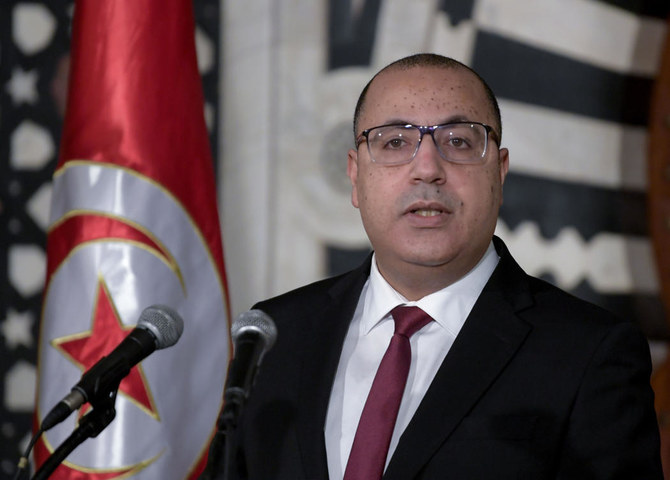
TUNIS: Tunisia’s Prime Minister Hichem Mechichi announced on Saturday a major cabinet reshuffle affecting 12 ministries, in the wake of high-profile sackings.
“The aim of this reshuffle is to achieve greater efficiency in the work of the government,” Mechichi said at a press conference in the capital Tunis.
The new line-up, which does not include any women, must be approved by parliament.
A few hours before the announcement, Mechichi had met with President Kais Saied, who insisted the “integrity” of proposed ministers should “raise no doubt,” according to a statement from the presidency.
“There is no place (in the government) for people who are subject to legal proceedings” or to “doubts about their background or their behavior that could undermine the state and the credibility of its institutions and the legitimacy of its decisions,” Saied said.
One of the officials to be replaced is former environment minister Mustapha Aroui, who was sacked and arrested in December in a scandal over hundreds of containers of household waste shipped from Italy.
Chiheb Ben Ahmed, CEO of the Tunisian Export Promotion Center (CEPEX), was proposed as his replacement.
Cabinet chief Walid Dhahbi has been put forward as interior minister to replace Taoufik Charfeddine.
The former lawyer and pillar of Saied’s election campaign was sacked earlier this month over high-level staffing changes he sought to make to some security agencies, according to a previous statement from Mechichi.
The reshuffle also impacts the ministries of health, justice, industry, energy and agriculture.
Ten years after the uprising that led to the fall of long-time dictator Zine El Abidine Ben Ali, Tunisia has successfully transformed into a democracy — albeit one still riven by corruption and economic pain.
The country has had nine governments in 10 years, but the transfers of power have been peaceful.
However, since a general election in 2019, the political class has been more fragmented than ever and paralyzed by infighting, fueling discontent over the continued economic malaise, which has been exacerbated by the novel coronavirus pandemic.


![]()

Tunisian premier announces major cabinet reshuffle
Short Url
https://arab.news/j3jh8
Tunisian premier announces major cabinet reshuffle
- The new line-up, which does not include any women, must be approved by parliament
- “The aim of this reshuffle is to achieve greater efficiency in the work of the government,” Mechichi said


Latest updates


Recommended


© 2026 SAUDI RESEARCH & PUBLISHING COMPANY, All Rights Reserved And subject to Terms of Use Agreement.