Pakistani baby born in Makkah reaches home, meets parents after yearlong wait

1 / 2
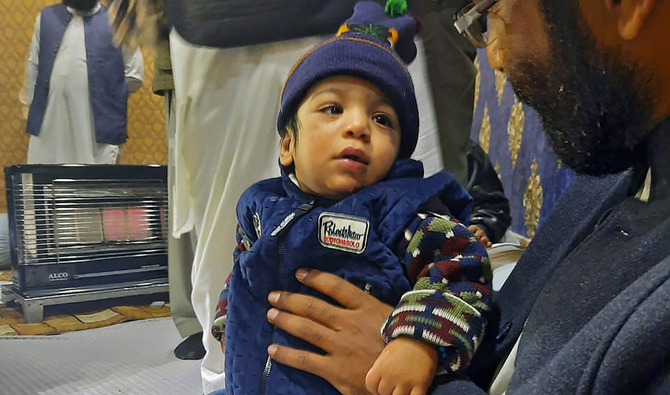
One-year-old Abdullah is reunited with his family in Quetta on Jan. 15 after undergoing successful treatment at Maternity and Children Hospital in Makkah. (Photo courtesy: Pakistan Consulate Jeddah)
2 / 2
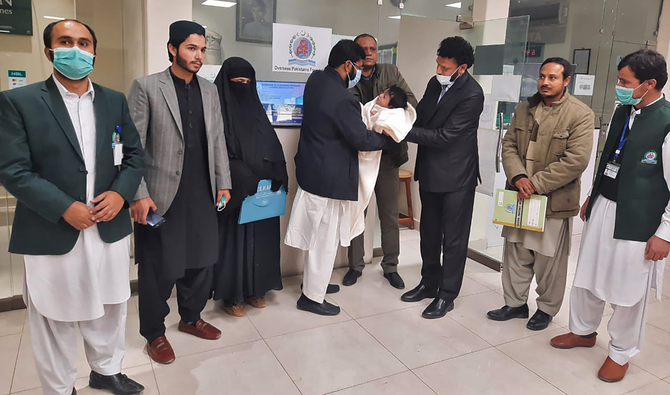
Pakistan Consulate Jeddah officials hand over one-year-old Abdullah to his parents at the Quetta airport on Jan 15. (Photo courtesy: Pakistan Consulate Jeddah)
Short Url
Updated 16 January 2021
Follow

Pakistani baby born in Makkah reaches home, meets parents after yearlong wait

  • Abdullah was born prematurely Jan. 9 last year to Pakistani Umrah pilgrims
  • Parents say medical treatment was paid for entirely by Saudi government

ISLAMABAD: A baby born prematurely to Pakistani Umrah pilgrims in Makkah last year was returned on Friday evening to his parents in Quetta, Pakistan — a full year after his birth and successful treatment in Saudi Arabia.

Bibi Hajra and her husband Ghulam Haider were forced to leave their baby behind after their Umrah visas expired following the birth of their son on Jan. 9 last year — a premature birth, with the baby weighing only 1 kg and suffering from severe medical complications at the Maternity and Children’s Hospital in Makkah.

The baby, named Abdullah, was placed on a ventilator and stayed on in the hospital for a period of 46 days under the observation of doctors and consultants specialized in neonatal intensive care.

After this, the child was transferred to special care under the supervision of the Social Service Department.

“We had to return to Pakistan and leave our baby in the hospital as our visas expired, and then could not go back due to coronavirus,” a tearful Hajra told Arab News on Saturday from Pakistan’s southwestern Quetta city.

“Initially, I was very worried about my baby, but the hospital administration remained in touch with us. They used to show me Abdullah on video and also send us his pictures,” she said.

“We are thankful to the Saudi government, hospital authorities, doctors, nurses and Pakistani consulate in Jeddah for their cooperation,” she added.

On Thursday, the Maternity and Children’s Hospital in Makkah handed Abdullah over to a delegation from the Pakistani Consulate after taking care of him for a full year.

Abdullah’s father, Haider, who is a dispenser at a small clinic in Quetta, also expressed his gratitude to the Saudi government and the Pakistani mission for their support.

“Our child remained under treatment for one year but we have not even been charged a single penny,” Haider told Arab News.

“All the expenses were taken care of by the Saudi government,” he said.

The return of Abdullah to Quetta, he continued, had been arranged by the Pakistani Consulate in Jeddah free of charge.

“The Pakistani Consulate was in contact with the hospital as well as with the parents of the child. They provided all the medical facilities and kept Abdullah in complete care. Now he is absolutely fine and one year old,” the community welfare attache of the Pakistani Consulate, Saqib Ali Khan, who received the boy from the hospital on Thursday, told Arab News.

“When the hospital administration assured us that the child is completely fine, we sent him back to Quetta through a delegation and he was received by the parents,” he said.

Khan thanked the Saudi government, the Saudi Ministry of Health and the medical team at the hospital for providing the child with special care, and for keeping in touch with the family in order to reassure them over the entire year of their separation.


February fifth warmest on record, extreme rain in Europe: EU monitor

Updated 5 sec ago
Follow

February fifth warmest on record, extreme rain in Europe: EU monitor

  • Global temperatures last month were 1.49C above preindustrial times
  • Temperatures and precipitation varied widely in Europe

PARIS: The world logged its fifth hottest February on record, with western Europe drenched by extreme rainfall and widespread flooding, the European Union’s climate monitor said on Tuesday.
Global temperatures last month were 1.49C above preindustrial times, defined as the 1850-1900 period before large-scale fossil fuel use drove climate change.
Temperatures and precipitation varied widely in Europe.
The average temperature in Europe was among the three coldest in the past 14 years at -0.07C.
But western, southern and southeast Europe experienced above-average temperatures, according to the Copernicus Climate Change Service.
Colder conditions were experienced in northwest Russia, Baltic countries, Finland and its Scandinavian neighbors.
“Wet and dry conditions across the continent showed a pronounced contrast: much of western and southern Europe was wetter than average, whereas the rest of the continent... was mostly drier than average,” the service said in its monthly report.
The United States, northeast Canada, the Middle East, Central Asia and east Antarctica had warmer-than-average temperatures.

- Need for global action -

Sea surface temperatures were the second highest for the month of February.
In the Arctic, the average sea ice extent was at its third lowest level for the month at five percent below average.
In the Antarctic, the monthly sea ice extent was close to average for February — a “sharp contrast to the much below-average” levels observed over the past four years, Copernicus said.
“The extreme events of February 2026 highlight the growing impacts of climate change and the pressing need for global action,” said Samantha Burgess, strategic lead for climate at the European Center for Medium-Range Weather Forecasts, which operates Copernicus.
“Europe experienced stark temperature contrasts,” Burgess said.
“Exceptional atmospheric rivers — narrow bands of very moist air — brought record rainfall and widespread flooding to western and southern Europe,” she said.
Human-driven climate change intensified torrential downpours that killed dozens and forced thousands of people from their homes across Spain, Portugal and Morocco between January and February, according to the World Weather Attribution (WWA) network of climate scientists.