

Pakistani baby born prematurely in Makkah reunited with parents after full year

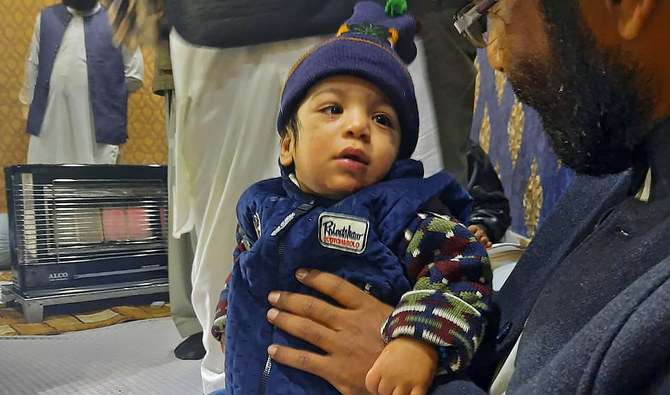
One-year old Abdullah is reunited with his family in Quetta on Jan. 15, 2021 after undergoing successful treatment at Maternity and Children Hospital in Makkah. (Photo courtesy: Pakistan Consulate Jeddah)
Short Url
Updated 18 January 2021
Follow

Pakistani baby born prematurely in Makkah reunited with parents after full year

  • Abdullah was born prematurely on January 9 last year to Pakistani Umrah pilgrims with medical complications
  • Parents say treatment for baby’s medical condition was paid for entirely by the Saudi government for a full year

ISLAMABAD: A baby born prematurely to Pakistani Umrah pilgrims in Makkah last year was returned on Friday evening to his parents in Quetta-- a full year after his birth and following his successful treatment in Saudi Arabia.

Bibi Hajra and her husband Ghulam Haider were forced to leave their baby behind after their Umrah visas expired following the birth of their son on Jan. 9 last year-- a premature birth with the baby weighing only 1 kg and suffering from severe medical complications at the Maternity and Children’s Hospital in Makkah.

The baby, named Abdullah, was placed on a ventilator and stayed on in the hospital under the observation of doctors and consultants specialized in neonatal intensive care for a period of 46 days.

After this, the child was transferred to special care under the supervision of the Social Service Department.

“We had to return to Pakistan and leave our baby in the hospital as our visas expired... and then could not go back due to coronavirus,” a tearful Hajra told Arab News on Saturday from Pakistan’s southwestern Quetta city. 

“Initially, I was very worried about my baby but the hospital administration remained in touch with us. They used to show me Abdullah on video and also send us his pictures,” she said.

“We are thankful to the Saudi government, hospital authorities, doctors, nurses and Pakistani consulate in Jeddah for their cooperation,” she added.

On Thursday, the Maternity and Children’s Hospital in Makkah handed Abdullah over to a delegation from the Pakistani consulate after taking care of him for a full year. 

Abdullah’s father, Haider, who is a dispenser at a small clinic in Quetta, also expressed his gratitude to the Saudi government and the Pakistani mission for their support.

“Our child remained under treatment for one year but we have not even been charged a single penny,” Haider told Arab News.

“All the expenses were taken care of by the Saudi government,” he said. 
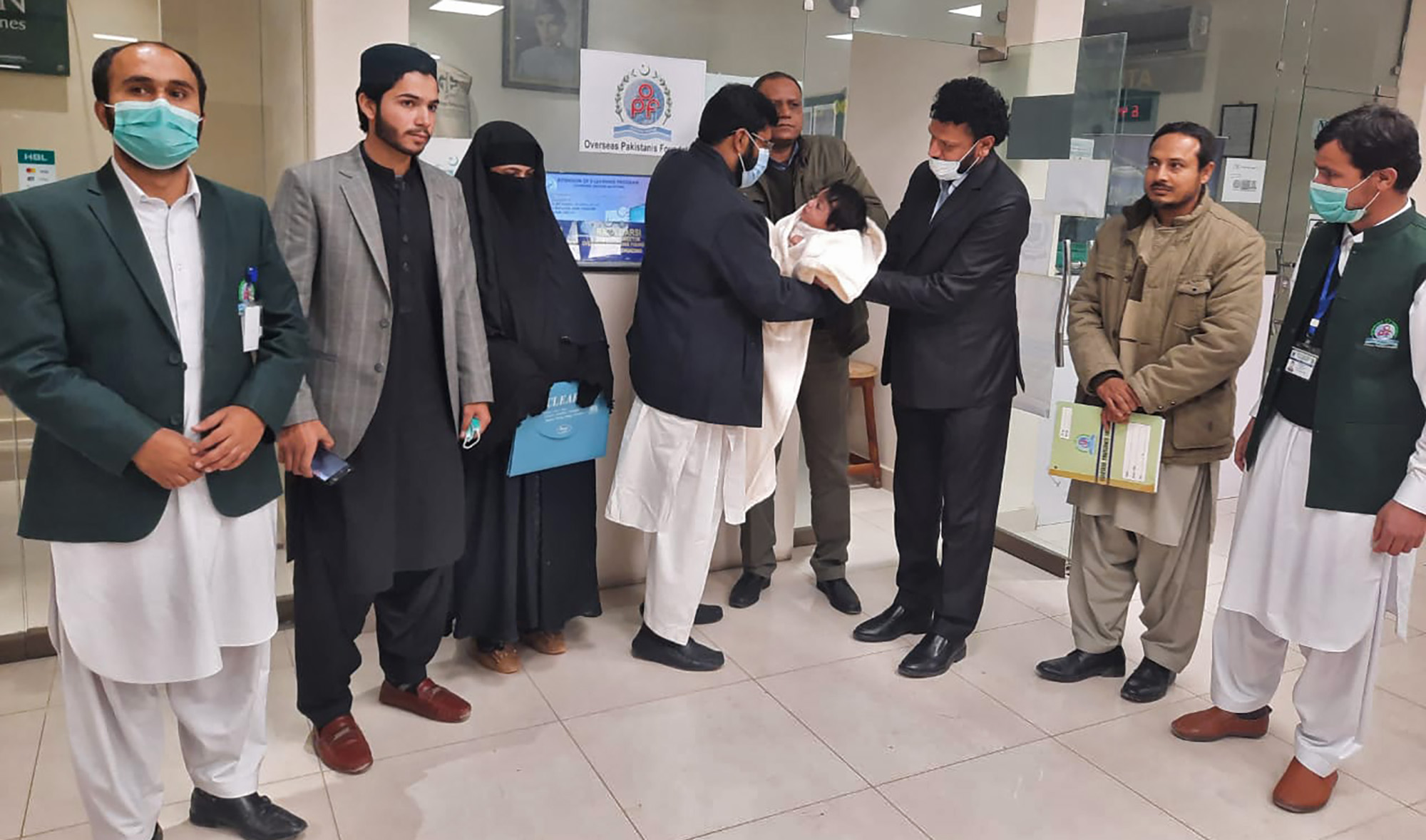


Pakistan Consulate Jeddah officials hand over one-year-old baby, Abdullah, to his parents at Quetta airport on Jan 15, 2021. (Photo courtesy: Pakistan Consulate Jeddah)

The return of Abdullah to Quetta, he continued, had been arranged by the Pakistani consulate in Jeddah without any cost incurred to his family.

“Pakistan consulate was in contact with the hospital as well as with the parents of the child. They (hospital) provided all the medical facilities and kept Abdullah in complete care. Now he is absolutely fine and one year old,” the community welfare attaché of the Pakistani consulate, Saqib Ali Khan, who received the boy from the hospital on Thursday, told Arab News on the phone from Jeddah.

“When hospital administration assured us that the child is completely fine...we sent him back to Quetta through a delegation and (he) has been received by the parents,” he said.

Khan thanked the Saudi government, the Saudi Ministry of Health and the medical team at the hospital for providing the child with special care, and for keeping in touch with his family in order to reassure them over the entire year of their separation.


Pakistan PM gives 48 hours to draft fuel-saving plan as global oil prices surge

Updated 4 sec ago
Follow

Pakistan PM gives 48 hours to draft fuel-saving plan as global oil prices surge

  • Government warns against hoarding after sharp fuel price hike amid Middle East tensions
  • PM wants provinces to enforce anti-profiteering measures and prevent public exploitation

ISLAMABAD: Prime Minister Shehbaz Sharif has asked his administration to formulate a strategy for fuel conservation and austerity in government affairs within 48 hours after a sharp rise in global oil prices pushed the country to increase domestic fuel rates, a senior minister said on Saturday.

The directive comes a day after the government raised petrol and diesel prices by Rs55 ($0.20) per liter, citing a surge in international energy prices triggered by escalating conflict in the Middle East after Israel and the United States launched attacks on Iran. The situation has rattled global oil markets and threatened key shipping routes.

Pakistan’s Information Minister Ataullah Tarar said Sharif had instructed officials to urgently prepare a practical plan aimed at reducing fuel consumption and promoting austerity across government institutions.

“The prime minister has given 48 hours to formulate an actionable strategy on savings, austerity and simplicity in government affairs,” he said in a social media post on X.

Tarar said Finance Minister Muhammad Aurangzeb and Petroleum Minister Ali Pervaiz Malik had also been tasked with consulting the country’s four provincial chief ministers to coordinate measures against fuel hoarding and ensure strict enforcement of government directives.

He informed the ministers had been asked to ensure that speculation and profiteering in fuel markets were prevented, adding that authorities would take strict action against violators.

“The prime minister has directed that no leniency be shown to elements involved in exploiting the public,” he said, warning that licenses of those petrol pumps violating government orders could be revoked.

Tarar also urged the public not to pay attention to rumors regarding petroleum supplies or pricing, saying the government and relevant ministries would continue to release verified information as the situation evolves.

He said Pakistan was not alone in facing rising energy costs, noting that many countries were grappling with similar pressures due to volatility in global oil markets.

Pakistan relies heavily on imported fuel to meet its energy needs and is particularly vulnerable to global price shocks, which can quickly push up inflation and strain the country’s fragile external accounts.