

Pakistani baby born prematurely in Makkah reunited with parents after full year

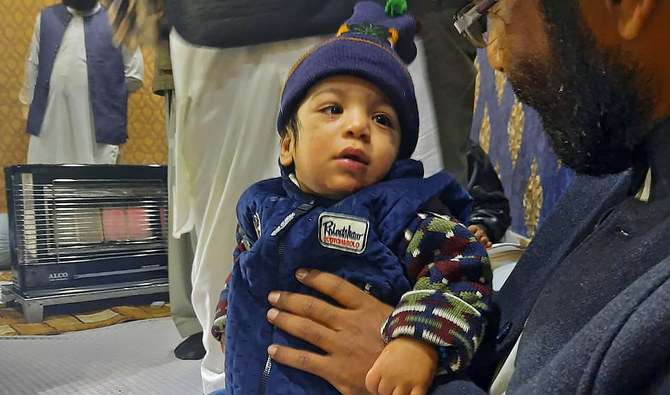
One-year old Abdullah is reunited with his family in Quetta on Jan. 15, 2021 after undergoing successful treatment at Maternity and Children Hospital in Makkah. (Photo courtesy: Pakistan Consulate Jeddah)
Short Url
Updated 18 January 2021
Follow

Pakistani baby born prematurely in Makkah reunited with parents after full year

  • Abdullah was born prematurely on January 9 last year to Pakistani Umrah pilgrims with medical complications
  • Parents say treatment for baby’s medical condition was paid for entirely by the Saudi government for a full year

ISLAMABAD: A baby born prematurely to Pakistani Umrah pilgrims in Makkah last year was returned on Friday evening to his parents in Quetta-- a full year after his birth and following his successful treatment in Saudi Arabia.

Bibi Hajra and her husband Ghulam Haider were forced to leave their baby behind after their Umrah visas expired following the birth of their son on Jan. 9 last year-- a premature birth with the baby weighing only 1 kg and suffering from severe medical complications at the Maternity and Children’s Hospital in Makkah.

The baby, named Abdullah, was placed on a ventilator and stayed on in the hospital under the observation of doctors and consultants specialized in neonatal intensive care for a period of 46 days.

After this, the child was transferred to special care under the supervision of the Social Service Department.

“We had to return to Pakistan and leave our baby in the hospital as our visas expired... and then could not go back due to coronavirus,” a tearful Hajra told Arab News on Saturday from Pakistan’s southwestern Quetta city. 

“Initially, I was very worried about my baby but the hospital administration remained in touch with us. They used to show me Abdullah on video and also send us his pictures,” she said.

“We are thankful to the Saudi government, hospital authorities, doctors, nurses and Pakistani consulate in Jeddah for their cooperation,” she added.

On Thursday, the Maternity and Children’s Hospital in Makkah handed Abdullah over to a delegation from the Pakistani consulate after taking care of him for a full year. 

Abdullah’s father, Haider, who is a dispenser at a small clinic in Quetta, also expressed his gratitude to the Saudi government and the Pakistani mission for their support.

“Our child remained under treatment for one year but we have not even been charged a single penny,” Haider told Arab News.

“All the expenses were taken care of by the Saudi government,” he said. 
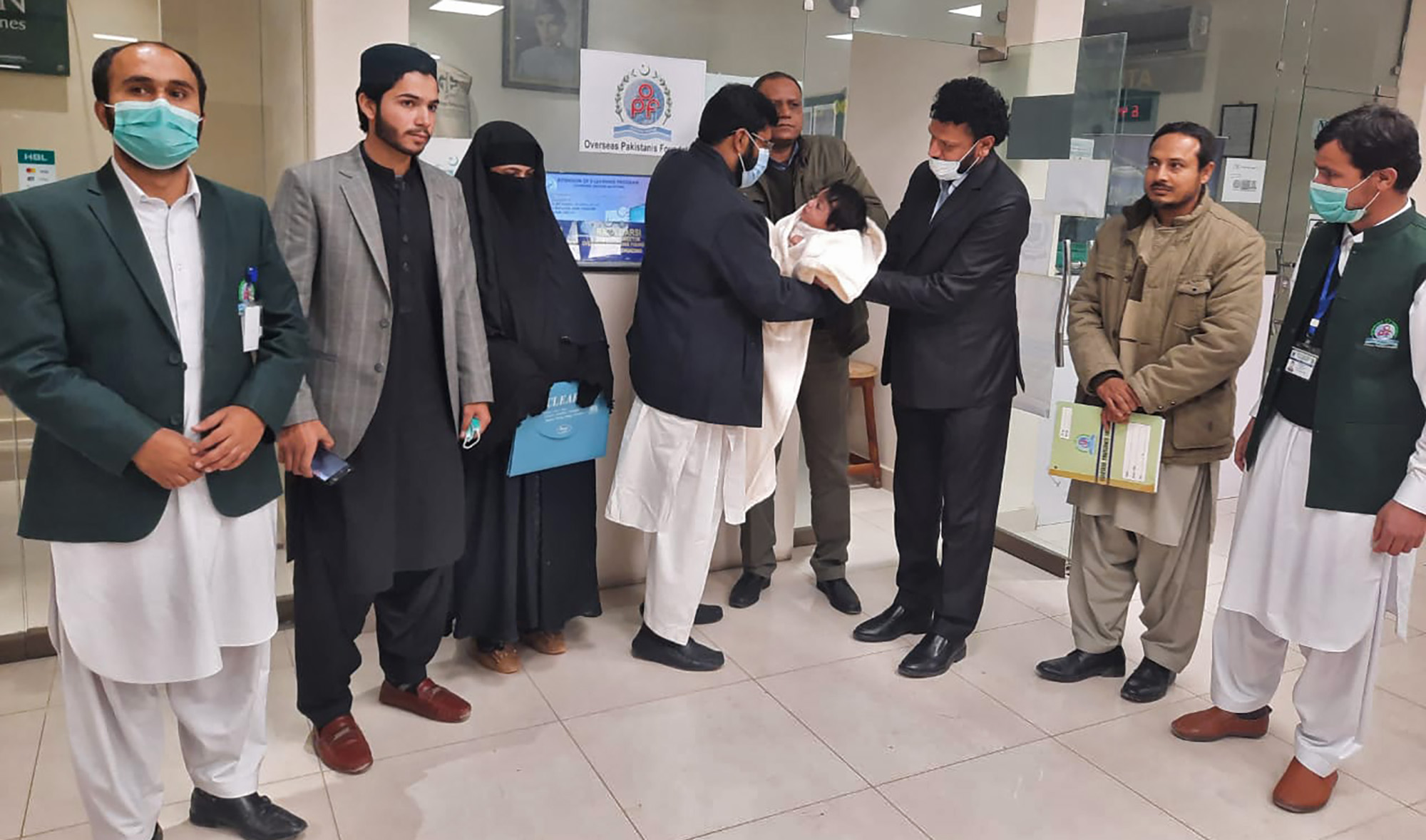


Pakistan Consulate Jeddah officials hand over one-year-old baby, Abdullah, to his parents at Quetta airport on Jan 15, 2021. (Photo courtesy: Pakistan Consulate Jeddah)

The return of Abdullah to Quetta, he continued, had been arranged by the Pakistani consulate in Jeddah without any cost incurred to his family.

“Pakistan consulate was in contact with the hospital as well as with the parents of the child. They (hospital) provided all the medical facilities and kept Abdullah in complete care. Now he is absolutely fine and one year old,” the community welfare attaché of the Pakistani consulate, Saqib Ali Khan, who received the boy from the hospital on Thursday, told Arab News on the phone from Jeddah.

“When hospital administration assured us that the child is completely fine...we sent him back to Quetta through a delegation and (he) has been received by the parents,” he said.

Khan thanked the Saudi government, the Saudi Ministry of Health and the medical team at the hospital for providing the child with special care, and for keeping in touch with his family in order to reassure them over the entire year of their separation.


Pakistan bank enables Shariah-compliant digital payment facility for passengers at Islamabad airport

Updated 23 February 2026
Follow

Pakistan bank enables Shariah-compliant digital payment facility for passengers at Islamabad airport

  • Pakistan is a cash-dominated market where a significant portion of transactions in the informal sector are made without any taxes, officials say
  • The move comes amid Pakistan’s efforts to introduce a cashless model at airports under which only digital service providers can provide services

KARACHI: Aik, Pakistan’s first Islamic digital bank, has enabled fully digital payments at Islamabad International Airport to offer travelers and passengers secure, Shariah compliant digital transaction facility.

The development comes amid Pakistan’s efforts to introduce a cashless model at airports across the country, under which only digital service providers can provide services to customers.

Aik, a subsidiary of Bank Islami, said it has onboarded merchants across the Islamabad airport and integrated QR code deployments at key touchpoints to allow passengers and visitors to make secure, seamless, and Shariah-compliant digital transactions at all counters, retail outlets, and service points.

It said the implementation complies with the regulations and framework set by the State Bank of Pakistan (SBP) and is a working model for a large-scale adoption of cashless systems in public infrastructure.

“This deployment reflects our commitment to building practical digital infrastructure that improves everyday transactions,” Aik Chief Officer Ashfaque Ahmed said in a statement.

“By enabling a fully cashless environment at a major national gateway, we are supporting efficiency, transparency, and financial inclusion at scale. This is not only a project; it is a foundation for Pakistan’s cashless future.”

Pakistan is a cash-dominated market where a significant portion of transactions, particularly in the informal sector, are conducted in cash. Officials say many of these transactions are aimed at avoiding taxes.

In recent years, the SBP has taken steps to ensure a transition toward a more cashless economy so that transactions are more traceable, reducing chances of tax evasion and corruption.

By digitizing Islamabad airport, aik said it continues to invest in secure and accessible financial solutions that “expand digital participation and support national economic modernization.”