



The decision by Twitter to permanently ban US President Donald Trump caused many people in the Arab world to accuse the platform of double standards.
Why, they wonder, did it take so long for action to be taken against him, and why are so many other public figures known for spreading hate and intolerance allowed to continue to tweet freely.
“Throughout history, God has imposed upon them (the Jews) people who would punish them for their corruption,” said Egyptian preacher Yusuf Al-Qaradawi in a fatwa.
“The last punishment was that of Hitler … This was a divine punishment for them. Next time, God willing, it will be done at the hands of the faithful believers.”
The Egyptian scholar has a long history of issuing hate-filled and antisemitic fatwas — yet he continues to enjoy the freedom provided by Twitter, which he joined in May 2011, to spread his objectionable views and ideas to more than 3 million followers.
“This decision (by Twitter to ban Trump) raises questions about the double standards with which these (social media) companies deal,” said veteran journalist and media expert Dr. Abdellatif El-Menawy, who until 2011 was head of news with Egypt’s national broadcaster. “And also the extent to which the motives of these companies for their decisions are considered honest motives all the time.
“Trump’s approach, which encourages hate, has not changed for years. These companies did not take a stance on the US president at the time, but have now taken a position (when he is about to leave office).
“There are other personalities, some of them from the Middle East, who have been using hate speech for years and none of the major social media companies have taken action against them.”
Twitter suspended Trump’s account on Jan. 8 in the aftermath of the storming of the Capitol by his supporters on Jan. 6. They gave “the risk of further incitement of violence” as the reason for the ban.
“In the context of horrific events this week, we made it clear on Wednesday that additional violations of the Twitter rules would potentially result in this very course of action,” the platform said in a blog post, detailing the reasoning behind its decision.
Late last year Twitter updated its rules relating to hateful conduct, saying that it aims to create a more inclusive environment for users. In a blog entry posted on July 9, 2019 and updated on Dec. 2, 2020, the company said: “Our primary focus is on addressing the risks of offline harm, and research shows that dehumanizing language increases that risk.”
However El-Menawy said this might be a case of “too little, too late” for the social media company to be heralded as a champion for standing up to hate speech. The timing of the Trump ban, he says, “is questionable and raises suspicions about the motives.”
Mohammed Najem, executive director of SMEX, a digital-rights organization focusing on Arabic-speaking countries, echoed El-Menawy’s concerns.
“It shows that the companies don’t really know what they are doing when it comes to content moderation,” he said.
“For years many civil-society groups, in the US and around the globe, have been asking the right questions about content moderation but they were mostly ignored, or not given enough attention or acted upon by the tech companies. They have a lot of work to do (on this issue) and they need to listen to civil-society groups.”
Throughout his term as president, Trump has courted controversy with his Twitter activity. Supporters, opponents and journalists worldwide closely monitor his personal account on the platform, more so than the official account of the presidency (@POTUS), for a glimpse into his mind and motives.
As Brian L. Ott and Greg Dickinson, authors of the book “The Twitter Presidency: Donald J. Trump and the Politics of White Rage,” wrote in an op-ed published by USA Today: “Historically, Twitter has been reluctant to hold Trump responsible for his speech, likely because he was their most notorious user.” They added: “Simply put, Trump was good for business.”
Trump — who was impeached on Wednesday on charges of “incitement of insurrection,” making him the first US president to be impeached twice — indeed was one of Twitter’s top users. He had nearly 89 million followers, and his posts had been retweeted 389,842,552 times and liked 1,659,180,779 times since he opened his account on March 18, 2009. He was mentioned in 16 million tweets on the day of the Capitol siege, and 17 million on the day after.
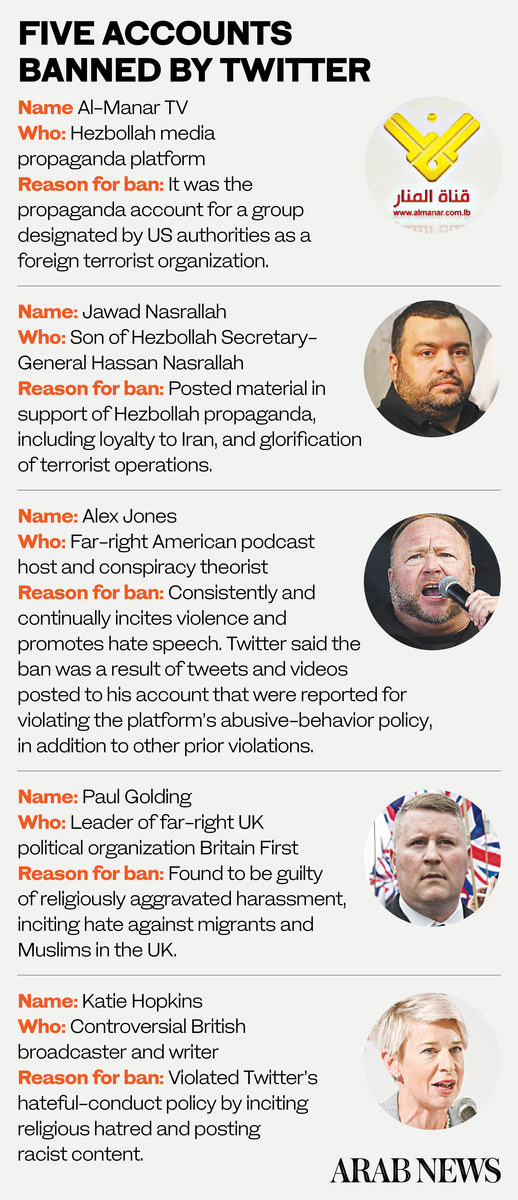
While Twitter has special rules that apply to the accounts of world leaders, it insists they are not immune to its enforcement policies. Yet some continue to post comment considered objectionable by many.
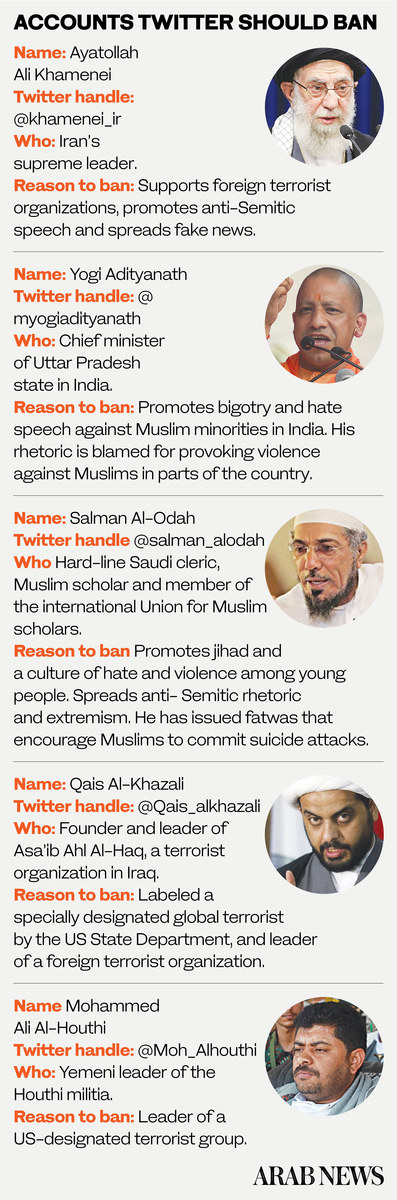
Iran’s Supreme Leader Ali Khamenei, for example, cannot be compared to President Trump in terms of number of followers or reach on Twitter, but his activity on the platform follows a similarly dangerous pattern. Just last week, the Iranian leader posted false claims across his multiple accounts — he has ones in English, Spanish, Farsi, Arabic and Russian — that COVID-19 vaccines developed in US and UK are “completely untrustworthy,” France has “HIV-tainted blood supplies,” and it is “not unlikely that they (Western countries) would want to contaminate other nations.”
This follows years of similarly dangerous and damaging tweets in which Khamenei incited violence against other nations. In May 2020, for example, he said that Iran will “support and assist any nation or any group anywhere who opposes and fights the Zionist regime.”
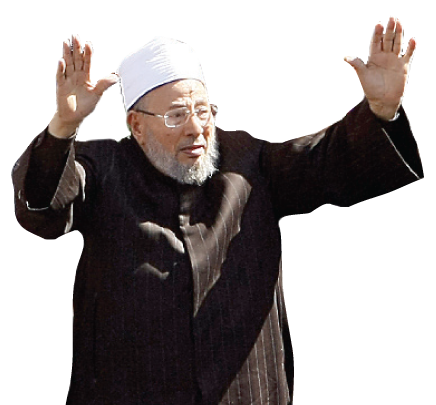
Yusuf Al-Qaradawi has a long history of issuing hate-filled fatwas — yet he continues to enjoy the freedom provided by Twitter, which he joined in May 2011, to spread his objectionable views and ideas to more than 3 million followers. (File/AFP)
Other accounts, such as those of Al-Qaradawi and Qais Al-Khazali — both of whom have featured in the Preachers of Hate series published by Arab News — also remain active. Al-Khazali, from Iraq, was designated as a global terrorist by the US State Department in January last year.
The issue is not unique to accounts originating in the Arab world. In India, for example, social-media platforms, including Facebook, have been criticized for continuing to allow users to spread hate speech.
Anti-Muslim rhetoric from Yogi Adityanath, chief minister of Uttar Pradesh state, is blamed for contributing to a rise in attacks against the minority Muslim community across the country, for example.
There are many accounts on Twitter and other social-media platforms that have prompted similar concerns. Observers warn that without better controls and moderation of objectionable content, Twitter runs the risk that its image as a promoter of free speech will be damaged and, through inactivity, it will come to be viewed as a promoter of hate speech.
Twitter did not respond to requests from Arab News for comment.


