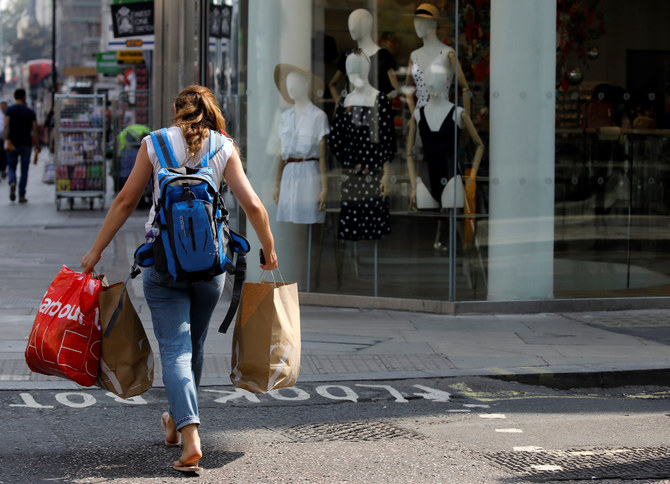
LONDON: Small businesses, from restaurants to nightclubs and wedding planners to beauty parlors, have won the right to insurance payouts after Britain’s highest court ruled their policies should cover losses caused by coronavirus lockdowns.
Six of the world’s largest commercial insurers — Hiscox, RSA, QBE, Argenta, Arch and MS Amlin — argued many business interruption policies did not cover widespread disruption after Britain’s first national lockdown last March.
But the UK Supreme Court dismissed appeals by the insurers after scrutinizing non-damage insurance policy clauses — which cover disease, denial of access to business premises and hybrid clauses — in a victory for the regulator and policyholders.
The test case, which has been watched closely overseas, has pitched the industry regulator against major insurance companies since last May and has been expected to affect 370,000 policyholders, 60 insurers and billions of pounds in claims.
Alistair Handyside, executive chair of the Professional Association of Self-Caterers UK, whose members had a policy with RSA, said he was delighted by a judgment that would mean survival for many amid a third lockdown.
But policyholders are now bracing for the next stage in their fight for payouts.
“It would appear we have won another battle 10 months too late,” said Murray Pulman, who runs The Posh Partridge cafe in Dorchester, southwest England.
“The war is not over, however,” he said.
“Getting payment, compensation and costs ... is another whole new fight which begins today.”
Hiscox, MS Amlin, Argenta and RSA said they would be paying claims as soon as possible.
Other insurers were not immediately available for comment. Hiscox estimated its 2020 COVID-19 estimate for business interruption had risen by $48 million net of reinsurance, bringing total claims to £136 million ($185.52 million).
Britain’s Financial Conduct Authority (FCA) said it would work with the industry to ensure they settled claims quickly and made interim payments if possible.
The case turned on business interruption policies with clauses offering cover when insured premises cannot be accessed because of public authority restrictions, in the event of a notifiable disease within a specified radius and hybrid wordings.
Insurers said they were paying valid claims but that they could not provide limitless cover for losses amassed when almost the entire economy was shut down and healthy people consigned to their homes in the most stringent restrictions on public life since World War Two.
London’s High Court ruled last September that some insurers had been wrong to deny cover, prompting six insurers, the FCA and the Hiscox Action Group of policyholders to challenge elements of the ruling they had lost in an appeal that leapfrogged the Court of Appeal because of its critical nature.
Christopher Croft, CEO of insurance brokers’ association LIIBA, said the industry’s reputation had been damaged.
“We need to think hard about how we redress that,” he said.

Businesses win COVID-19 insurance payouts after UK top court ruling
https://arab.news/jqjgc
Businesses win COVID-19 insurance payouts after UK top court ruling
GLOBAL MARKETS-Shares skid as oil blasts past $100 after Iran strikes Gulf shipping
SYDNEY: Shares in Asia fell broadly on Thursday as oil prices roared 9 percent past $100 a barrel on reports of more ships struck in Gulf waters and terminal shutdowns — a jump that could rapidly stoke inflation and push global borrowing costs higher.
Investors took little comfort from the International Energy Agency’s plan to release 400 million barrels of oil from its reserves, the largest such move in its history. As part of that, the US said it would release 172 million barrels of oil from next week.
Brent crude futures jumped 9.2 percent to $100.37 a barrel, extending a rise of more than 4 percent overnight. US crude futures surged 8.1 percent to $94.26 a barrel.
Shares slid, with MSCI’s broadest index of Asia-Pacific shares outside Japan falling 1.5 percent, while the Nikkei dropped 1.4 percent.
Chinese blue-chips lost 0.6 percent and Hong Kong’s Hang Seng index skidded 1.2 percent.
Both S&P 500 futures and Nasdaq futures fell 0.9 percent. EUROSTOXX 50 futures were down 0.8 percent and DAX futures lost 1 percent.
Two fuel tankers in Iraqi waters had been struck by explosive-laden Iranian boats, Iraqi security officials said early on Thursday, while an Iraqi official told state media that its oil ports “have completely stopped operations.”
Bloomberg reported that Oman has evacuated all vessels from its key oil export terminal at Mina Al Fahal as a precautionary measure.
“The market remains very concerned in terms of what’s going on in the Strait of Hormuz, and basically, information that we are getting over the last 24 hours is not a good reading,” said Rodrigo Catril, a senior FX strategist at NAB.
“It sort of reemphasizes the view that we should be worried about this and the risk is oil prices are going to get higher from here rather than coming down.”
Iran had earlier stepped up attacks on merchant ships in the Strait of Hormuz, raising the number of ships struck in the region since fighting began to at least 16. Tehran has warned the world to get ready for oil at $200 a barrel.
Throwing more uncertainty into the air, US President Donald Trump on Wednesday declared the war on Iran has been won but he will stay in the fight to finish the job.
INFLATION RISKS
US data showed the consumer price index rose 0.3 percent in February, in line with forecasts and above January’s 0.2 percent increase. The report, however, was not regarded as particularly relevant given that the Iran war has started to fuel inflation.
In bond markets, the risk of rising inflation outweighed safe-haven considerations to shove yields higher globally. Yields on 10-year Treasury notes rose 3 basis points to 4.2374 percent on Thursday, having jumped 7 bps overnight.
Fed funds futures extended their slide as investors feared higher inflation would make it harder for the Federal Reserve to ease policy. Markets are just wagering one more rate cut from the Fed this year.
The danger of energy-driven inflation has led markets to wager the next move in rates from the European Central Bank could be up, possibly as early as June.
Nervous investors sought the liquidity of dollars while shunning currencies from countries that are net energy importers, including Japan and much of Europe.
The euro slipped 0.2 percent to $1.1539, after closing at the weakest level since November last year. The dollar inched up 0.1 percent to 159.12 yen, the strongest level since January when reported rate checks from the US Fed spooked yen bears.
The risk-sensitive Australian dollar lost 0.4 percent to $0.7122, having hit a more than three-year high of $0.7188 on Wednesday as bets for an imminent rate hike from its central bank grew.