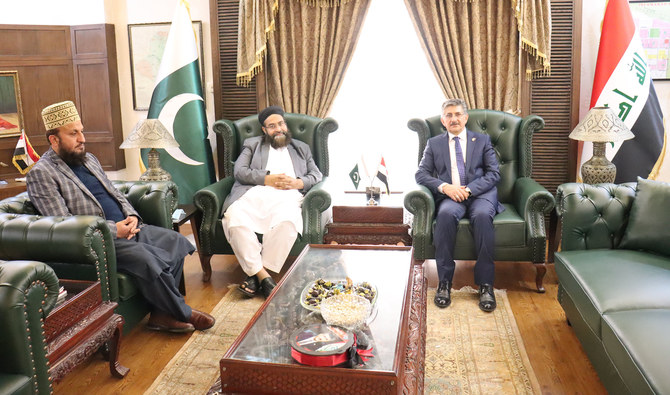
ISLAMABAD: The Pakistani prime minister’s special advisor on religious harmony and the Middle East, Tahir Mahmood Ashrafi, on Thursday called on the ambassadors of Oman and Iraq in Islamabad and announced that consultations were underway to set up a Pak-Arab Federation.
In his meeting with Iraq's Ambassador to Pakistan, Hamid Abbas Lafta, and Oman's Ambassador to Pakistan, Al- Sheikh Muhammad Umar Ahmed Al-Marhoon, Ashrafi said Prime Minister Imran Khan had been reinforcing better ties and bilateral coordination with Arab Muslim countries.
“Consultation is also underway to setup Pak-Arab Federation through assistance of all sections of society in Pakistan and public representatives and scholars of Arab Muslim countries at public level to promote relations,” Ashrafi said in a statement. “It is welcoming that leadership and people of Oman and Iraq are also willing and dedicated to strengthen ties and promote relations with Pakistan.”
He said every effort would be made to facilitate investors from Arab countries and to increase employment opportunities for Pakistanis in Arab states.
Lafta and Al-Marhoon said Pakistan was a very important Muslim country and had always played a “very effective role” to strengthen ties with all Muslim nations.


Pakistan says consulting with Muslim states to set up Pak-Arab Federation
https://arab.news/nc4dh
Pakistan says consulting with Muslim states to set up Pak-Arab Federation

- PM’s advisor on the Middle East calls on ambassadors of Oman and Iraq in Islamabad
- Says PM Khan focused on better ties, more coordination with Arab nations

UN says 270,000 Afghans have returned from Iran, Pakistan this year
- UNHCR says 110,000 Afghans returned from Iran while 160,000 returned from Pakistan since start of 2026
- Return numbers seem to have risen since Gulf war erupted on Feb. 28, says UNHCR official in Afghanistan
GENEVA: Some 270,000 Afghans have returned to their country from Pakistan and Iran so far this year, the UN said Tuesday, warning that the escalating Middle East war risked pushing the numbers higher.
UNHCR, the United Nations’ refugee agency, said that 110,000 Afghans had returned from Iran and another 160,000 had returned from Pakistan since the start of 2026.
And the numbers seem to have risen since the Middle East erupted on February 28, with the United States and Israel unleashing a barrage of strikes on Iran, and Tehran responding with drone and missile strikes on Israeli and US interests across the region.
Since then, there have been some 1,700 returns from Iran to Afghanistan each day, Arafat Jamal, UNHCR’s representative in Afghanistan, told reporters in Geneva.
Speaking from Islam Qala, on the Afghan-Iranian border, he said the situation there was “deceptively calm.”
“Returns are orderly but freighted with tension and apprehension,” he said, adding that with the hostilities elsewhere escalating, “I do fear there is more to come.”
“We are preparing for massive returns.”
He pointed out that Afghanistan was “facing the ramifications of what is happening with Iran,” while clashes have erupted along the Afghan border with Pakistan.
The new Middle East war, he warned, was “layering itself on top of an existing war on another frontier,” Jamal said.
UNHCR highlighted that the latest crises came after returns to Afghanistan had already been “exceptionally high” in recent years.
More than five million Afghans had returned from neighboring countries in the past two years, including 1.9 million returning from Iran last year alone.
Jamal warned that “many Afghan families are now facing cycles of displacement: first forced to flee Afghanistan, later displaced again inside Iran due to conflict, and now returning once more to Afghanistan.”
“And upon return in Afghanistan, the triply-displaced enter a spiral of precarity and uncertainty.”
Returns from Pakistan had meanwhile stabilized in recent weeks, as the main crossing point at Torkham remained closed due to the tensions there, Jamal said.
But he warned that “movements could increase sharply once the border reopens.”
UNHCR and the UN children’s agency UNICEF said Tuesday they were working to strengthen their capacity to operate at the borders and within Afghanistan.
But “given the scale of returns and the financial constraints facing humanitarian operations, additional support will be needed if arrivals increase,” UNHCR said, without specifying the amount needed.


