

Germany accuses Turkish think tank of pushing government propaganda in Europe

1 / 2
Turkey's President Recep Tayyip Erdogan, right, Foreign Minister Mevlut Cavusoglu, left, and Finance Minister Berat Albayrak, center, wearing face masks to protect against the spread of coronavirus, attend an inauguration ceremony, in Istanbul, Saturday, July 4, 2020. (AP)
2 / 2
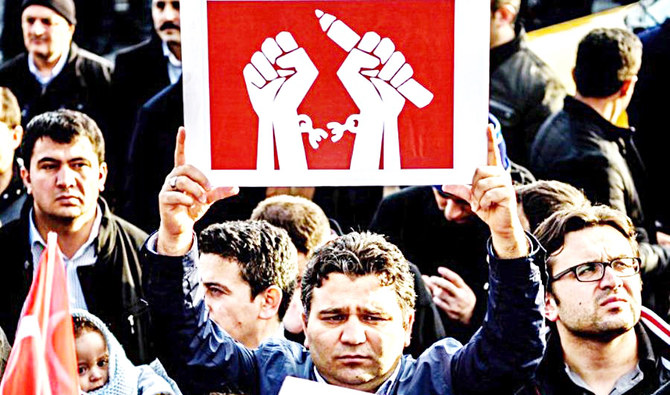
Demonstrators protest against the Turkish government’s curbs on media. (AFP/File)
Short Url
Updated 10 January 2021
Follow

Germany accuses Turkish think tank of pushing government propaganda in Europe

  • Germany’s internal intelligence service, BfV, has been investigating SETA’s activities in Germany for a while. Last month it published a report accusing SETA of pursuing the Turkish government’s agenda in Germany

ANKARA: Germany has accused a Turkish think tank of being a front for President Recep Tayyip Erdogan’s party and spreading government propaganda in Europe.

The Foundation for Political, Economic and Social Research (SETA) has had an office in Berlin since 2017.

SETA is known to be financed by the family of Erdogan’s son-in-law and former finance and treasury minister, Berat Albayrak, and it has representative offices in Brussels and Washington D.C.

Germany’s parliament accused SETA of collecting intelligence and spreading the views of the Turkish government using scientific research activities as a cover.

The federal government said that SETA’s aim was to garner influence in German public opinion and frame the political debates about Turkey with various instruments, including nominating candidates in local elections. It was acting in response to a parliamentary inquiry from the Free Democratic Party (FDP).

Stephan Thomae, from the FDP, said the government had lost its patience and abandoned its cautious approach toward Turkey’s efforts to establish diplomatic leverage in Germany, Deutsche Welle reported.

“It has been clear for some time that SETA is part of the government of Turkey 's information game,” tweeted Steven A. Cook, a senior fellow at the New York-based Council on Foreign Relations. “Too few in Washington understand that it is not actually a research organization.”

SETA previously came under fire from the international community in 2019, when it published two reports.

It catalogued the correspondents of international news outlets in Turkey, while another report on the structure of the outlawed Kurdistan Workers’ Party (PKK) in Europe claimed that the group collaborated with racist white supremacists on the continent.

HIGHLIGHT

Germany’s parliament accused SETA of collecting intelligence and spreading the views of the Turkish government using scientific research activities as a cover.

Press freedom groups condemned the SETA media report as a dangerous escalation in the treatment of journalists, and a criminal complaint against the SETA report was filed on a series of charges including “inciting the public to hatred and enmity.”

The report profiled social media sharing and the personal backgrounds of Turkish journalists who worked for international media, including Arab News, effectively making them a government target.

Germany’s internal intelligence service, BfV, has been investigating SETA’s activities in Germany for a while. Last month it published a report accusing SETA of pursuing the Turkish government’s agenda in Germany.

“US authorities should follow suit with SETA’s Washington counterpart. This propaganda shop has long been the main beacon of Erdoganism in the United States,” Sinan Ciddi, associate professor of national security studies at the Marine Corps University in the US, tweeted.

Turkish opposition parties’ requests for a parliamentary inquiry about SETA’s financial resources and activities were rejected by Ankara in 2019.

SETA has been exempt from tax since 2013, unlike other think tanks in Turkey.

The Turkish presidency’s communication director Fahrettin Altun and the presidency’s lead spokesman Ibrahim Kalin used to work at SETA.

SETA has not yet released an official statement about the German government’s claims.


How Gaza’s shattered fishing industry deepened the enclave’s food security crisis

Updated 6 sec ago
Follow

How Gaza’s shattered fishing industry deepened the enclave’s food security crisis

  • Once a pillar of local food security, Gaza’s fishing sector has been reduced to a fraction of its prewar capacity
  • UN agencies warn the destruction of boats and ports has deepened aid dependence and worsened protein shortages

DUBAI: Gaza’s fishing industry — once a critical source of food, income and affordable protein — has been largely destroyed as a result of Israel’s war with Hamas, worsening the Palestinian enclave’s food security crisis.

According to the UN Food and Agriculture Organization, fishing activity in Gaza now stands at less than 10 percent of prewar levels following the widespread destruction of boats, ports and equipment, combined with prolonged maritime closures enforced under Israel’s naval blockade.

UN and human rights organizations estimate that up to 72 percent of Gaza’s fishing fleet has been damaged or destroyed, alongside near-total devastation of related infrastructure, including landing sites, storage facilities and repair workshops.

Israel's naval blockade has Gaza's fishing industry to decline to about a tenth of pre-war levels. (Reuters photo)

The remaining vessels are small, damaged skiffs capable of operating only meters from shore.

Ramzy Baroud, a journalist, author and editor of The Palestine Chronicle, said the destruction of Gaza’s fishing sector must be understood as part of a deliberate policy aimed at preventing Palestinians from developing independent food-producing systems.

Baroud says Israel had pursued a strategy since 1967 to foster Palestinian dependency — first on the Israeli economy, and later on humanitarian aid entering Gaza through Israeli-controlled crossings — leaving the population permanently vulnerable to economic collapse.

“This vulnerability is functional for Israel, as it allows the Israeli government and military to leverage their control over Palestinian lives through political pressure in pursuit of concessions,” he told Arab News.

Palestinians were prevented from developing local industry through restrictions on imports and exports, while much of Gaza’s arable land was seized or turned into military targets, he said.

“Likewise, the fishing sector was deliberately crippled through direct attacks on fishermen, including arrests, live fire, confiscation of equipment, and the sinking or destruction of boats,” he added.

FAO has documented widespread destruction across Gaza’s coastal fishing areas.

“In Gaza’s fishing areas now lie broken boats, torn nets, and ruined infrastructure, standing in stark contrast to the once-vibrant industry that supported thousands of fishers for generations,” Beth Bechdol, FAO deputy director-general, said in a statement.

Before the war, more than 4,000 registered fishermen worked along Gaza’s 40-kilometer coastline, supporting tens of thousands of family members and contributing to local food security in an enclave heavily dependent on imports.

Today, the majority have been stripped of their livelihoods, as access to the sea has become sporadic, dangerous, or entirely prohibited.

For decades, fishing off Gaza was restricted to shifting maritime zones — typically between three and 12 nautical miles offshore — often tightened or closed entirely during periods of escalation.

Since October 2023, when the Israel-Hamas conflict began, humanitarian organizations say there have been extended periods of total maritime closure, effectively banning fishing and depriving Gaza’s population of one of its few remaining sources of local food production.

Baroud said the assault on Gaza’s fishing sector was not a by-product of war, but part of a deliberate strategy that intensified during the conflict.

“For Gaza, the sea represents freedom,” he said. “All of Gaza’s other borders are controlled by Israel, either directly or indirectly.”

Israel had consistently worked to deny Palestinians access to the sea, he said. And despite commitments under the Oslo Accords to allow fishing up to 20 nautical miles offshore, those provisions were never honored.

“The assault on Gaza’s fishing sector is therefore not incidental,” Baroud said. “It is about severing Palestinians from one of the few spaces not entirely enclosed by walls, checkpoints, and military control.”

Israel has generally rejected or not accepted accusations that it is unlawfully targeting Gaza’s fishermen, framing incidents at sea as enforcement of security zones or as under investigation rather than deliberate attacks on civilians.​

In past lethal incidents at sea highlighted by Human Rights Watch, the Israel Defense Forces have typically said boats “deviated from the designated fishing zone” and that forces fired after warnings were ignored.

According to FAO, rebuilding Gaza’s fishing sector will be impossible without a fundamental change in access and security conditions.

“For Gazans, the sea was not just a source of food, but a source of livelihood and identity,” Bechdol said.

“FAO can assist to help rebuild Gaza’s fishing industry. But for this to happen, peace must first be established and fishers must be allowed to operate their boats and cast their nets without fear of harm.”

Ciro Fiorillo, head of the FAO office for the West Bank and Gaza, said the agency is primed to offer assistance once the security situation improves.

“FAO is ready to restart projects, replenish damaged boats and equipment, and inject emergency funds as soon as these key fishing inputs for production are allowed to enter the Strip, a sustained ceasefire is in place, and access to the sea is restored,” Fiorillo said in a statement.

Since the Oct. 7, 2023, Hamas-led attack on southern Israel triggered the Israeli military assault on Gaza, much of the enclave has been flattened, tens of thousands killed, and some 90 percent of the population displaced.

Even since the ceasefire came into effect with the exchange of hostages and prisoners in October last year, pockets of violence have continued and humanitarian needs remain dire. The collapse of fishing has only compounded an already catastrophic food crisis.

The UN Office for the Coordination of Humanitarian Affairs has repeatedly warned that the destruction of food-producing systems — including agriculture, fisheries and markets — has pushed Gaza toward famine, with households facing extreme shortages of protein and calories.

With farmland destroyed, livestock killed and imports severely restricted, fish was once among the few foods that could still be sourced locally.

Its near disappearance has driven prices beyond reach for most families and increased dependence on limited humanitarian aid.

“This is about denying Palestinians access to life itself — to survival,” said Baroud.

The destruction of fishing forces Palestinians into deeper dependence on humanitarian aid that Israel itself controls, effectively weaponizing food rather than allowing Palestinians to sustain themselves independently, he said.

Human rights groups documenting maritime enforcement report that fishermen attempting to operate — even close to the shore — face gunfire, pursuit, detention and arrest, contributing to a climate in which fishing has become a life-threatening activity rather than a livelihood.

According to rights monitors, the destruction of larger vessels has eliminated the possibility of reaching deeper waters, forcing the few remaining fishermen to operate in unsafe, shallow zones with damaged equipment, limited fuel and no protection.

Baroud said international law clearly obligates an occupying power to protect civilian livelihoods and ensure access to food and means of survival.

“The systematic targeting of fishermen — who are civilians engaged in subsistence activity — cannot be justified as a military necessity, especially when it results in starvation and famine,” Baroud said.

He said the Fourth Geneva Convention prohibits collective punishment, the destruction of civilian infrastructure and the targeting of livelihoods.

The Palestinian Centre for Human Rights has described the restriction of Gaza’s fishing sector as part of a broader assault on civilian survival systems, warning that the denial of access to the sea has direct implications for nutrition, employment and aid dependency.

Baroud said the recovery of Gaza’s fishing sector could not occur in isolation from the broader economy.

“Only a measure of real freedom for Palestinians — freedom of movement, access to land and sea, and the ability to import, export and produce independently — can allow Gaza’s industries and economy to recover,” he said.

Without ending the system of control governing Palestinian life, Baroud said, any discussion of reconstruction or recovery would remain hollow.

As famine warnings intensify, the fishing sector’s collapse stands as a stark example of how Gaza’s food system has fractured.

What was once a daily livelihood is now reduced to occasional, high-risk attempts to secure food.

With no functioning fleet and no safe access to waters, Gaza’s fishermen are operating at the edge of survival.