KARACHI: Prime Minister Imran Khan announced during his trip to Quetta on Saturday that his government was planning to set up a new security cell that would be responsible for providing protection to the minority Hazara community.
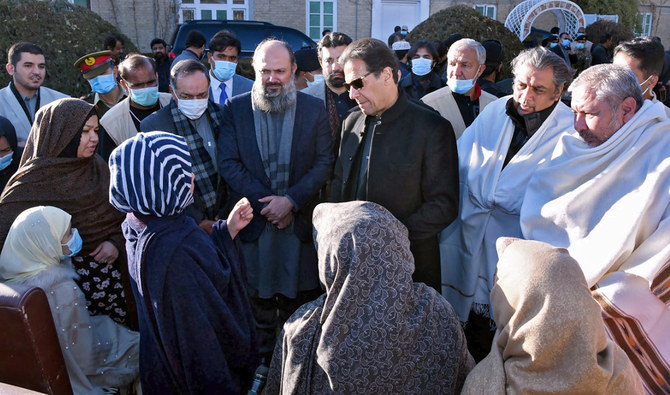
Khan made the statement while interacting with the grieving relatives of 11 Shia Hazara coal miners who were killed in a sectarian attack by Daesh on January 3.
"I was constantly in touch with our intelligence agencies and discovered that there are about 35 to 40 people who were committing such acts of terror," he said. "We have developed a whole program [to counter such incidents] and are making a new security cell that will be responsible for providing you full protection."
He added that he knew how members of the Hazara community were targeted in the past, adding that his administration would forcefully go after the perpetrators of the recent attack.
"Our intelligence agencies informed us in March that India was planning to instigate trouble in Pakistan by assassinating leaders of Shias and Sunnis," Khan continued. "I must also applaud the Inter-Services Intelligence [Pakistan’s spy agency] for preempting at least three or four assassination plots. So, I have absolutely no doubt in my mind that this tragedy was also part of the bigger [geopolitical] game."
Thousands of Shia Hazaras in southwestern Balochistan had blockaded a highway in Quetta with the bodies of the coal miners after last week's sectarian, saying they would not withdraw or bury the deceased until Khan met them and the killers were brought to justice.
A controversy erupted on Friday, however, when the prime minister suggested that the mourners were "blackmailing" him by not burying their dead.
"This is not the first time our community has been targeted," a grieving Hazara woman told him while explaining why the protesters were insisting on meeting with him. "Several ministers also visited us in the past and promised to offer us protection. That's why you were our only hope."
Khan said that his mission was not just to unite people in Pakistan but also address sectarian divisions within the Muslim world.
"Don't worry, we will fully take care of you," he told a member of Hazara community who said that her only brother, who took care of the whole family, had been killed in the incident.
The prime minister, who landed in Quetta on Saturday after the burials of the coal miners, assured the families of the slain workers that his government would fully implement its written agreement with them and provide full protection to their community.
Earlier on Friday, protesters and grieving families were met by two federal ministers and provincial chief minister after the agitation worsened following the Prime Minister's controversial words.
Speaking to the media after talks with the protesters, the government's chief negotiator, Ali Haider Zaidi, said that a written agreement had been struck between the Hazara community and the government for the first time.
According to the agreement, a copy of which is available with Arab News, a high-level commission will investigate the incident and the outcomes of other investigations of militant acts against the Shia Hazara community in the last 22 years.
The agreement says the commission will expedite the punishment/execution of those arrested "in acts of terrorism" against the Hazara Shia community, and would "probe" the community's missing persons cases.
The government will provide Rs. 1.5 million ($9,360) as monetary compensation to the family of each slain person and "initiate process for job employment" to the next of kin of the slain.
The agreement also says that the government of Balochistan and other law enforcement agencies would chalk out a "comprehensive security strategy" for highways and for mines belonging to the Hazara Shia community.
Under the agreement, a special committee will be formed to address the grievances of the Hazara community in the issuance of national identity cards and passports.
Federal Maritime Minister Ali Zaidi, Special Assistant to the PM Zulfi Bukhari, National Assembly Deputy Speaker Qasim Suri, Provincial Home Minister Mir Zia Langu and other provincial ministers and civil society leaders were present during funeral prayers offered in Quetta on Saturday, alongside thousands of other attendees.


![]()

Special security cell to provide protection to minority Hazara community — PM Khan
Short Url
https://arab.news/4zv8y
Special security cell to provide protection to minority Hazara community — PM Khan
- The prime minister blames India for the killing of Hazara coal miners, describing the tragedy as 'part of the bigger game'
- Khan promises to forcefully go after the perpetrators of the recent anti-Hazara attack and bring them to justice
Latest updates


© 2026 SAUDI RESEARCH & PUBLISHING COMPANY, All Rights Reserved And subject to Terms of Use Agreement.