

Almost 2.3 million people need aid in Tigray: UN report

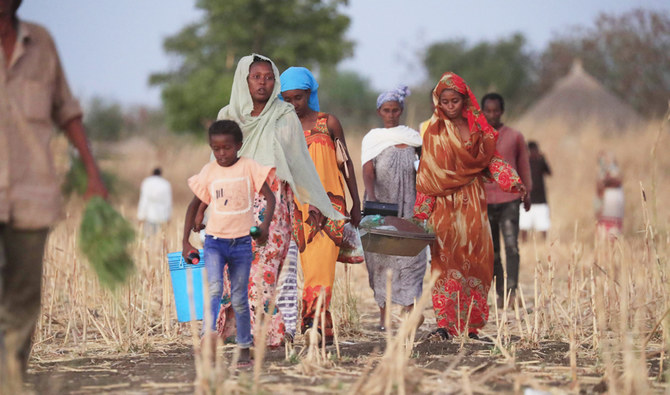
The fighting in Tigray has left thousands dead, and sent tens of thousands of refugees streaming across the border into Sudan. (File/AFP)
Short Url
Updated 08 January 2021
Follow

Almost 2.3 million people need aid in Tigray: UN report

  • The findings in the humanitarian report stem from two missions conducted at the end of December by UN and government agencies

NEW YORK: Fighting is still going on in several parts of Ethiopia’s northern Tigray region and almost 2.3 million people, or nearly half of the population, need aid, a UN report said.
The report, the most comprehensive public assessment of the humanitarian situation in Tigray since conflict erupted there on Nov. 4, was posted online late on Thursday.
It said food supplies were very limited, looting was widespread and insecurity remained high.
Federal government troops are fighting the Tigray People’s Liberation Front (TPLF), a political party that was governing the province. The government declared victory in late November though the TPLF vowed to fight on.
Ethiopia’s National Defense Force said late on Thursday that four senior TPLF members had been killed and nine arrested.
The TPLF could not be reached for comment.
The whereabouts of TPFL leader Debretsion Gebremichael, other members of the party’s central committee and many high-ranking former military officers remains unknown.
The findings in the humanitarian report stem from two missions conducted at the end of December by UN and government agencies.
They said the humanitarian situation was dire and two out of four refugee camps in Tigray remained inaccessible.
The report said fighting was reported in rural areas as well as on the periphery of regional capital Mekelle and the towns of Shire and Sheraro, among other locations.
The fact-finding teams also said schools, hospitals and administrative offices had been looted and damaged.
They said only five out of 40 hospitals in Tigray were physically accessible, with another four reachable by mobile networks.

FASTFACT

The fact-finding teams said only five out of 40 hospitals in Tigray were physically accessible, with another four reachable by mobile networks.

They said the health facilities in the major cities that were partially functioning had “limited to no stock of supplies and absence of health workers.”
The disruption might also coincide with a massive spike in COVID-19 cases, the report said.
“The interruption of COVID-19 surveillance and control activities for over a month in the region, coupled with mass displacements and overcrowded conditions in displacement settings, is feared to have facilitated massive community transmission of the pandemic,” it said.
The report said regional and local bureaucratic hurdles were preventing some agencies getting into Tigray, despite clearance from the federal government. It also said humanitarian supplies and equipment were being looted in some areas.
Ethiopia’s own estimates of people in need of aid are even higher than UN figures. The UN said 950,000 needed aid before the conflict and another 1.3 million would now need help.
However, the report said the government-run Tigray Emergency Coordination Center estimated that more than 4.5 million people needed emergency food assistance, including 2.2 million people who had been forced to flee their homes within Tigray.
Reuters could not immediately reach the center for comment and other government officials were unavailable.


Terror at Friday prayers: Witnesses describe blast rocking Islamabad mosque

Updated 2 sec ago
Follow

Terror at Friday prayers: Witnesses describe blast rocking Islamabad mosque

  • The Daesh group has claimed responsibility for the attack, according to the SITE Intelligence Group, which monitors jihadist communications
ISLAMABAD: A worshipper at the Shiite mosque in Islamabad where dozens of people were killed in a suicide blast on Friday described an “extremely powerful” explosion ripping through the building just after prayers started.
Muhammad Kazim, 52, told AFP he arrived at the Imam Bargah Qasr-e-Khadijatul Kubra mosque shortly after 1:00 p.m. (0800 GMT) on Friday and took up a place around seven or eight rows from the Imam.
“During the first bow of the Namaz (prayer ritual), we heard gunfire,” he told AFP outside the Pakistan Institute of Medical Sciences (PIMS) hospital, where many of the wounded were brought for treatment.
“And while we were still in the bowing position, an explosion occurred,” he said.
Kazim, who is from Gilgit-Baltistan in northern Pakistan and lives in Islamabad, escaped unharmed, but accompanied his wounded friend to the PIMS hospital for treatment.
“It was unclear whether it was a suicide bombing, but the explosion was extremely powerful and caused numerous casualties,” Kazim said.
“Debris fell from the roof, and windows were shattered,” he added. “When I got outside, many bodies were scattered... Many people lost their lives.”
The Daesh group has claimed responsibility for the attack, according to the SITE Intelligence Group, which monitors jihadist communications.
Another worshipper, Imran Mahmood, described a gunfight between the suicide bomber, a possible accomplice and volunteer security personnel at the mosque.
“The suicide attacker was trying to move forward, but one of our injured volunteers fired at him from behind, hitting him in the thigh,” Mahmood, in his fifties, told AFP.
“He fell but got up again. Another man accompanying him opened fire on our volunteers,” he said, adding the attacker “then jumped onto the gate and detonated the explosives.”
As of Saturday morning, the death toll stood at 31, with at least 169 wounded.
The attack was the deadliest in the Pakistani capital since September 2008, when 60 people were killed in a suicide truck bomb blast that destroyed part of the five-star Marriott hotel.

Lax security

Describing the aftermath of the attack, Kazim said unhurt worshippers went to the aid of those wounded.
“People tried to help on their own, carrying two or three bodies in the trunks of their vehicles, while ambulances arrived about 20 to 25 minutes later,” he told AFP.
“No one was allowed near the mosque afterwards.”
Kazim, who has performed Friday prayers at the mosque “for the past three to four weeks,” said security had been lax.
“I have never seen proper security in place,” he told AFP.
“Volunteers manage security on their own, but they lack the necessary equipment to do it effectively,” he said.
“Shiite mosques are always under threat, and the government should take this seriously and provide adequate security,” he added.