

Pakistan says setting up interfaith harmony councils to resolve ‘sectarian conflicts’

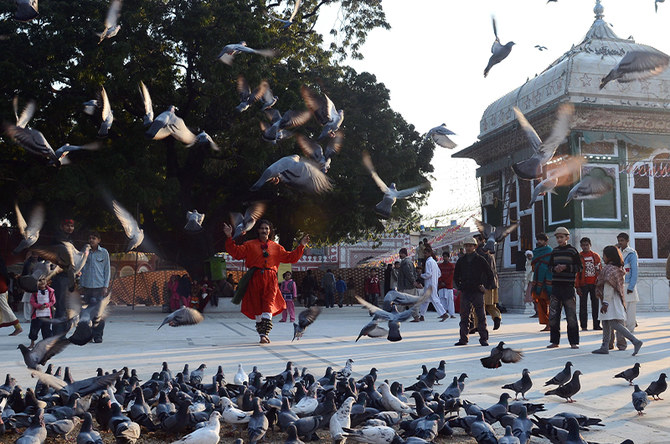
A Pakistani Muslim devotee dances at the shrine of saint Mian Mir Sahib during the 389th death anniversary of the saint in Lahore on January 20, 2013. (AFP/File)
Short Url
Updated 08 January 2021
Follow

Pakistan says setting up interfaith harmony councils to resolve ‘sectarian conflicts’

  • Pakistan is currently in the midst of protests over the killing of 11 miners from the Shia Hazara minority in southwestern Balochistan on Sunday
  • PM’s adviser on interfaith harmony says no space for sectarianism in Islam, militant groups like Daesh, Taliban, Al-Qaeda have no ‘link’ with Muslims

ISLAMABAD: Tahir Mahmood Ashrafi, special adviser to the prime minister on religious harmony and the Middle East, has said Pakistan is establishing interfaith harmony councils at the local, provincial and national levels to promote dialogue and resolve sectarian conflicts.

Pakistan is currently in the midst of protests over the killing of 11 miners from the Shia Hazara minority in southwestern Balochistan on early Sunday. The Daesh group claimed responsibility for the attack in a statement on its website. The militant group has repeatedly targeted Pakistan’s minority Shias in recent years. 

Families of the victims placed the dead bodies on a road connecting Quetta with Sukkar on Sunday, but later moved them to the provincial capital where they have been sitting with the coffins on a major highway since. They demand that they will call off their sit-in only when Prime Minister Imran Khan visits Quetta to meet protesters. 

“We are going to establish interfaith harmony councils from the grassroots level to the top, from the union council level to the national level to promote dialogue and resolve all issues among different sects through negotiation,” Ashrafi told international media in an interview. ”There is no space for sectarianism in Islam. We have a tolerant society in Pakistan, where we work together with Christians, Hindus, Sikhs, and other minorities.”

“Daesh, Pakistani Taliban, Al-Qaeda, and other organizations are killing innocent people. They are linking themselves with Islam, but they have no link or relation with Muslims and Islam,” Ashrafi added. 

Ashrafi said there was no pressure on Pakistan to recognize Israel. 

Pakistan currently does not recognize the state of Israel over its thwarting of Palestinians’ aspirations for a state of their own. Israel captured the West Bank and East Jerusalem, the Sinai peninsula and the Gaza Strip and the Golan Heights in the 1967 Middle East war. Palestinians want East Jerusalem as the capital of their future free state, a demand Pakistan has supported for decades.

“Our prime minister has categorically rejected any plan to establish any kind of relationship with Israel until there is a just settlement, which satisfies Palestinians. And I don’t think Saudi Arabia will accept Israel too,” Ashrafi said. “Again, I repeat that no country has asked us to accept Israel. Pakistan is not a small country. We are a nuclear power, have a strong army and are a strong nation. Nobody can order us to establish ties with Israel.”


Pakistan plans $80 million seafood zone at Karachi harbor to target Gulf markets

Updated 45 min 51 sec ago
Follow

Pakistan plans $80 million seafood zone at Karachi harbor to target Gulf markets

  • Plan aims to move exports away from raw seafood toward higher-value processed products
  • Project will be developed under public-private partnership or build-operate-transfer model

KARACHI: Pakistan plans to develop a seafood processing and export zone at Karachi’s Korangi Fisheries Harbor that could cost up to $80 million to boost value-added exports and position the country as a supplier to the Gulf and other regional markets, Maritime Affairs Minister Muhammad Junaid Anwar Chaudhry said on Saturday.

The proposed 100-acre project aims to shift Pakistan away from exporting raw seafood by building modern processing, cold-chain and packaging infrastructure linked to international buyers, as Islamabad looks to expand its blue economy and deepen maritime trade ties with the region.

In a statement, Chaudhry said the zone would be developed, financed and operated under a public-private partnership or build-operate-transfer (BOT) model, with private investors running the facilities and the Qur’angi Fisheries Harbor Authority retaining regulatory oversight.

“The estimated project cost ranges between $60 million and $80 million, based on regional benchmarks from countries such as Vietnam, China and Ecuador, which have developed similar seafood parks,” Chaudhry said.

He said the facility would include 20 to 25 medium- to large-scale seafood processing units for fish, shrimp and cephalopods, alongside large-scale cold storage, blast freezing, packaging facilities, logistics and export terminals, and a wastewater treatment plant to ensure environmentally compliant operations.

“Packaging and labeling units would operate under international food safety and quality standards, including HACCP and ISO certifications, offering vacuum packing, modified atmosphere packaging and retail-ready solutions,” he said, referring to Hazard Analysis and Critical Control Points, a preventive food safety system.

ISO certification verifies that a company’s management systems meet international standards.

The minister said the zone would be used exclusively for commercial seafood processing, packaging, cold storage and export-oriented activities, with multi-temperature storage ranging from minus 18 to minus 40 degrees Celsius and ice plants capable of producing 50 to 100 tons daily.

Chaudhry said the preferred investment structure is a BOT concession under which the private partner would finance, develop and operate the project for an expected 20-year tenure, with ownership reverting to the harbor authority at the end of the concession period.

He added that the estimated internal rate of return was projected between 13 percent and 17 percent, with revenue generated through lease rentals, processing fees, logistics services and export-linked earnings.

“The project will position Pakistan as a key maritime trade and seafood export hub serving Gulf, East African and Asian markets,” Chaudhry said.