


NEW YORK: Syria and close ally Russia clashed with the US and other nations over a Western initiative to suspend Syria’s voting rights in the global chemical weapons watchdog for failing to provide details of three chemical attacks in 2017 that investigators blamed on the Bashar Assad regime.
The confrontation in the UN Security Council foreshadowed a showdown when the 193 member states of the Organization for the Prohibition of Chemical Weapons (OPCW) meet in The Hague, Netherlands, in April to consider a French-drafted measure, on behalf of 46 countries, to suspend Syria’s “rights and privileges” in the body.
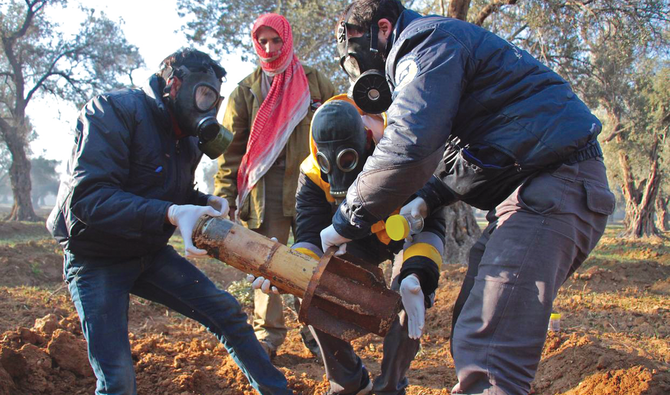
The French proposal was a response to Syria’s failure to meet a 90-day deadline set in July by the OPCW’s executive council for Damascus to declare the nerve agent sarin and chlorine, which OPCW investigators said last April were dropped by the Syrian air force on the central town of Latamneh in late March 2017.
The Western effort reflects a much broader effort to obtain accountability for Syrian chemical attacks and highlight claims that the Assad regime is secretly continuing its chemical weapons program.
Syria joined the Chemical Weapons Convention in September 2013, pressed by Russia after a deadly chemical weapons attack that the West blamed on Damascus.
By August 2014, the Assad regime declared that the destruction of its chemical weapons was completed. But Syria’s initial declaration of its chemical stockpiles and chemical weapons production sites has remained in dispute.
Ireland’s UN ambassador, Geraldine Byrne Nason, a new council member, said it was “deeply disturbing” that the OPCW still cannot determine whether the initial declaration was accurate or complete because of gaps and inconsistencies. She said the problems are not “minor” as some would portray, alluding to Russia.
“Over those seven years, the number of issues that need to be addressed has expanded from five to 19,” Byrne Nason said. “There have been 17 amendments to Syria’s declaration including the addition of a production facility, four research and development centers, and doubling of the amount of declared agents and chemicals.”
In addition, she said, there are issues related to “hundreds of tons of missing agents and munitions reported destroyed” before Syria joined the chemical convention as well as recent reports of a production facility that Damascus declared as never having been used, “where there is clear evidence to the contrary.”
Norwegian Ambassador Mona Juul, another new council member, also expressed concern at Syria’s failure to explain an unnamed chemical that can be used in chemical weapons but also has non-weapons uses. It was detected at the Barzah facilities of the Syrian Scientific Studies and Research Center.
Russia’s deputy UN ambassador, Dmitry Polyansky, again accused OPCW investigators of being “unscrupulous” and alleged they used “forgeries” and “manipulations” to blame Syria.
He called the chemical watchdog “seriously ill with politicization.” And he accused a number of unnamed countries of “playing this `chemical card’ to step up pressure on the Syrian government that they failed to overthrow in the wake of the so-called Arab Spring.”
As for the initial Syrian declaration, Polyansky said Damascus was not “an extraordinary case,” pointing to amended declarations by Western countries including France and Germany as well as Libya. He accused Western delegations of trying to “inflate agitation” around Syria.
French Ambassador Nicolas De Riviere expressed regret at “the false accusations of those who seek to discredit OPCW” and its findings about Syria’s attacks.
“There is simply the reality of the facts,” he said. “We all know them: the regime used weapons of war prohibited by international law against its own population, and since then we have seem chemical weapons re-emerge and become commonplace in Syria and elsewhere.”
British Ambassador Barbara Woodward said OPCW investigators, alone and initially with a UN team, determined Syria used chemical weapons on at least six occasions.
“These are not hypothetical issues for the thousands of Syrian civilians who have suffered the horrifying effects on the body of nerve agents and chlorine,” she said.
Syria’s deputy foreign minister and former UN ambassador, Bashar Ja’afari, accused some unnamed Western nations of using the OPCW “as a platform to fabricate allegations and then justify an assault and aggression on Syria.”
The aim, he said, is “to frame the Syrian government for the use of chemical weapons and exonerate the terrorists and the sponsors ... and give them the necessary means to escape through the occupied Golan area through Israel to the capitals of Western states where they can live.”
Russia’s Polyansky said Syria could not meet the OPCW’s anti-Syria demands on Latamneh because it “simply doesn’t have” the chemical weapons and facilities the organization is seeking.
“Hopefully, the majority of delegations at the member states’ conference in April will reject this provocation, and the West-initiated decision, which is `punitive’ by nature, will not pass,” he said.
US deputy ambassador Richard Mills said neither the Security Council nor the world “is fooled” by Russia’s accelerated campaign to discredit the OPCW.
He urged council members to call on all countries to support the French draft against Syria in April “aimed at promoting accountability for the Assad regime’s actions.”
“It is time that the Syrian people, and indeed all the globe’s people, be allowed to live in a world free of the threat of chemical weapons,” he said.


