Iran dithering on crash probe, says Ukraine airline

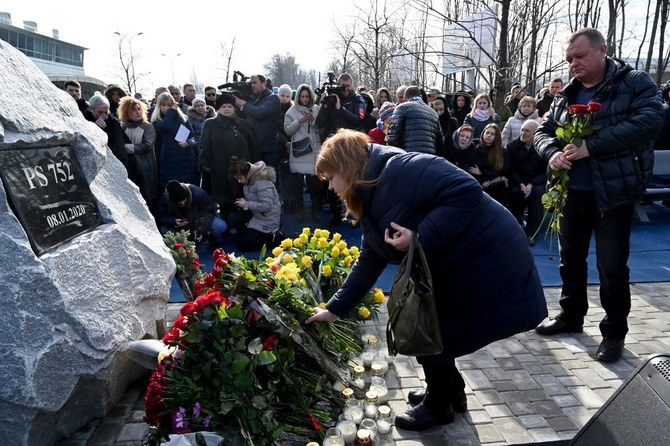
Relatives and colleagues of the 11 Ukrainians who died in a plane mistakenly shot down by Iran lay flowers during a ceremony. (File/AFP)
Short Url
Updated 06 January 2021
Follow

Iran dithering on crash probe, says Ukraine airline

  • Tehran has admitted its anti-air missiles brought down the plane by mistake on January 8 last year
  • We haven’t got an answer to the main question: how could this happen and who is responsible: UIA chief

KIEV: Iranian investigators probing the downing of a passenger plane a year ago are deliberately dragging their feet, Ukraine International Airlines (UIA) said on Wednesday.
Tehran has admitted its anti-air missiles brought down the plane by mistake on January 8 last year during heightened tension with the US, killing all 176 passengers and crew, including 55 Canadians.
“We haven’t got an answer to the main question: how could this happen and who is responsible,” UIA chief Yevhenii Dykhne told AFP, saying “the process isn’t moving.”
“The tactic on the Iranian side is to sweep under the rug, to drag their feet,” he said.
“There needs to be more serious pressure from those countries whose citizens died.”
Canadian Prime Minister Justin Trudeau last month called on Iran to answer questions about the downed plane after an independent Canadian report complained that Iran was “investigating itself, largely in secret.”
The report said Iran’s probe suffered “obvious conflicts of interest... with few safeguards to ensure independence, impartiality or legitimacy.”
Ukraine officials confirmed this week they had received on December 31 a preliminary “technical report” from Iran on the circumstances of the disaster.
They now have two months to review the document and decide if they are satisfied.
Iran’s Revolutionary Guards on Wednesday blamed the “bitter event” on “the inhuman adventurism of the United States and its terrorist actions in the region.”
The disaster came as Iranian forces were on high alert after the US assassination of revered Iranian military commander Qasem Soleimani in neighboring Iraq and a retaliatory Iranian rocket attack on US bases there.
In a statement, the Guards — seen as Iran’s ideological army — called the deaths “very difficult and sad for everybody.”
But they said the event “proved once again that the global arrogance (the US) has reached the height of vice and resentment against the Islamic Republic and the people of Iran.”
Tehran has offered to give $150,000 to the families of each of the victims.
But airline boss Dykhne joined widespread criticism of the offer, dismissing it as a “media strategy just designed to test our reaction.”
Iran’s government has not made an official proposal for payouts, he added, arguing that “international precedents” should be used to set the level of compensation.
In 1996, Washington agreed to pay a total of $61.8 million to the families of 290 people killed in an Iran Air plane shot down by a US warship in 1988.
And after its 2003 admission of responsibility for the 1988 Lockerbie bombing of a US-bound passenger plane, Libya paid $2.7 billion to the families of the 270 people killed.
Whatever the amounts, payouts should only follow technical and criminal inquiries into the deaths and a determination whether the shooting down of the plane was due to human error or a planned “military” act, Dykhne said.


For Syria’s Kurds, dream of autonomy fades under Damascus deal

Updated 5 sec ago
Follow

For Syria’s Kurds, dream of autonomy fades under Damascus deal

  • “We made many sacrifices,” said Mohammed, spokesperson for the YPJ
  • The YPJ is part of the Kurdish-led Syrian Democratic Forces that spearheaded the fight against Daesh

HASAKEH, Syria: At a military base in northeast Syria, Roksan Mohammed recalled joining the battle against Daesh group militants. Now her all-woman fighting unit is at risk after a deal with Damascus ended the Kurds’ de facto autonomy.
“We made many sacrifices,” said Mohammed, spokesperson for the Women’s Protection Units (YPJ), who stood with a gun slung over her shoulder.
“Thousands of martyrs shed their blood, including many of my close comrades,” the 37-year-old added.
The YPJ is part of the Kurdish-led Syrian Democratic Forces (SDF) that spearheaded the fight against Daesh in Syria with the help of a US-led coalition, leading to the militants’ territorial defeat in the country in 2019.
But Kurdish forces now find themselves abandoned by their ally as Washington draws closer to the new Syrian government of President Ahmed Al-Sharaa, who ousted longtime ruler Bashar Assad in 2024.
Under military pressure from Damascus, the Kurds agreed to a deal last month on integrating their forces and civilian institutions into the state. It did not mention the YPJ.
“The fate of female Kurdish fighters seems to be one of the biggest problems,” Mutlu Civiroglu, a Washington-based analyst and expert on the Kurds, told AFP.
“Kurds will not accept the dissolution of the YPJ,” he added, as “in their political system, women have an elevated status.”
“Each official position is safeguarded with a co-chair system which dictates that one must be a woman,” he said.
YPJ fighter Mohammed remained defiant.
“Our fight will continue... we will intensify our struggle with this government that does not accept women.”

- Disagreements -

Under the deal, Syria’s Kurds must surrender oil fields, which have been the main source of revenue for their autonomous administration.
They must also hand over border checkpoints and an airport, while fighters are to be integrated into the army in four brigades.
However, the two sides disagree on the deal’s interpretation.
Damascus “understands integration as absorption, yet Kurds see it as joining the new state with their own identity and priorities,” Civiroglu said.
“The issue of self-rule is one of the major problems between the two sides.”
For the Kurds, the agreement all but ended their de facto autonomy in Syria, which they established during the country’s 13-year civil war.
“Previously, our regions were semi-autonomous from Syria,” said Hussein Al-Issa, 50, who works for the Kurdish administration’s education department.
But “this is no longer the case,” he said, after the government drove Kurdish forces from wide areas of northeast Syria in January and the two sides agreed to the deal.
“Coupled with the loss of territory over the past month, the January 30 agreement appears to spell the end for Kurdish ambitions to establish a federal or decentralized system in Syria,” said Winthrop Rodgers, an associate fellow at Chatham House.
The decision by US President Donald Trump’s administration “not to intervene was a key factor, along with Arab and tribal defections from the SDF,” he added.

- ‘Not a single bullet’ -

The Kurds have not hidden their bitterness toward Washington, under whose leadership the anti-militant coalition had positioned bases in Kurdish-controlled areas.
A source with knowledge of the matter told AFP that during a meeting in Iraqi Kurdistan last month, US envoy to Syria Tom Barrack told SDF chief Mazloum Abdi that the United States “will not fire a single bullet against Damascus” for the Kurds.
Kurdish education department worker Issa said the US abandonment was “a major blow to the Kurds.”
“Their interests with us ended after we finished fighting Daesh,” he said.
He added that Turkiye, an ally of Washington and Damascus, had “applied pressure” to end the Kurds’ autonomy.
Barrack, who closely followed the negotiations, said last month that the SDF’s original purpose in fighting Daesh had “largely expired” after Syria joined the anti- Daesh coalition.

- Defections -

Sharaa is intent on extending the state’s authority across the country.
In early January, after a previous deal with the Kurds stalled for months, he went on the offensive, with government forces clashing with Kurdish fighters in parts of Aleppo province before pushing eastwards.
But he avoided the bloodshed that tarnished the early months of his rule, when hundreds of members of the Alawite minority were massacred on the coast in March, and after deadly clashes erupted with the Druze in the south in July.
A source close to Damascus told AFP that “authorities coordinated with Arab clans from SDF-controlled areas months prior to the offensive,” in order to secure their support and ensure government forces’ “entry into the region without bloodshed.”
Arab personnel had made up around half of the SDF’s 100,000 fighters.
Their sudden defection forced the SDF to withdraw from the Arab-majority provinces of Raqqa and Deir Ezzor with little to no fighting and to retreat to Kurdish areas.

- ‘No rights’ -

Sharaa issued a decree last month on Kurdish national rights, including the recognition of Kurdish as an official language for the first time since Syria’s independence in 1946.
The minority, around two million of Syria’s 20 million people, suffered decades of oppression under the Assad family’s rule.
“We lived under a political system that had no culture, no language and no political or social rights... we were deprived of all of them,” said Roksan Mohammed.
Issa, who teaches Kurdish, said he feared they would lose their autonomous administration’s hard-won gains.
“There is great fear for our children who have been doing their lessons in Kurdish for years,” he said.
“We do not know what their fate will be.”