

Lawyer seeks to free man acquitted in Daniel Pearl’s killing

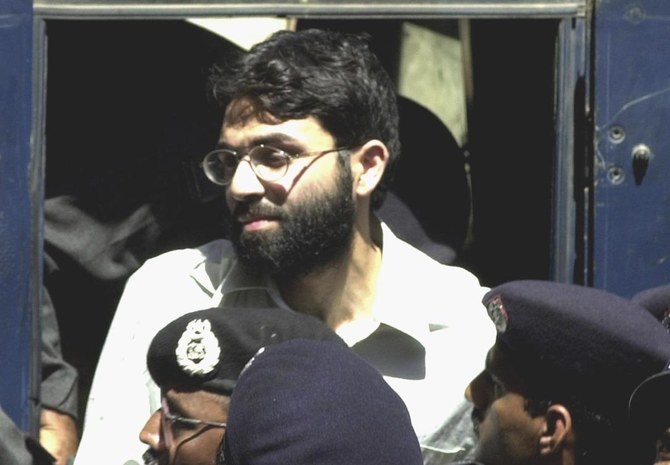
Ahmed Omar Saeed Sheikh arrives at a court in Karachi, Pakistan, March 29, 2002. (AP Photo)
Short Url
Updated 06 January 2021
Follow

Lawyer seeks to free man acquitted in Daniel Pearl’s killing

  • Key suspect in Pearl’s murder remains in custody in a jail in the southern port city of Karachi, despite the acquittal
  • US acting attorney general says United States “stands ready” to take custody of Omar Sheikh to stand trial in America

ISLAMABAD: The lawyer for a Pakistani man convicted and later acquitted in the 2002 killing of American journalist Daniel Pearl said Wednesday that he will petition the Supreme Court to free his client.

Ahmed Omar Saeed Sheikh, the key suspect in Pearl’s slaying, remains in custody in a jail in the southern port city of Karachi, despite the acquittal. Pearl’s family and the Pakistani government have appealed the acquittal to the Supreme Court, which resumed its hearing this week. A decision is expected before the end of the month.

Sheikh’s lawyer, Mehmood A. Sheikh, has been trying to get his client, who has been on death row for 18 years, freed since the acquittal.

The lawyer told the Associated Press he was demanding freedom for Sheikh in line with an order issued last month by the Sindh High Court. The lawyer, who is not related to Sheikh, said he also wants three other co-accused suspects freed. Their lesser charges of aiding and abetting were also overturned.

Last month, the US warned it won’t allow Sheikh to escape justice. Acting US Attorney General Jeffery Rosen praised Pakistan for appealing the Sindh court’s order but said that if “those efforts do not succeed, the United States stands ready to take custody of Omar Sheikh to stand trial” in America.

The Pearl family lawyer, Faisal Siddiqi, said he will oppose the petition, adding he was confident Sheikh would not be freed.

“He will not be released,” said Siddiqi. “Omar Sheikh’s lawyer’s request has twice been denied.”

Sheikh was convicted of helping lure Pearl to a meeting in Karachi, during which he was kidnapped. Pearl was investigating the link between Pakistani militants and Richard C. Reid, 
dubbed the “Shoe Bomber” after trying to blow up a flight from Paris to Miami with explosives hidden in his shoes.

A gruesome video of Pearl’s beheading was sent to the US Consulate. The 38-year-old Wall Street Journal reporter from Encino, California was abducted Jan. 23, 2002. His body was later found in a shallow grave in a southern Karachi neighborhood.

Sheikh was sentenced to death and the others to life in prison for their role in the plot. The acquittal had stunned the US government, Pearl’s family and journalism advocacy groups.


Pakistan reports current account surplus in Jan. owing to improved trade, remittances

Updated 17 February 2026
Follow

Pakistan reports current account surplus in Jan. owing to improved trade, remittances

  • Pakistan’s exports crossed the $3 billion mark in Jan. as the country received $3.5 billion in remittances
  • Last month, IMF urged Pakistan to accelerate pace of structural reforms to strengthen economic growth

ISLAMABAD: Pakistan recorded a current account surplus of more than $120 million in January, the country’s finance adviser said on Tuesday, attributing it to improved trade balance and remittance inflows.

Pakistan’s exports rebounded in January 2026 after five months of weak performance, rising 3.73 percent year on year and surging 34.96 percent month on month, according to data released by the country’s statistics bureau.

Exports crossed the $3 billion mark for the first time in January to reach $3.061 billion, compared to $2.27 billion in Dec. 2025. The country received $3.5 billion in foreign remittances in Jan. 2026.

Khurram Schehzad, an adviser to the finance minister, said Pakistan reported a current account surplus of $121 million in Jan., compared to a current account deficit of $393 million in the same month last year.

“Improved trade balance in January 2026, strong remittance inflows, and sustained momentum in services exports (IT/Tech) continue to reinforce the country’s external account position,” he said on X.

Pakistan has undergone a difficult period of stabilization, marked by inflation, currency depreciation and financing gaps, and international rating agencies have acknowledged improvements after Islamabad began implementing reforms such as privatizing loss-making, state-owned enterprises (SOEs) and ending subsidies as part of a $7 billion International Monetary Fund (IMF) loan program.

Late last month, the IMF urged Pakistan to accelerate the pace of these structural reforms to strengthen economic growth.

Responding to questions from Arab News at a virtual media roundtable on emerging markets’ resilience, IMF’s director of the Middle East and Central Asia Jihad Azour said Islamabad’s implementation of the IMF requirements had been “strong” despite devastating floods that killed more than 1,000 people and devastated farmland, forcing the government to revise its 4.2 percent growth target to 3.9 percent.

“What is important going forward in order to strengthen growth and to maintain the level of macroeconomic stability is to accelerate the structural reforms,” he said at the meeting.

Azour underlined Pakistan’s plans to privatize some of the SOEs and improve financial management of important public entities, particularly power companies, as an important way for the country to boost its capacity to cater to the economy for additional exports.

“This comes in addition to the effort that the authorities have made in order to reform their tariffs, which will allow the private sector of Pakistan to become more competitive,” the IMF official said.