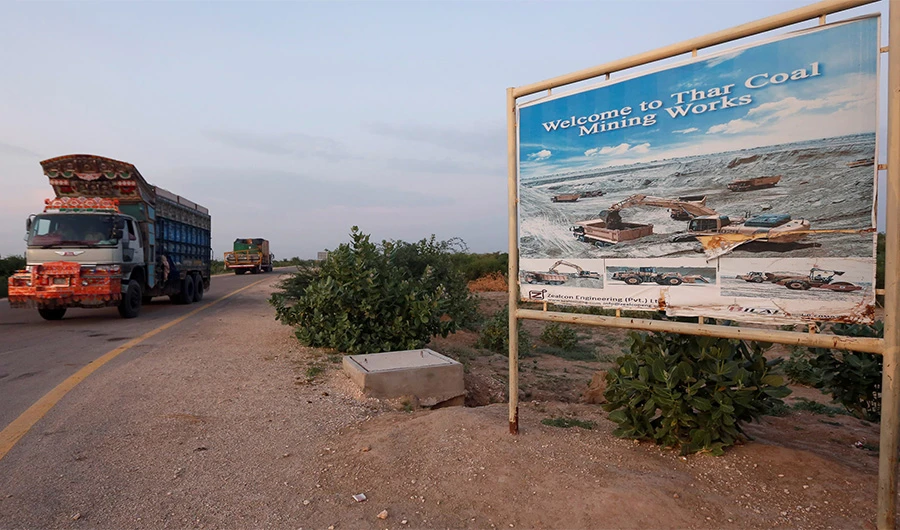
- HUBCO, Engro, Fauji Fertilizer and Fatima Group to initiate a surface coal gasification and liquefaction program to ease country’s dependence on imported oil
- Nadeem Babar, special adviser to the prime minister on petroleum, said existing and under contract coal projects would continue but no new coal power plants would be commissioned
KARACHI: Four Pakistani leading coal mining and power generation companies are planning to convert huge deposits of coal into gas and liquid in the Thar desert in southern Sindh province, officials said, as the country moves to ban new coal-fired power plants.
Last month, Pakistani Prime Minister Imran Khan told a virtual gathering of global leaders: “We have decided we will not have any more power based on coal … We have already scraped two coal power projects which were supposed to produce 2600 megawatt of energy. By 2030, 60 percent of all energy produced in Pakistan will be clean energy.”
Chinese companies are financing and building most of Pakistan’s coal plants through the over $60 billion China-Pakistan Economic Corridor (CPEC), a flagship of China’s belt and road initiative.
The Thar desert is home to the largest lignite coal reserves in the world at an estimated 175 billion tons — the equivalent of 50 billion tons of oil and 2000 trillion cubic feet of gas, according to the Geological Survey of Pakistan.
Now, four companies engaged in coal mining and power generation have decided to initiate a surface coal gasification and liquefaction program to ease the country’s dependence on imported oil.
“Four companies in principle have agreed to jointly work on coal gasification and liquefaction into petroleum products to substitute fuel imports,” Khalid Mansoor, the CEO of Hub Power Company (HUBCO), told Arab News. “The companies include HUBCO, Engro, Fauji Fertilizer and Fatima Group.”
Nadeem Babar, special adviser to the prime minister on petroleum, told Arab News existing, and under contract coal projects, would continue but no new coal power plants would be commissioned or built.
“We are looking at coal to liquids and coal to gas technologies now,” he said.
Pakistan currently has four coal-fired power plants worth $6.7 billion, with three using imported coal. The combined capacity of these plants set up under CPEC is 4,620 MW.
In the last five years, the share of coal-based power in Pakistan’s energy mix has gradually increased from almost negligible to more than 20%, according to the National Electric Power Regulatory Authority (NEPRA).
The share of coal-based electricity generation in total thermal generation during the fiscal year 2019-20 was 31.84%, up from 18.71% in 2018-19. The utilization of coal-based power plants during fiscal year 2019-20 was almost 66% of total installed capacity of coal-based power plants, NEPRA data showed.
Coal utilization is set to expand further as five more power plants, built under the CPEC umbrella at a cost of more than $3.3 billion, are scheduled to commence operations by the end of 2026. Among these upcoming power plants, four will use Thar coal, according to the Private Power and Infrastructure Board (PPIB).
“Presently coal’s share is around 20% in Pakistan’s power generation for the past 11 months, and 15% for the month of November 2020,” Samiullah Tariq, head of research at Pakistan Kuwait Investment, said. “In my view, the share of coal in power generation will increase with the increase in power demand in the next two to three years as power plants in Thar come online.”
To meet future demand of coal, mining companies are increasing capacity in Thar, officials said.
“Mining is being scaled up in Thar from current annual mining capacity of 3.8 million tons to 7 million ton while in phase III the capacity would go up to 13 million ton per annum,” the HUBCO chief said, adding that one of the company’s coal power projects in Thar was expected to start commercial production by the end of this year.
But as the industry gears up to exploit more coal reserves, many are calling for a complete ban on coal mining and power generation.
“The world is facing climate change crisis and the biggest contributor to the climate change is fossil fuel, and in fossil fuels the biggest contributors are coal-fired power plants,” Muhammad Ali Shah, the chairman of the Pakistan fisher-folk forum, which strongly opposes coal utilization, said, adding that as a signatory of the Paris Agreement, Pakistan needed to move away from coal to lower its greenhouse gas emissions.